Showing posts with label Los Angeles Library Tour. Show all posts

Sunday, March 1, 2015

Los Angeles Library Tour - Altadena Main Library


How has this library gone under our radar for so many years? We've been through Altadena. We've had friends who live in Altadena. And yet, we've never visited either of their two libraries. 
We finally made up for lost visits a couple of weekends ago. The library is almost hidden in the woodsy foothills at the corner of Mariposa and Santa Rosa Avenue (aka Christmas Tree Lane). Walking inside, a sense of familiarity and comfort takes over. The library, designed by Boyd Georgi & Associates (from Altadena) was opened in 1967.  There have been some modernizations, but for the most part, it feels like 1967 in the best possible way
There are beautiful sculptures at both entryways.  Wood relief panels surround the desks. 


The children's room has a colorful mural.

The feature we loved the most there is a sunken reading area in the center of the library, complete with palm tree planter. (We hear they are looking for landscapers to propose a new design to fill the planters.
 
We were astounded at some of the books and cds in their collection. Thankfully the library has held onto the amazing collection they've built over the years instead of excessively weeding it of its charm.  They have incredible art and photography books, lots of jazz cds, and local history books we haven't seen at any other library. We checked out a boxful on our first visit. They had Glenn Bray's The Blighted Eye! I can't find that anywhere!
This library is a hidden gem in the forest, absolutely worth a visit.

Tuesday, August 19, 2014

Los Angeles Library Tour- Grant R. Brimhall Library (aka Thousand Oaks' main library)

Close your eyes and imagine the library Buck Rogers visits. Its likely that the Grant R. Brimhall Library in Thousand Oaks might be a close proximity. I would even describe my initial impression of the library as 'breathtaking.'


A quick zip around the fiction and non-fiction section revealed a nice selection and the library definitely has little touches that show they have the customer in mind.

Things like:

*A sorting shelf at the end of each row that indicates the newly returned books that are waiting to be reshelved but available to be checked out.

* Signage is plentiful and informative but not overwhelming.

* Fliers for events are strategically placed throughout the library (and again, not overwhelming).

* The placement of the public computer stations allows a greater amount of room between you and the neighboring computer.

* They have an honor system coffee cart and vending machines with bottled water.

* Their library foundation runs a gift shop.

* There are lots of spaces to sit and get lost in a book.

*It is quiet without being oppressively quiet.

Aside from the architecture, there are several things that make this library unique. They have a huge children's section (easily larger than any other Southern California library I've been to) which has a large fish tank at its entrance (similar to the Cerritos library), is well-maintained, and has an incredible selection of puppets that are available to check out. PUPPETS!


If at all possible plan your visit to coincide with the hours that the Special Collections room is open (currently Tuesday and Wednesday 1 to 5pm, and Thursday 5 to 8pm). Besides being a remarkable repository of local history, the Special Collections librarian, Jeannette Berard, can show you the library's piece de resistance- the American Radio Archive. Established in 1984 to preserve and document the history of radio. What started as a collection of radio history, it has grown to include all of broadcasting. They have sound recordings, scripts, dvds, and a whole lot of books on every aspect of broadcasting. Its very easy to while away a few hours at this library.

Thursday, May 29, 2014

Los Angeles Library Tour - Inglewood Public Library + UPDATE

The day started off innocently enough, we were heading towards Inglewood to see Helen Lundeberg's WPA mural "The History of Transportation." I only had a vague idea of where it was located and we did our usual 'lets hit up anything that looks interesting along the way.' After the obligatory stop at Randy's donuts we headed east on Manchester and passed by a very cool intaglio piece snaking up the side of a building. We circled the block to get a closer view and discovered signs pointing us to a public library.

Highlights included:
The largest(circa 1972)poured-in-place intaglio sculpture known in the world by artist Tom Van Sant.


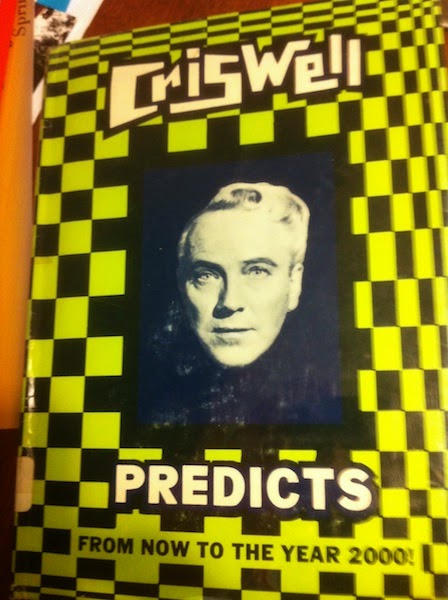
The ability to check out Criswell Predicts From Now To the Year 2000 (1968), in which the Amazing Criswell prognosticates computers ('education and newspapers which will be available through your TV') and same-sex marriage (though he did think it would happen in England by 1972). Its been a fun read.

They have artwork available for circulation!

Inglewood's former Library Director John W.Perkins (1962 to ?)must have been a hell of a guy. The collection developed by the library during his tenure is amazing. There are so many volumes here that I haven't seen in other systems. We'll be sure to check out their online catalog before our next visit, similar to LAPL's Central Branch they have more material in a depository downstairs, but are happy to retrieve the items.

The parking lot was metered and unfortunately we didn't have enough change in the car for more than an hour of browsing but the quick tour we made, and the new library card we acquired, ensures that we'll be back.

*** UPDATE ***

The above blog post has been sitting in my drafts file for a year (our original visit was May 24, 2013). Aside from the fact a year flies by in the blink of an eye, here is what else I learned within that year.

Inglewood's former Library Director John W. Perkins was indeed a hell of a guy who amassed an amazing collection, AND wrote or commissioned many books on library service and administration (take a look at them on Worldcat). I was able to get most of these books through interlibrary loan and found them interesting and forward thinking -- they even published Library of Congress Classification Adapted for Children's Library Materials! Another fascinating read associated with the Inglewood Library was a report documenting their decision to break free of the Los Angeles County Library system and become a municipal library. Perkins was hired on following the split and did a remarkable job of building a research library in Inglewood.

Sadly the collection has undergone heavy weeding within the past year, so get down there and check it out NOW!

Friday, August 10, 2012

Los Angeles Library Tour - Pomona Public Library

The plaque at the entrance reads:
Built by the people of Pomona for the preservation and advancement of the intellectual, cultural, and social life of the community.
There has been much talk in the past several months about the possible closing of the Pomona Public Library. Pomona has been on my short list to visit for awhile and we were finally able to make it out there. With our trusty copy of Cruising the Pomona Valley by Charles Phoenix, we headed towards Pomona with the idea of making a day of it, maybe topped off with a period appropriate meal at Vince's or Grinder Haven.

I can't emphasize too strongly that it was well worth the trip. And we never made it further than the library. What's not to love? The Welton Becket designed building, the amazingly nice staff, the Laura Ingalls Wilder room, the quality book collection, the Pomona statue, the indoor patios, and most of all the lovingly prepared history of the library that currently lives downstairs. I was like a kid in a candy store, snapping away with my camera, perusing their stacks, and marveling at their reference and genealogy sections.

We had already steeled ourselves to the fact that it might be a tad foolhardy to get a library card at a library that was about an hour away from our house. That self-imposed rule quickly went out the window after browsing the aisles. The Pomona Public Library has books I've never seen on the shelves at other libraries. Dozens of books in my 'favorite' sections were new to me, I HAD to check them out. It took us years to finally visit, but we'll be coming back frequently.

If you've made it this far I'm sure your eyes may be glazing over so I'll hit the highlights-

Pomona Library is the third oldest system in all of Los Angeles County (only Los Angeles Public Library and Pasadena Public Library are older). It began life as a subscription library (at $3 per year) in 1887.
In December 1901, the Pomona Library Board petitioned Andrew Carnegie for funds to build a public library. According to a February 18, 1902 Los Angeles Times article, the letter read in part: 'The population is largely composed of people of the middle class, highly appreciative of educational and literary advantages, but not able to gratify their tastes and inclinations except as they are furnished the opportunity through public libraries." Carnegie agreed to pony up $15,000 if the City Council agreed to provide a site and support the library 'at a cost of no less than $1500 a year'. Sadly the resulting Carnegie Library was demolished in 1966.
The statue of Pomona, goddess of fruit and trees, was given to the Pomona Library for safe-keeping in 1889. Its featured on the Pomona city seal and the city flag! [The sign at her feet noted that it was a gift to the city by Rev. C.F. Loop. According to Los Angeles Times articles from 1889, it was shipped from Italy to New York, and finally on to Pomona. It was given to the city by Loop during the 1889 July 4th celebration. According to his March 1900 obituary in the Times, Loop was a successful horticulturalist and an expert on olives.] The library website has photos of the statue over the years. I especially love the one of the guy cleaning her with a dustbuster.

When the library re-opens on September 4, 2012 after a two-week shuffle to close off the bottom floor, I hope the exhibit of the library's history makes it upstairs. It deserves to be a highlight.

The much loved Laura Ingalls Wilder Room (her books are still in the top five best sellers on Amazon for children's American historical fiction) has an amazing wall sized wooden map based on Wilder's books. Clara Webber, Pomona's children's librarian from 1948-1970, began a correspondence with Laura Ingalls Wilder, information about the collection can be found here on Pomona's website.
Welton Becket & Associates (in this case Randall Tozier) designed the 57,000 sq ft building, which was officially dedicated on September 13, 1965. An interesting letter regarding their collaboration can be found here. Becket's better known buildings include: Capitol Records, Cinerama Dome, (original) Pan Pacific Auditorium, Beverly Hilton Hotel, and the Los Angeles Music Center.
I've come across former city librarian Raymond Holt's name over and over during my research. He seems to be a real mover and shaker, I'll have to delve deeper into his career.

While we were there we saw the Library Director Bruce Guter leading a tour of people through the building. I saw David Allen's post about 35 reasons to rescue Pomona's library on the Inland Valley Daily Bulletin website the next day. Mr. Allen, thank you for spreading the word, the library is definitely worth rescuing!

Wednesday, July 18, 2012

Los Angeles Library Tour - Fontana Lewis Library & Technology Center

Ok, not technically Los Angeles, but its not too far down the road. As we often do when we're out driving around, we made a turn when we saw a sign that said 'Library' with an arrow pointing towards parts unknown.
We weren't expecting to find the huge 'bright and shiny' Lewis Library & Technology Center. According to a plaque out front the library was dedicated April 19, 2008, with 'funding in the amount of $14,900,000 from the California Reading and Literacy Improvement and Public Library Construction and Renovation Act of 2000'. Overall the library is light, airy, and spacious. The teen section looks like a cross between a Matchbox slick track and an amusement park ride, and was being well-used on the day we visited. There's a coffee bar attached to the library and a nice Friends of the Library bookstore (word of warning- they only sell FOTL books to library cardholders).
Our favorite part of the library was definitely the Fontana Historical Society room on the second floor. Open whenever volunteers are available (call the library before you visit 909-574-4500), we enjoyed a leisurely hour learning about Fontana's Woman's Club (and seeing a photo of the men who were members), the Kaiser plant, and the Fontana Speedway. We also got directions to nearby historical buildings and a couple good places to eat. We'll definitely be back to visit.

Wednesday, June 20, 2012

Los Angeles Library Tour - Lennox Library (CLOSING for remodel June 29, 2012)

We stumbled upon the County of Los Angeles Public Library's Lennox branch recently and were amazed and charmed by both the building and the staff.


According to the Los Angeles Times, the library is part of the Lennox Civic Center that was dedicated May 14, 1948. The then $328,000 (approximately $3,380,000 today) Civic Center also housed a Sheriff's substation, the Los Angeles County Building and Safety Department and the County Charities Department.

Designed by architect Adrian Wilson, the brick building with its rounded corner entrance, and 'County Library' sign, are eye-catching as you drive north towards the intersection of Hawthorne Blvd and Lennox Avenue. Projects Adrian Wilson worked on include the New Chinatown Los Angeles Master Plan (1938), Los Angeles County Courthouse, the Anaheim Convention Center, Ship of the Desert house in Palm Springs, and the recently renovated Casa Verdugo Library in Glendale.

The other offices in the complex are boarded up and appear to have been closed a little while, but we were happy to see the library was open.

On our first visit, Library Manager Peter Hsu couldn't have been nicer or more helpful. He showed us around the library and pointed out the plans for an upcoming remodel the library would be undergoing. I returned some books today and found out that the last day the current library would be open is Friday, June 29. The remodel will take two years to complete.

It is definitely worth the drive to see inside the original library now while you still can. Complete the trip with a stop at the beautiful Chips restaurant nearby, designed in 1957 by architect Harry Harrison.

Tuesday, February 7, 2012

Los Angeles Library Tour - Moorpark Library

An intriguing invitation came across the Calix listserv on January 26th inviting people to visit the Moorpark Library for their 100th anniversary celebration on January 28. We quickly switched up our plans and headed to Moorpark.


Moorpark is a small town off highway 23 west of Simi Valley. The library was warm and inviting and so was the staff. I was glad to see a few displays up in the library which gave a bit of history.

One display was a copy of the Moorpark Enterprise newspaper dated Thursday, August 1, 1912. There was an article announcing that a Ventura County Public Library was being opened at the Women's Club and would be staffed by Mrs. E.C. Graham every Friday from 2pm to 5pm. The list of books that could be found at the library when it opened (about 50-60 titles) seems pretty progressive - Wireless Telegraphy, When Patty Went To College, Women Wage Earners, Dominant Dollar and Some Famous American Schools. It was interesting to see that topics of relevance today, including timely gadgetry, were equally relevant then.

This was the first celebration event of their centennial year with more events each month, leading up to the big day, August 1, 2012. The next event is at 2pm Sunday, February 12 and will feature memories of Moorpark with the Moorpark Historical Society. They are also having a big Friends of the Library used book sale through February 15.

Thursday, January 5, 2012

Los Angeles Library Tour - LAPL Granada Hills Branch


The Los Angeles Public Library website indicated that the Granada Hills branch would be closed from January 8, 2012 to approximately February 6, 2012. Intrigued, I hopped in the car to check out what was going on. I really like the Granada Hills branch, it's a nice little library with a solid cookbook section. Turns out that they'll be closed for plumbing repairs during that time. And their book drop will also be unavailable. The closest LAPL branches (in case you'd like to visit or return some books) are the Mid-Valley Regional branch on Nordhoff and the Panorama City branch on Roscoe.

This recent visit made me curious about the branch's history so I did a little digging through the Los Angeles Times, with some sightseeing via LAPL's photo collection thrown in.

Post-WWII San Fernando Valley was filling out thanks to new housing developments and the G.I. Bill, which allowed returning soldiers to purchase homes. In 1956 Granada Hills was still being serviced by a bookmobile which was stationed at the corner of Chatsworth and White Oak for three hours every Friday afternoon. During April of that year, Helen Jenks, head of the Valley Traveling Branch of the Los Angeles Public Libraries, met with the Granada Hills Woman's Club book group and suggested that Granada Hills might be a good location for a library if there was community interest. A site was chosen and after many years of back and forth eminent domain negotiations, the land was finally acquired in September 1960 for the purpose of a city park and a public library. The slow moving process continued and an architect was finally chosen in mid-1961.

Burbank architect, Joe B. Jordan, was appointed by the Los Angeles Board of Library commisioners to build branch libraries for both Granada Hills (corner of Chatsworth St. and Petit Ave.) and Northridge (corner of Nordhoff St. and Darby Ave.). According to the Los Angeles Times, the board requested one design that could be used for both locations as a cost-cutting measure when accepting bids from contractors. LAPL's photo collection has some great photos of the 6000 sq ft 'twin libraries' - click here for Granada Hills and here for Northridge.

In July of 1962, a check in the amount of $6,787 (the largest donation LAPL had received for book purchases in twelve years) was given by the community to set up the Mabel Ross Memorial Fund. The money was used to purchase young adult books for the new Granada Hills Library, which would now have the largest YA section of any LAPL branch in the city.

The library opened on November 28, 1962, with more than 300 people in attendance. The branch was so popular that within two weeks so many books had been checked out the shelves were almost bare and library officials alotted an additional $9,000 to buy more. In April 1963, due to their high circulation numbers, the library implemented a policy that only allowed five childrens books to be checked out at one time. For the first time in LAPL's history circulation numbers reached over 14 million books checked out system wide in 1964. Outside of the Central Library, Granada Hills was the fifth busiest branch library (West Valley was the busiest branch). By 1965 it was the second busiest branch library (behind West Valley). By 1974 the Granada Hills branch was sorely in need of expansion. It served a community of nearly 60,000 residents, of which 52,000 are library card holders. With the prospect of the expansion project taking up to a year to complete, the library temporarily moved to a leased store in the shopping complex on the northeast corner of Balboa and San Fernando Mission. The expansion doubled the size of the library. And its still always a buzz of activity when I go in there. Good to see!

If you make a visit to the Granada Hills branch (pre- or post- plumbing repairs, there are some great restaurants nearby. The Sinatra Room at Casa de Pizza on San Fernando Mission is a must-see and their food is really good. You can't go wrong by beating a path to the Safari Room's door either. Champagne taste on a beer budget! And the service is impeccable (thanks Bobby!).

Sunday, April 3, 2011

Los Angeles Library Tour - Hawthorne Library


Hawthorne's first library was established in 1913 and the current branch was built in 1962. The new branch quickly proved popular - in it's first six months circulation numbers jumped from a ranking of 26th place (for the previous branch) to 5th place. By 1965 the branch was the most used regional branch in the county system with Monday, Tuesday and Wednesday nights being the busiest. Shortly after the library opened, a group of 'young folks', ranging in age from 10 to 14, formed the Junior Friends of the Hawthorne Library. The ambitious group of approximately 50 had committees for arts and posters, children's book week, school co-ordinating, ways and means, refreshments and special services. In 1964, the (adult) Friends of the Hawthorne Library began a program of creating 'talking books' for the visually handicapped. Volunteers read from such classics as Dickens Christmas Carol and Goodbye Mr. Chips and were recorded on a reel to reel machine donated by the Hawthorne Lions Club.
Community programs during their first decade included art exhibits, film series and investment lectures. During the mid-1970s they also circulated 8mm and super 8mm for 10 cents each.
You learn something new everyday! A 1970 article in the Los Angeles Times on the cookbooks of the Hawthorne library has a librarian explaining that each county library concentrates on one of the 10 Dewey decimal classifications from 000 to 999 and their specialty is the 600s "and that includes cooking, dogs, data processing, gardening, carpentry, cats and winemaking."
In 1978, as part of Hawthorne Library's 65th anniversary celebration, children were invited to submit artwork depicting what they thought the library looked like in 1913 or what they think it will look like in the year 2000. I wonder if they saved any of those?

Today the library is an excellent resource for car buffs (with a whole aisle populated with Chilton manuals) and crafters (more craft books than you can shake a bejeweled stick at). Every Wednesday night a group of local residents, known as the Hawthorne Knit Wits, meet at the library to work on their knitting and crocheting. Evidence of their handiwork, in the form of bookworm bookmarks, can be purchased at the front counter for $1.00.

Sunday, February 20, 2011

Los Angeles Library Tour - LAPL Panorama City Branch


San Fernando Valley’s Panorama City began life in 1949 as a planned community, the brainchild of industrialist Henry J. Kaiser. The same Henry J. Kaiser behind Kaiser Shipyard, Kaiser Aluminum, Kaiser Steel and Kaiser Permanente. The Valley has grown by leaps and bounds since then and in the middle of this urban sprawl, on the corner of Roscoe and Lennox, is a great library.
Designed by Glendale architect Graham Latta, the original branch of the Panorama City Branch Library was 6,000 square feet and cost $146,805 (including construction and books). The brick building featured exposed steel trusses, a covered walkway/entryway, air-conditioning and a whopping 18-car parking lot. Click here for a photo of the original library's exterior from the LAPL's photo database. Opened to the public on May 25, 1959, it was the first library branch in an area that was previous serviced by bookmobile only. Other branches that also opened in 1959 include West Hollywood, El Sereno and Canoga Park. That year, the Los Angeles Public Library had its busiest circulation year in two decades. By 1964, the Panorama City Branch was the fourth busiest branch in LAPL’s (then) 61-branch system. (In order, the busiest branches were: West Valley, West Los Angeles, North Hollywood, Panorama City, Granada Hills, Westchester, Canoga Park, San Pedro, Van Nuys and Sherman Oaks).
By the mid-90s the library had outgrown its 6000 sq ft. A new 12,500 sq ft branch was built on the site of the ‘old library’ and opened in March 1999. There is a modest-sized selection of English and foreign language books, magazines, newspapers, and other media (including a large selection of Mexican pulp novels).
This branch had an amazing cookbook selection, including my ‘go to’ bread-baking cookbook that I would check out annually during the coldest months. Sadly, over the last several months, almost all of the cookbooks have been stolen. By moving them to a more visible location behind the reference desk, the thefts have slowed but the selection is incredibly sparse. There were less than two dozen cookbooks on the shelf on our most recent visit. It amazes me that people would steal something they can borrow for free. If you have any new or gently used cookbooks lying around that you aren’t currently using the Panorama City Library might be a perfect repository for your excess.

Tuesday, February 8, 2011

Los Angeles Library Tour - Pasadena Central Library


This weekend we visited the Pasadena Central Library, the first of three stops we had planned for Saturday. The other two being the Scenic View Ahead: The Westways Cover Art Program, 1928-1981 exhibit at the Pasadena Museum of California Art and the China Modern: Designing Popular Culture 1910-1970 exhibit at the Pacific Asia Museum. Both are walking distance from the library!

In 1927, the firm of Myron Hunt and H.C. Chambers completed the Central Library which is now listed on the National Register of Historic Places. It is grand and spectacular to look at, yet completely warm and functional inside. We parked in the large (free) lot and entered through the north entrance, which was once the service entrance. From here, the library seems like a crazy maze of display cases, shelves, books, and stairways. By contrast, the entrance through the front courtyard into the main hall (off Walnut Street), feels as though you’ve walked into a dark wood-paneled library from a hundred years ago. Maybe that’s why location scouts have frequently cast the Pasadena Central Library as Library #1. (My favorite being the ‘San Francisco’ library Goldie Hawn works at in “Foul Play”.) The Main Hall acts as the heart of the library. Not only does it contain the check out and reference desks, it leads you to the children’s wing, the business wing, the humanities wing, the centennial room (which includes a great Californiana collection), and the four levels of circulating book stacks. The staff was extremely helpful - I loved the addition of someone with a headset and a giant pin that said 'Ask Me' wandering the stacks.

I urge you to visit the library’s website. It gives a detailed description of the architecture and interior accents that make the library so unique. Next time we visit, a guided tour is in order!

The library went through a major restoration in the late 1980’s. Great care went into bringing the library into the computer age without destroying the look and feel. Computers were imbedded into walls and desks while maintaining the dark oak wainscoting.

The Metro Rail Gold Line has a stop at Memorial Park, just southwest of the library. Old town Pasadena is walking distance, as are a bunch of great restaurants, like Russell’s (‘famous since 1930’ -definitely try their hamburgers) and the ever popular breakfast destination Marstons.

Sunday, January 30, 2011

Los Angeles Library Tour - Brand Library and Art Center


If The Brand Library was just a library, it would be exceptional. The fact that it was once the home of Leslie Coombs Brand, one of Glendale's early banking and business pioneers, makes it historic. The fact that it has an amazing art center makes it a showcase for arts of all sorts. The fact that it is located in Brand Park overlooking Glendale, makes it one of Los Angeles' most interesting and beautiful attractions.
According to the city of Glendale's website, the Brand Library and Art Center was once El Miradero. Completed in 1904, El Miradero was the home to Brand and his wife. Mr. Brand died in 1925, followed by Mrs. Brand in 1945. Leslie Coombs Brand's will provided that the property be turned into a park and library upon his (and his wife's) death. The Brand Library opened in 1956 and in 1969 the arts center was added.
The entire complex is almost one of those "only in Los Angeles" locations. The entrance to the park has a Moorish feel which mirrors the former residence/current library. Look up the hill, past a row of palm trees, and you'll see El Miradero. It is such a beautiful and photogenic locale, there always seems to be a wedding party posing on the lawn in front (perhaps second only to the Mulholland fountain outside Griffith Park).
The Brand Library houses the Arts and Music collections of the Glendale library system. The Glendale library system moved all of their music collections to this branch, so it is quite extensive. They've got records. Actual vinyl records. There is a good selection of VHS and DVD on the arts. I asked about the 16mm films that were once in circulation at the main Glendale library branch. They are now gone. I'll always remember checking out "Skater Dater" on 16mm and screening it in our backyard on an old Bell & Howell projector.
The Brand is inspiring in so many ways. Just browsing the aisles, there is so much eye-candy. The library is a great resource for enthusiasts of all the arts. On the pages of over one hundred thousand volumes you can find Indian movie posters, product graphics, matchbooks, comics, photography, pattern books, furniture making, interior design, fashion, music, painting, drawing, architecture. Where do I stop?
If you're still looking for a little more, there is a gallery showcasing local artists, lectures on an array of fascinating topics, and a recital hall for your listening pleasure.
When the relatives visit from out of town and they want to get some local flavor you can always pack a picnic lunch (or stop by Glendale's Mario Italian Deli and grab some sandwiches). Head up to The Brand. Spend the day wandering the grounds. Browse the aisles. Enjoy the view.
Surrounding the library is a 31 acre park which offers hiking and biking trails, a basketball court, softball field, children's playground, the Whispering Pines Teahouse and Friendship Garden and the Doctors Museum & Gazebo. And if you've been there all day don't forget to stop by Foxy's for dinner.

Sunday, October 17, 2010

Los Angeles Library Tour - Acton / Agua Dulce Library


Over the last year, we've seen the Los Angeles Library Public Library System drastically cut hours, staff, and services. So, it was amazing to hear that the Los Angeles County Library System has opened a new branch in Acton. The Acton / Agua Dulce Christopher Colombo Brevidoro Library opened on September 29, 2010. According to their website, the library is named in honor of Christopher Colombo Brevidoro, an Italian immigrant who founded the Colombo Lilac Ranch with his wife Ida Brevidoro. Their sons, John and Robert Brevidoro, donated the land in 2003 to the County of Los Angeles for a new library.
This library is new. Really new. Everything inside was purchased new for the collection. We did speak to a librarian who said that some older books that had been donated from other locations would soon be making their way over. It is kind of an amazing thing to browse the shelves of so many new books. Most have never been opened before. They've filled the collection with a little bit of everything. Kudos to the Photography/Music section where I found a bunch of punk rock books.
They have a large children's area seperated from the rest of the library, about two dozen computer stations, and a nice selection of dvds and cds. Each cd is labeled on the spine with an easy to read black text on white sticker. Amazing! Why don't more libraries do that?
Everyone we came in contact with, both the librarians and patrons, had a sense of excitement and wonder. People were really interested in what the library had to offer. It was a good feeling.
And keeping with the tradition of local artists providing pieces to libraries, we find two great examples inside. Above the main desk hangs David Baker's "Reading Gives Your Imagination Wings". Two vibrant metal wings guard a scroll with this inspirational message. Across the library is Anne Marie Karlsen's "Frontier". It appears to be five patterned discs, but as you look closer, you see the patterns are made up of images from the Antelope Valley.
We took the 14 up to the library, passing the "Oak of the Golden Dream" (supposedly, where gold was first discovered in California). We passed by Vasquez Rocks and did our best Star Trek impersonations. We stopped in for breakfast / lunch at Crazy Otto's, home of the world record holding "World's Largest Omelette".
To summarize, head north out of town. Eat a big breakast at Otto's. Walk it off at Vasquez Rocks. Relax at the Acton / Agua Library.

Monday, September 6, 2010

Los Angeles Library Tour - Norwalk Regional Library


This weekend, we made it back to the Norwalk Regional Library (see previous Norwalk post). They were open this time and it was definitely worth the wait.

At 39,000 square feet it was the largest library ever built in the county public library system when it was dedicated in July 1969, The exterior almost has a museum-like quality to it. Windows are adorned with gold metal screens. As you walk toward the entrance, you are greeted by two mosaics designed by Ben Mayer. They each depict events and industries that have shaped California - such as agriculture (orange trees), transportation (trains and ships), aerospace (jets and rockets). These mosaics alone are worth a trip to Norwalk.

Inside, the grand touches continue. There are many giant gold light fixtures which compliment the screens outside. Additional mosaics form what almost appears to be a UFO hovering over the children's section.

This branch of the Los Angeles County Public Library system held many books we had never seen at any other libraries we've visited. We've been to a lot of libraries, and after awhile the same books seem to pop up from one branch to the next. But here, the aisles were filled with rare books waiting to be discovered. I found this in the arts and crafts section: Pop Topping!. And in the Los Angeles history section, we found Previews of Coming Attractions: Scenes and Faces from the Permanent L.A. Fun Game. Haven't seen that in years.

The local history section is amazing. They had a giant selection of magazines (three different publications on libraries and two on restaurants. How often do you see that?) Plenty of government and reference material. A small but functional audio/visual department. They also had a lot of nice exhibit cases to show off the summer reading programs.

After loading up on books, we drove down the way to Bellflower for a lunch at Fronks. Giant sized burgers topped off what turned out to be an epic trip to the Norwalk Regional Library.

Sunday, August 22, 2010

Los Angeles Library Tour - Whittier Central Library


Wow. The Whittier Central Library is one of those places that you walk into and it is the library of my nostalgic dreams. Beautiful design inside and out. It truly is a destination library.

Designed by William H. Harrison, the library was opened in 1959 and still feels futuristic and functional. Inside it is inviting and open with a nice lounge area near the front, a huge children's section, large fiction section, lots of hard to find titles as well as new releases. Numerous internet stations and aisles of deep shelves. A large parking lot faces the rear entrance of the library but the front entrance on Washington Avenue is not to be missed.

The first time we visited, the audio/visual department was upstairs. It was almost like an independent record store! There were record albums decorating the information counter and they even had a painting of Janis Joplin on the back wall. When we stopped in on our latest visit, we found out that they had to close the top floor due to budget cuts. Hopefully they can reopen it soon. Two ways you can support the library - add to the donation box across from the circulation desk or participate in the silent auction of rare books in the lobby.

When I was a kid, I could spend hours browsing the library shelves and come away with a load of books on a variety of topics- anything I found remotely interesting. As I grew older and the 'leisure hours' of the day lessened due to school or work, I narrowed my reading topics and mainly hit just those particular sections of the library. The Whittier Central Library brought me back to that childhood way of browsing the aisles. I went up and down every aisle and found more books than I can possibly get through in the alloted time. Adult practicalities returned to me before I moseyed up to the circulation desk, I narrowed my selection for the day and wrote down the books I put back so they can be easily pulled on the next visit.

While we did make the Whittier Central Library our main destination, thats not to say thats all we did in Whittier. We made a stop by our favorite supplier of all things tiki, Oceanic Arts. We had delicious puffy picadillo tacos at Arturo's. Cruised Greenleaf toMonte's Camera. Found some cool thrift stores. Dropped some cash at Lovells Records and The Little Old Bookshop. It was a full day. Get to Whittier early. And often!

Sunday, July 25, 2010

Los Angeles Library Tour - LAPL Central Library

Lets start with the mothership of L.A. public libraries, LAPL's Central Library. If you're a library lover, and likely you are if you've stumbled across this blog, you've know doubt been already. But if you haven't, get going! After a devastating fire at this branch in 1986 that destroyed 20% of the collection, the 'new' (and larger) library rose from the ashes with the hard work and dedication of its staff, a throng of volunteers and the support of Angelenos. One trip is not enough time to take it all in but if you are looking for an elusive book (or magazine, newspaper, telephone book, CD, DVD, etc), chances are you'll find it here.
The first floor of the library houses the library store, a cafe, a Panda Express, lockers, the main circulation desks, an auditorium, a courtyard, International Languages, Popular Library and computers to access the library's catalog. If you only have a few minutes to browse the Popular Library will be your best bet. Besides shelves and shelves of the most recent books the library received you’ll find an impressive collection of dvds, cds, audio books and magazines, all available to check out. There are six more floors of books available, each floor houses specific subjects. Signs and maps are positioned throughout the library to help you find your way and the catalog lists the department you'll find your book in (for example, along with the call number it will say - Central Library - History Dept. or Central Library - Science & Tech. Dept). The second floor UP houses books, magazines, VHS and DVDs on Art, Music, Recreation, Children's Literature and Teen'Scape (aka Young Adult). A word of warning- Central Library houses their Reference and Circulation books side by side on the same shelves. If there is an 'R' on the spine of a book it is available for library use only and can not be checked out. The second floor is also home to two galleries - the permanent Annenberg Gallery and the Getty Gallery which has rotating exhibits. The second floor rotunda is a thing of beauty. The original location of the card catalog and the main circulation desk, the Lodwrick M. Cook Rotunda is the site of Dean Cornwell's beautiful mural depicting California history and the bronze globe/astrological chandelier which is nine feet in diameter and weighs one ton. The third floor up houses Fiction & Literature.
Descending back down the escalators to the first floor you will walk down a hallway passing the First Floor Galleries (which also have rotating exhibits) and into the skylit atrium where you'll find the bank of escalators that leads to the lower levels. Lower level 1 houses the Business and Economics section. Lower level 2 houses Science, Technology and Patents along with the most impressive array of culinary history and cookbooks I've ever seen. Ever. If this is a favorite subject of yours too please check out the Culinary Historians of Southern California. They have fascinating lectures on food topics in the Mark Taper Auditorium at the Central Branch. (http://www.culinaryhistoriansofsoutherncalifornia.org/). Lower level 3 houses Social Science, Philosophy, Religion and the Computer Center. You can sign up here to vie for space on one of the Central Libraries 63 computers available for public use. Lower level 4 houses the History and Genealogy section, with the most impressive collection of California history books I've seen in Southern California. As signs scattered throughout the library remind you, what you see on the shelves is just a small portion of their holdings. If you don't see what you're looking for by all means ask, their staff is friendly and helpful. Tired of riding the escalator? You will find an elevator back near the genealogy books - hop on and check out the creative re-use of the library's card catalog.
A favorite trip to Central involves an all day ticket on the Metro Rail (currently $6) with a stop at Union Station along the way for breakfast, lunch or dinner at Phillipe's. If you've never been you've got to try their world famous french dip - make sure to ask for it double-dipped. If you've got nothing but time do yourself a favor and walk up to New Chinatown or over to Olvera Street and stroll the shops, enjoy the sites and soak in some of the city's history. When you're ready to hit the library climb on board the Red Line at Union Station and head towards Pershing Square. From the Pershing Square station its just a three block walk north on Fifth Street to the Central Library on Fifth and Flower. (If its a Saturday and you choose to drive parking can be found under the library for just $1.00 for the whole day with validation). If we only want to spend an hour or two we'll limit our trip to Arts, Music and Recreation (Level 2) or History (Lower level 4). By then our bags are filled with more books than we can reasonably carry (there is a limit of 30 books per card) which equals at least two weeks of enjoyment and brain-filling opportunities. A fine finish to the day trip should involve dessert at Clifton's Cafeteria on Broadway. Opened in 1935, Clifton's Brookdale (as it was originally known) is about a ten block walk from the library and I can guarantee you've never seen anything like it (unless of course you've been there before). The only words that come close are 'Disneyland in cafeteria form'.