Showing posts with label Central Library. Show all posts

Sunday, December 18, 2022

The Wartime Information Desk of the Los Angeles Public Library

Los Angeles Times May 15, 1942

Los Angeles Public Library 1941-1942 annual report

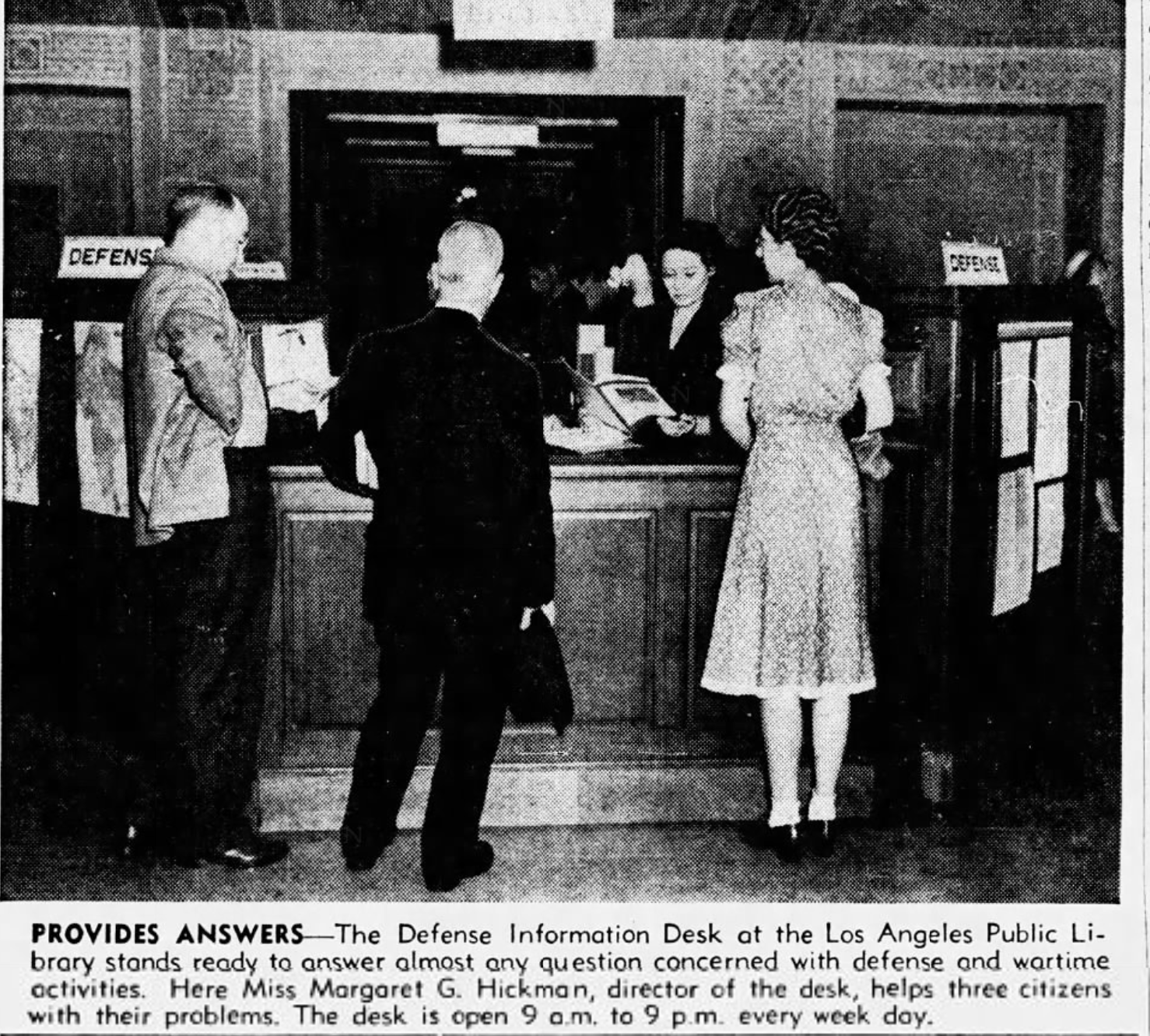
Within two weeks of the bombing of Pearl Harbor the Los Angeles Public Library opened their Wartime Information Desk, centrally located in the lobby off of Fifth Street. The desk would "disseminate information on national defense" and anything pertaining to World War II. Its earliest name, according to the Los Angeles Times was the Citizens' Bureau of Information. The library had thought about providing a similar service for a few months but Municipal Reference librarian (stationed at City Hall) Josephine Hollingsworth convinced Althea Warren that, after December 7, 1941, they was receiving far too many reference questions to keep up with. Ms. Warren put the Wartime Information Desk in the hands of principal librarian Margaret Gabriel Hickman who had been the head of the foreign language department since 1928. The 1942 library annual report lists an organizational chart that mentions that Wartime Information Desk personnel were taken from other library departments. Staffing the desk was supplemented by Work Project Administration (WPA) and National Youth Administration (NYA) workers.
Los Angeles Daily News December 17, 1941

The Wartime Information Desk averaged 300 questions a day with another 100 arriving via letters received weekly. Throughout much of 1942 and into 1943 the library had a frequent column called "War Queries" in the Los Angeles Daily News answering some of the questions. These included queries about military service, defense jobs, Victory Garden information, and V-mail.
Los Angeles Daily News December 19, 1941

Los Angeles Daily News, December 1942

The desk was ended in October 1943 because the public by then was better educated on the workings of the war (specifically rationing, the draft, and housing), and the efforts turned towards veteran's vocational training. The clipping files, pamphlets and indexes from the Wartime Information Desk were deposited with the Sociology Department (are they still there?).

Sunday, March 28, 2021

Monica Shannon: Advocate for Libraries, Leprechauns and Luckless Pigwidgeons

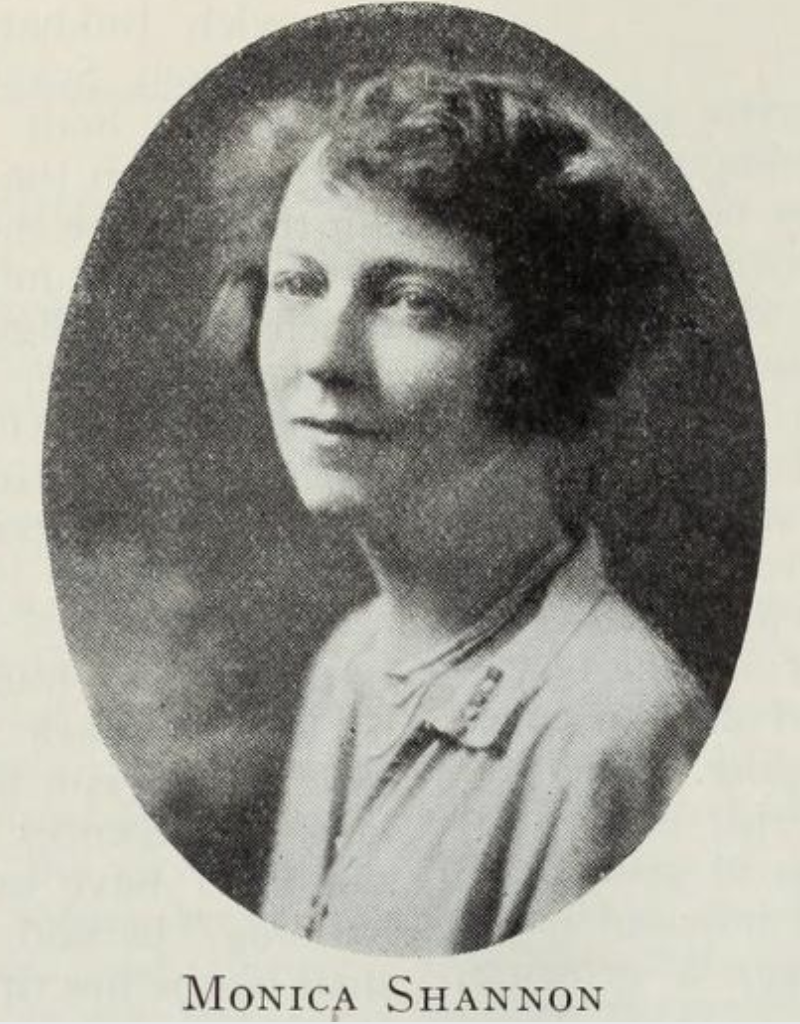
You may know Monica Shannon as the author of the 1935 Newbery Award-winning book Dobry, but have you read her fairy tales set in California? They are remarkably descriptive and among the strangest books I’ve read in a long time. We also have her to thank, at least partly, each time we walk through the doors of the Central Library. Women's History Month marks the perfect time to remember Monica Shannon (1889-1965), the library staff member who became a Newbery Award-winning author of whimsical children’s books and, as the person in charge of the early 1920s library bond issue campaigns, played a large role in the construction of Central Library and several branches.

Portrait of Monica Shannon [n.d] Library Journal, January 1, 1930.

Monica Shannon grew up in a household of bibliophiles and storytellers which may have contributed to her choice of librarianship as a profession. She was one of the fourteen graduates from the 1915 class of the Training Class of the Los Angeles Public Library, which prepared attendees for library work. At the time, the library rented three upper floors within the Metropolitan Building at the corner of S. Broadway and W. 5th Street “in the very center of the shopping district.” For the next two years following her graduation, Ms. Shannon worked as an Attendant in the Circulation Department of the library. Something about her, perhaps her work ethic or way with people, propelled her through the ranks. By 1918, according to the library’s annual report, Ms. Shannon was the Attendant-in-Charge of the Science and Industry Department, assisting patrons with reference questions and requests which were often focused on the petroleum industry. She was soon given a new position, one that required excellent organizational and personal skills.

The Metropolitan Building location was quickly being outgrown and City Librarian Everett C. Perry understood the value of sharing the library’s plight with the city. On October 1, 1919 Monica Shannon became responsible for the newly created Department of Publicity. Her first order of business was to educate the public on the benefits of the library and the need for a “suitable central building.” An effort to highlight library departments, locations and services began in earnest in late 1919 within the Los Angeles Public Library Monthly Bulletin, given freely to patrons. Topical articles were written by Ms. Shannon or under her direction. For example, the August 1920 issue centered on the impact of branches and small locations called deposit stations. Meanwhile, another issue chronicled the history of the Los Angeles Public Library from its inception in 1872 until 1920. Thanks to these informative bulletins, Angelenos became better acquainted with the library and its contributions to the city. They more easily understood the importance of having a “Main Library” in a building the library owned that offered a sense of permanence and eliminated rent payments.

Los Angeles Public Library Monthly Bulletin, [March 1921], Google Books.

By 1921, the reasons for the library of Los Angeles to have its own building were many. Los Angeles was one of the fastest growing cities in the United States and, remarkably, the number of library patrons were multiplying quicker than the population. It required an elevator ride, at the Metropolitan Building, to access the library and it wasn’t a particularly large elevator. The library was in a great part of town but it was difficult to get to, the space was crowded and the rent was set to go up by a considerable amount within a few years. Anticipating that it may take quite some time for the approval and construction of a new library, on April 1 the Library Board of Commissioners appealed to the Los Angeles City Council to include a library bond issue on an upcoming ballot. The City Council agreed to place a $2,500,000 bond on the June 7 ballot for a library building and site.

Overcrowding in the library was a problem by 1921. [n.d.] Graham Photo Co./Los Angeles Public Library Institutional Photo Collection
https://tessa.lapl.org/cdm/singleitem/collection/photos/id/96036/rec/8

City Librarian Everett R. Perry, the Board of Library Directors and Monica Shannon (as the Director of Publicity for the Los Angeles Public Library) created a plan for the bond issue drive that was impressive, all the more so when you realize it was just a four week campaign.

Tuesday, July 21, 2015

Circa 1940 - How do you use the Los Angeles Public Library?

Do you remember how you learned to use the library?  Perhaps through a school field trip or a parent took you and explained the ropes.  For some people they go years between visits to a public library and have to re-learn that nonfiction is broken done (generally) by the Dewey decimal system and that fiction is shelved alphabetically by the author’s last name.  But there is more to know to get the fullest benefit of what a public library has to offer.
With that in mind, City Librarian Althea Warren compiled the Los Angeles Public Library Handbook of Central Library Collections in 1940.  The handbook served as gentle instruction on potentially daunting tasks such as obtaining a library card, finding a book in the catalog, and locating the item on the shelves.  One thing that I felt was lacking in the handbook was a reassurance that reference librarians do not bite and are there to help guide you in your search for information.  Each of these things, how to get a card, find what you are looking for, ask for help, are still obstacles for some patrons today.
There are interesting facts revealed throughout the handbook.  For example, having a phone book/city directory listing in your name, along with a photo ID, was the quickest way to get a library card in 1940.  The oldest holding specifically mentioned in the handbook is a 1535 edition of Ptolemy.  
Originally priced at 25 cents, the 60-page handbook is a fascinating glimpse into the workings of a pre-WWII Central Library.  With only two floors open to the public they packed a lot of knowledge into a small area, and each specialized department is still recognizable today.   Compare maps of the 1940 Central Library to the renovated library today.


In 1940, the first floor featured Teachers and Children’s books, Genealogy, International languages, Philosophy and Religion, Periodicals, Newspapers, the bindery, and the lecture and exhibits room.  (Today it holds the Popular library, Circulation desks, Library Store, Security, Meeting Rooms, and cafe.)


The second floor in 1940 featured History, Sociology, Science and Industry, Fiction, Literature, Art, Music, the Map room, and the California Room.  The Circulation counters were located in the Rotunda that features Dean Cornwell’s murals.  All that remains of the card catalog can be seen there as well.  (Today its the Children's section, Teen'scape and the Getty Gallery.)

Each specialized department is given several pages in the handbook.  Specific Department Librarians summarize their department beginning with where it is located within the Central Library.  Additional information given includes the (then) current total of books in each Dewey decimal subclass, certain items in the collection are highlighted, the most-used reference materials in the department are listed, and oftentimes needs or goals of the department are communicated.
Want to know more? You can read Los Angeles Public Library Handbook of Central Library Collections for yourself at the Central Library!  (Call number: REF 027.47949 L881-8 1940)

Sunday, July 1, 2012

Los Angeles Library History: Library Bond of June 1923

Reading through a program for Los Angeles Music Week May 19-26, 1923, I was surprised to find an ad to 'Protect Your Library Site Vote Yes on Library Bonds June 5th, Proposition No. 2'. The ad featured a ditty:

It's up to you to see it through,
Ye voters, one and all.
Don't let our Library fine and new
Be hid by buildings tall.
Then vote for bonds the plot to buy,
The plot that hides our view;
This be our constant battle-cry,
"It's up to you! It's up to YOU!"

I was not a fan of the ditty but I did wonder what the story was, so I did some searching on the Los Angeles Times via LAPL.

By May 1923, the site of the State Normal School on 'Normal Hill' had been acquired and cleared, ready to commence building the Central Library. The Flower Street frontage needed to be purchased still (hence Proposition No. 2), because it was 'covered with unsightly shacks' according to the May 20, 1923 edition of the Los Angeles Times. The article went on to point out that the Flower Street frontage was necessary as the new library would be overshadowed on all other sides - the Bible Institute on the south side, by a hill on the north side and the Biltmore Hotel on the east side.

The Library Bond had many supporters including the Los Angeles Stock Exchange, the Los Angeles Chamber of Commerce, City Planning Commission, and Sons of the Revolution. According to a May 27, 1923 Los Angeles Times article, three thousand Boy Scouts canvassed door to door to 'vote yes!', and small lunch wagons operating on the east side of the lot 'have printed library slogans on their menu cards.'

The June 6, 1923 edition of the Times lists:
YES - 10,880 votes
NO - 2,484 votes


Another interesting bond passed that day. Should a subway under Pershing Square be approved?
YES - 11,645
NO - 3,373

Sunday, November 28, 2010

Completely painless holiday shopping that also benefits the library!


Whether you visit in person or shop online, Los Angeles Public Library's Library Store should be your go-to for painless holiday shopping. I hate malls and love libraries so its the perfect solution for me. They have Los Angeles-centric gifts (including a nifty Los Angeles map totebag that is ironically made in Brooklyn), autographed books (including the great Los Angeles in Maps written by LAPL's own Glen Creason and based on the exhibit he curated in late 2008/early 2009, L.A. Unfolded: Maps from the Los Angeles Public Library), library-centric gifts (including t-shirts, magnets, buttons, mugs and totebags that profess 'Libraries are cool, check it out!', banned book bracelets, the Bookopoly and Liebrary board games, etc.) The only drawback is that I fall victim to the classic 'one for you, two for me' and tend to overspend on gifts for myself. Of course, I don't feel TOO bad - all sales from the Library Store support the Los Angeles Public Library. I recommending checking it out in person so you can marvel at the awesome bookworm that beckons all to the store.

Sunday, July 25, 2010

Los Angeles Library Tour - LAPL Central Library

Lets start with the mothership of L.A. public libraries, LAPL's Central Library. If you're a library lover, and likely you are if you've stumbled across this blog, you've know doubt been already. But if you haven't, get going! After a devastating fire at this branch in 1986 that destroyed 20% of the collection, the 'new' (and larger) library rose from the ashes with the hard work and dedication of its staff, a throng of volunteers and the support of Angelenos. One trip is not enough time to take it all in but if you are looking for an elusive book (or magazine, newspaper, telephone book, CD, DVD, etc), chances are you'll find it here.
The first floor of the library houses the library store, a cafe, a Panda Express, lockers, the main circulation desks, an auditorium, a courtyard, International Languages, Popular Library and computers to access the library's catalog. If you only have a few minutes to browse the Popular Library will be your best bet. Besides shelves and shelves of the most recent books the library received you’ll find an impressive collection of dvds, cds, audio books and magazines, all available to check out. There are six more floors of books available, each floor houses specific subjects. Signs and maps are positioned throughout the library to help you find your way and the catalog lists the department you'll find your book in (for example, along with the call number it will say - Central Library - History Dept. or Central Library - Science & Tech. Dept). The second floor UP houses books, magazines, VHS and DVDs on Art, Music, Recreation, Children's Literature and Teen'Scape (aka Young Adult). A word of warning- Central Library houses their Reference and Circulation books side by side on the same shelves. If there is an 'R' on the spine of a book it is available for library use only and can not be checked out. The second floor is also home to two galleries - the permanent Annenberg Gallery and the Getty Gallery which has rotating exhibits. The second floor rotunda is a thing of beauty. The original location of the card catalog and the main circulation desk, the Lodwrick M. Cook Rotunda is the site of Dean Cornwell's beautiful mural depicting California history and the bronze globe/astrological chandelier which is nine feet in diameter and weighs one ton. The third floor up houses Fiction & Literature.
Descending back down the escalators to the first floor you will walk down a hallway passing the First Floor Galleries (which also have rotating exhibits) and into the skylit atrium where you'll find the bank of escalators that leads to the lower levels. Lower level 1 houses the Business and Economics section. Lower level 2 houses Science, Technology and Patents along with the most impressive array of culinary history and cookbooks I've ever seen. Ever. If this is a favorite subject of yours too please check out the Culinary Historians of Southern California. They have fascinating lectures on food topics in the Mark Taper Auditorium at the Central Branch. (http://www.culinaryhistoriansofsoutherncalifornia.org/). Lower level 3 houses Social Science, Philosophy, Religion and the Computer Center. You can sign up here to vie for space on one of the Central Libraries 63 computers available for public use. Lower level 4 houses the History and Genealogy section, with the most impressive collection of California history books I've seen in Southern California. As signs scattered throughout the library remind you, what you see on the shelves is just a small portion of their holdings. If you don't see what you're looking for by all means ask, their staff is friendly and helpful. Tired of riding the escalator? You will find an elevator back near the genealogy books - hop on and check out the creative re-use of the library's card catalog.
A favorite trip to Central involves an all day ticket on the Metro Rail (currently $6) with a stop at Union Station along the way for breakfast, lunch or dinner at Phillipe's. If you've never been you've got to try their world famous french dip - make sure to ask for it double-dipped. If you've got nothing but time do yourself a favor and walk up to New Chinatown or over to Olvera Street and stroll the shops, enjoy the sites and soak in some of the city's history. When you're ready to hit the library climb on board the Red Line at Union Station and head towards Pershing Square. From the Pershing Square station its just a three block walk north on Fifth Street to the Central Library on Fifth and Flower. (If its a Saturday and you choose to drive parking can be found under the library for just $1.00 for the whole day with validation). If we only want to spend an hour or two we'll limit our trip to Arts, Music and Recreation (Level 2) or History (Lower level 4). By then our bags are filled with more books than we can reasonably carry (there is a limit of 30 books per card) which equals at least two weeks of enjoyment and brain-filling opportunities. A fine finish to the day trip should involve dessert at Clifton's Cafeteria on Broadway. Opened in 1935, Clifton's Brookdale (as it was originally known) is about a ten block walk from the library and I can guarantee you've never seen anything like it (unless of course you've been there before). The only words that come close are 'Disneyland in cafeteria form'.