Showing posts with label COLA. Show all posts

Thursday, March 31, 2022

Libraries in Southern California Named After Women

Women's History Month seems like a fitting time to look at some of the local libraries named after women. In addition to the libraries listed below, the 7 1/2 Los Angeles Public Library branches named after women can be found here. More photos of all of these libraries can be found on Instagram.

AC Bilbrew Library


The AC Bilbrew branch of the Los Angeles County Library was dedicated in 1974. The architect, Vincent J. Proby, also designed the beautiful, colorful glass feature in the lobby.

I can't say enough good things about this library. The staff is friendly, the collection is unique, and don't miss that cloth lion in the children's section (near the patio). The Black Resource Center and the art (part of the Golden State Mutual Life Insurance art collection) are incredible--worth the drive from all over Southern California.

Madame AC Bilbrew was a radio personality, musician, composer and more. She deserves much more recognition, as does her namesake library.


The Brewitt Neighborhood Library, a branch of the Long Beach Public Library, was named after former Long Beach City Librarian Theodora R. Brewitt in 1955. There is an excellent branch history (and coloring book page!) online at: longbeach.gov/library/news/brewitt-anniversary/ Before her career at Long Beach (she started with LBPL in 1921, and was City Librarian from 1922 to 1950), Theodora Brewitt headed the Los Angeles Public Library training class, and worked at the Alhambra Public Library. She was an early adopter of adding films and vinyl records to libraries.

The brick and steel library, designed by Francis J. Heusel, features large windows that let in a lot of natural light. Newspaper articles at the time of its opening described the large front windows, likening the library's ambiance to that of an expensive store (I'm guessing the beached mahogany furniture helped that assessment).

The staff is incredibly helpful.

Ruth Bach Neighborhood Library
The Ruth Bach Branch of the Long Beach Public Library was named in honor of Long Beach's first female councilmember. Mrs. Bach was community oriented and active in many clubs and committees before she died in 1956 at the age of 50. [Interesting tidbit: Her son, Richard Bach, wrote the bestsellers Jonathan Livingston Seagull, and Illusions: The Adventures of a Reluctant Messiah.] The Long Beach Public Library has created a history of the Bach Branch, including a coloring page. https://www.longbeach.gov/library/news/bach-feature/

The library, designed by Louis Shoall Miller, opened in February 1958 and photos taken at the time look like they're straight out of Sunset magazine. When it was built, it was the largest branch in the Long Beach system. The library is still a mid-century beauty with large windows/walls of glass. I love the park setting, and when I was there, the place was buzzing with kids finding books to take home. Don't miss their Long Beach local history section, lots of unique items.


Mayme Dear was a library volunteer, Library Council member, and president of the Gardena Friends of the Library. Her interest in libraries was lifelong. She worked in her high school library growing up in Ohio, and after graduation worked at the Youngstown and Mahoning County Library (the building is still there). According to a family history, her intention was to major in library science but Youngstown University didn't offer that degree--she settled on a liberal arts degree instead. Following her death in 1990, community members asked that the library be named in her honor. This Los Angeles County Library was renamed the Gardena Mayme Dear Library in May 1992. Family members, including her eldest son Don Dear (former mayor of Gardena), were in attendance. A portrait of Mayme Dear by artist Betty Donahue hangs on a wall at the library.

Two more works of art grace the library. A 1964 mosaic by Livio Napoliltani, offering an interpretation of the evolution of man's culture, graces the front of the library. A beautiful and serene garden designed by Japanese landscape designer Paul Takuma Tono, was built by Gardena Valley Gardener's Association in 1964. The award-winning garden can be enjoyed on three sides from within the library. The staff is very helpful and the collection contained materials I haven't found at other libraries.
Mayme Dear [February 1990] as the first patron to use the new automated system. 
Image from library's scrapbook, photographer unknown.
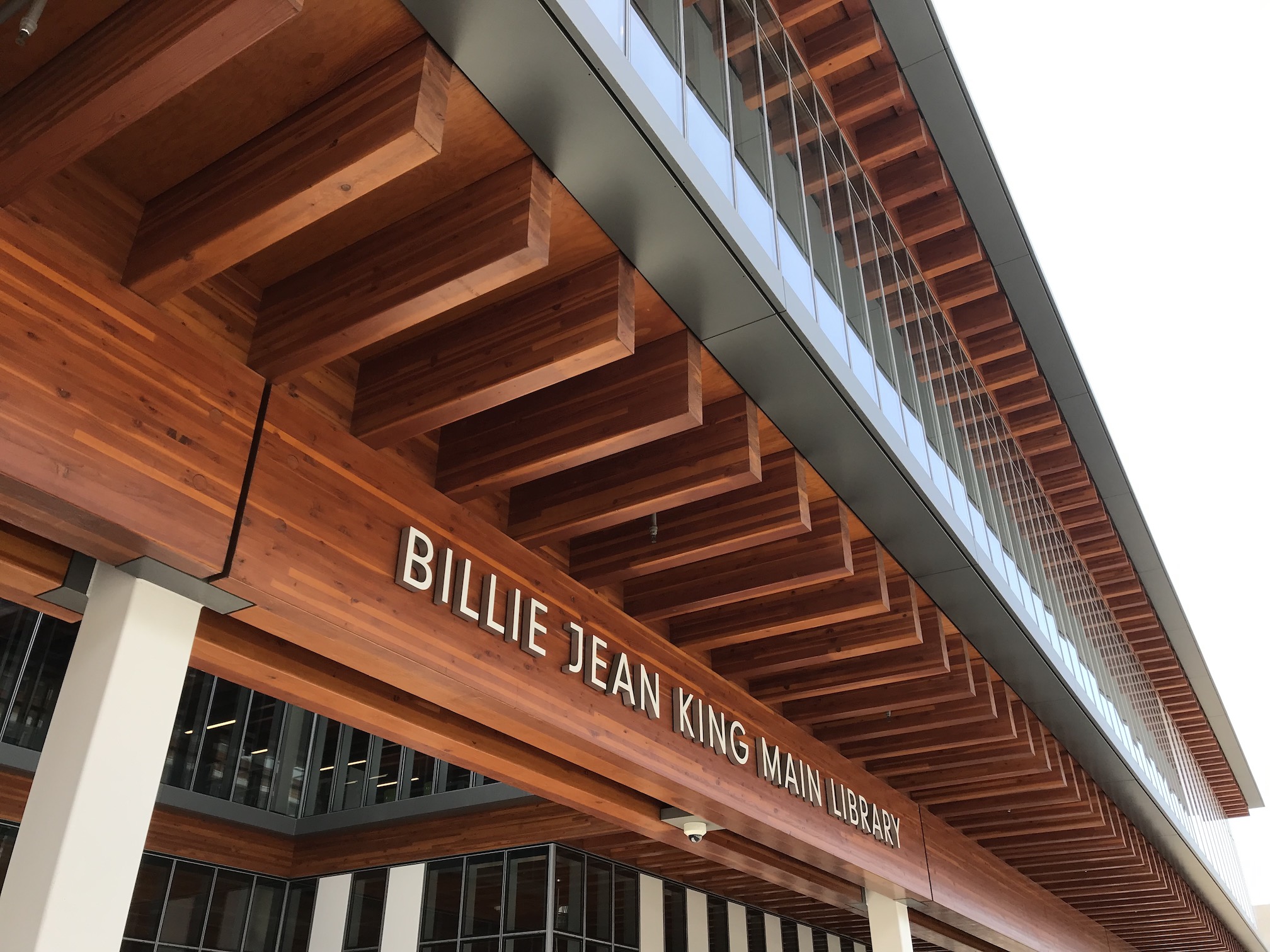

The Long Beach Public Library named their new main location after tennis legend Billie Jean King, who was born and raised in Long Beach (and learned to play tennis on it's public tennis courts). The longtime advocate for gender equality is also the author of nine books, available at her namesake library.

The large glass, steel and wood structure was dedicated September 21, 2019. The library definitely feels huge when you walk in, thanks to high ceilings, light colors, and minimal bookcases on the first floor near the staircase. Don't miss the nautical themed children's section and The Studio (an all-ages makerspace with 3D printers, a Cricut, sewing machine, letterpress and more). There is a lot to explore, including the Special Collections available to look at by appointment in the Miller Room. The restored Suzanne Miller WPA murals, although high up on the wall, are pretty impressive.


The Michelle Obama Neighborhood Library, a branch of the Long Beach Public Library, was dedicated September 16, 2010. The library has sustainable features (including LEED and community garden) and I really appreciated the displays celebrating the businesses/buildings that were replaced by the library, as well as the history of the library (originally known as the North Library). You can't miss the refurbished spire from the Atlantic Theatre (1942-2014).


In 2019, the Claremont Library was renamed in honor of Helen Renwick, a local philanthropist who, in 1919, donated the land the library sits on. The current building, designed by architects Laurence Hutner Jr. and Richard Appel, was dedicated in 1975.

Ms. Renwick was the widow of a Davenport (IA) lumber mill owner who moved to Claremont following his death. In addition to donating the land for the library, she also funded buildings and donated land to Pomona College. Did I mention she also wrote poetry?

This branch has a great book collection, a robust Friends group and a shiny, modern public restroom. Shops, restaurants, a museum, and a Rhino Records store are all within walking distance.

There are more local libraries named after women that I hope to visit soon. Do you have a favorite one to share?

Friday, May 14, 2021

Lennox Branch of the Los Angeles County Library Opens in Civic Center

Dedication of the Lennox Branch, the second county-owned building. [1948]
County of Los Angeles Public Library History


A new building for the Lennox Branch of the Los Angeles County Library was opened May 14, 1948. It was one of the four buildings that made up Lennox's Civic Center and the library later included a regional office. It was a small branch. Upon its opening, the Lennox Branch accommodated 16 adults and 16 children in the reading room according to a staff newsletter. The branch was quickly popular and more library cards were issued in the first month than the previous six months combined. By January 1950 a regional card catalog was installed that represented the holdings of nine branches in the area. The adult materials alone accounted for 40,000 cards in the catalog.

The branch closed in late 2012 for renovation and reopened April 11, 2014.


Before and after photos of the Lennox Branch (Photos by author)


Wednesday, April 7, 2021

A Look at the Mobilibraries of the Los Angeles County Library

For National Bookmobile Day (newly dubbed National Library Outreach Day), here is a quick look at the Mobilibraries of the Los Angeles County Library (aka County of Los Angeles Public Library). For a history of the Los Angeles Public Library Traveling Branches click here.

From September 17 through October 3, 1948, Los Angeles County Fairgoers in Pomona got their first glimpse of the Mobilibrary. It was parked right there in front of the race track grandstand on the main thoroughfare and was visited by approximately 1000 people according to the library's staff newsletter. Mobilibrary Unit No. 1 was the first bookmobile of the Los Angeles County Library system and two librarians were there from 2pm to 8pm daily to explain how it would be used. The bookmobile, or mobile unit as the library called it, had been on display for one day, September 9, at the Antelope Valley Fair. Its purpose was to provide service to smaller communities in the Antelope Valley, not including Lancaster and Palmdale which already had library branches.


Los Angeles County Supervisor Roger W. Jessup takes a look at Los Angeles County Library's Mobile Unit No. 1. Note the shelving which was custom built in the "Library Shop" (aka Property and Transportation Division). Photo dated February 8, 1949. Herald Examiner Collection/Los Angeles Public Library Photo Collection

Monday, February 7, 1949 marked the beginning of the Mobilibrary's weekly 600-mile tours of the Antelope Valley. The bookmobile initially carried 1000 books on custom-made shelves. The shelving was the work of James E. Cobb, head of the Library's Property and Transportation Division, and his crew. By mid-1949, a duplicate of Mobilibrary Unit No. 1, this one owned by the Los Angeles County Sheriff's Department, was also pressed into service. This bookmobile, which had one library-appointed driver and librarian, provided service to road camps and forestry camps in remote areas of the county. This bookmobile, later dubbed Wayside Mobilibrary, was housed at Wayside Honor Rancho (now known as Peter J. Pitchess Detention Center).

The end of 1949 saw the start of Mobilibrary Unit No. 2 service to western Los Angeles County--Malibu, Topanga, Cornell, Agoura and Calabasas, which was not already served by branch libraries. The bookmobile--which also provided reference, reader's advisory and accepted requests for any book in the system-- stopped at schools, fire stations, post offices and beaches. Some stops were as short as fifteen minutes while others stretched to three hours. Scheduled stops were adjusted over time based on popularity and use. However, the wear and tear of servicing such large areas weekly necessitated the request for new Mobiliibraries in 1950.

The Los Angeles County Library Antelope Valley Mobilibrary in 1951.
County of Los Angeles Public Library History Collection

Although owned by the Sheriff's Department, an agreement was reached in December 1951 to allow the Wayside Mobilibrary to service the lower Mint Canyon and Bouquet Canyon communities on a trial basis for two days a week. This supplemented the service of the Newhall Branch Library and the Library Stations in the Saugus and Sulphur Spring schools. This route also served Castaic and Val Verde. According to The Newhall Signal at the time, County Librarian John D. Henderson hoped the service would be useful to the communities and that a future budget would allow the library to purchase a bookmobile dedicated to full-time library service in the area. Children made use of the bookmobile but adult circulation was low. Unfortunately the resignation of the librarian in May 1952 meant the temporary suspension of service to this area.

Responding to the rapid growth of the Lakewood area, Mobilibrary Unit No. 4 was added in late 1951 to supplement the small branch library there. The bookmobile was initially housed at Bellflower and would become known as the Los Cerritos Mobilibrary. It was later housed in Norwalk. One fun tidbit about that bookmobile--when the driver/attendant retired after almost sixteen years of working with the Mobilibrary, his younger brother took over as driver/attendant.

One of the Los Angeles County Library's Mobilibraries parked at an unknown location, circa 1954.
County of Los Angeles Public Library History Collection

A new Mobilibrary, with capacity for 1700 books, was added in March 1956. It was broken in by subbing for a Lancaster bookmobile which was in the shop. It would soon make its way to the Malibu route and the (old) Malibu Mobilibrary will take over for the Puente Valley Mobilibrary, which will become a spare bookmobile. Additional mobile units on some routes and replacement vehicles for the bookmobile service were often noted in the staff newsletters. Three $9,000 bookmobiles were ordered in 1957 and arrived in 1958. This meant a second Mobilibrary (aka Newhall Mobilibrary) could be added to the Antelope Valley, which allowed for longer stops, and better service, for the outlying areas. The late 1950s summer schedules of the Newhall Mobilibrary even included brief stops to homes! Second mobilibraries were also added to the East San Gabriel Valley Region (housed at the West Covina Branch) and Malibu.

The East San Gabriel Valley Region Mobilibrary as seen in the Monrovia Daily News-Post, 
October 17, 1958

Housing the bookmobile was a challenge. The first Malibu Mobilibrary is a prime example. It was originally housed in the garage of the driver. When the driver retired it briefly lived at the Las Flores Canyon Fire Station before a Beverly Hills real estate developer allowed the bookmobile to park at a property he had on Malibu Road. That accommodation lasted six months and the Malibu Mobilibrary was moved to the Lennox Branch. One perk to this arrangement was the quicker filling of requests and more varied rotation of stock than at previous housing locations.

At the height of Mobilibrary service there were seven community Mobilibraries and one institutional (Wayside) Mobilibrary that, along with branches, served an area of 3315 square miles (per 1959-60 Los Angeles County Library Annual Report). That is a pretty impressive feat. Today, the Antelope Valley and Santa Clarita (aka Newhall) bookmobiles continue to provide service. A third, known as the Urban Outreach bookmobile, serves areas of Whittier, East Los Angeles, La Puente, Rowland Heights and Azusa. A tip of the hat to Los Angeles County Library bookmobile drivers and librarians, past and present!

Sources: LA County Library staff newsletters and various newspapers including Monrovia Daily News-Post, The Signal (Santa Clarita, CA), The Van Nuys News, Los Angeles Times, The East Whittier Review and more.

Sunday, March 28, 2021

Bruggemeyer Memorial Library Dedicated in March 1929

Bruggemeyer Memorial Library in 1940. 

Judge Mancha Bruggemeyer gifted Monterey Park with a library on March 28, 1929. The $40,000 library, at 256 W. Garvey, was complete with automatic heating/cooling and shelves full of donated books.

It was built as a memorial to Bruggemeyer's late wife, (Ro)Berta Pauline Bruggemeyer. A portrait of Mrs. Bruggemeyer by artist Mischa Askenazy was hung in the "memory room" of the library. According to the Los Angeles Times, "objects in memory of Mrs. Bruggemeyer will be placed [in the memorial hall] until such time as the demand for book space shall call for a change of plans."

Monterey Park mayor, Sam B. Jones, accepted the library from Bruggemeyer. The library was, at that time, a branch of the Los Angeles County Library system. County Librarian Helen E. Vogleson and Monterey Park branch librarian, Mrs. Helen Thomas, were also in attendance at the library dedication.

Mrs. Helen Thomas and Mr. Bruggemeyer were married the next month, on April 21, 1929.

Undated photo of Judge Mancha Bruggemeyer
Learn more about the interesting life of Mr. Bruggemeyer here.


Thursday, January 28, 2021

The Story of the Texas Twin to the Old Lancaster Branch of the Los Angeles County Library

 In 1950, three siblings from Texas paid a visit to the Pasadena Public Library. John, Louemma and Winnie May Reber sought the advice of Doris Hoit, City Librarian of Pasadena. Could she recommend any small library buildings for them to tour? The siblings wanted to donate a library to their community of Raymondville in Willacy County, Texas and were looking for inspiration. 

        The Reber siblings (left to right): Louemma, John and Winnie May Reber [n.d]
Screenshot from Reber Memorial Library, Raymondville, Texas YouTube video [2014]

The Rebers grew up working on their family's 260-acre farm in Illinois. Those early lessons of hard work stuck with them throughout life. As an adult in his early 40s, John Reber moved to Texas for health reasons and purchased land and cattle. With the help of his sisters who also moved, they soon had a "model ranch," according to local newspaper reports. The Reber sisters helped organize a woman's club in Raymondville (Texas) and that's when the need for a library was most keenly felt. Club meetings involved presentations based on essays that members were assigned to write on a variety of topics. Without a library nearby, club members used the Reber family's set of Encyclopedia Brittanica to conduct research for their essays. The Reber siblings talked it over and offered the county $50,000 to build a library, if the county would finance the book collection, fund the personnel and run the library. County officials agreed. Fast forward to the Rebers on their library exploratory trip in Southern California during the summer of 1950.

Ms. Hoit suggested they visit the newly dedicated Los Angeles County Branch Library in Lancaster on Fig Avenue. This library was in service from April 1950 until a new Lancaster Library (on Avenue J at Kingtree) was built in 1964. The Rebers were impressed with the Lancaster Library. They contacted the County of Los Angeles Board of Supervisors for permission to use the library's plans and specifications in order to build the Reber Memorial Library in Texas. The architects of the library, [Robert Farquhar] Train and [Robert George] Smith, were also consulted.

Los Angeles County Library, Lancaster Branch 
opened April 1950 on Fig Avenue
(Photo: County of Los Angeles Public Library History/LA County Library Digital Collections)
 

A plaque that once graced the front entrance of the Lancaster Library, also known as the Antelope Valley Regional Library, attests to the determination of women's clubs to champion libraries.
(Photo: County of Los Angeles Public Library History/LA County Library Digital Collections)

The Reber siblings were in luck, the consulted parties said yes. Soon they were back in Raymondville to begin library construction. While I could not find an exact date, I believe the library opened in July 1951. The Rebers were happy that the community took so quickly to the library. For example, individuals and organizations in the area donated books to fill the library's shelves. The Rebers also praised Mrs. J.S. Robinson, the librarian, for her wonderful work as evidenced by "the happy youngsters [at the library] for one of the story teller's hours." The Rebers saw the library as their legacy. Not only does the building's cornerstone announce their gift 'Given to the people of Willacy County and their children,' but a newspaper article in 1955 describes a large cherry wood grandfather clock made by Jacob Reber, the sibling's grandfather, that would also be left to the library.


Reber Memorial Library at 193 N. 4th Street, Raymondville, Texas
Built in 1951 using the same plans as the Fig Avenue location of the 
Los Angeles County (CA) Public  Library,  Lancaster Branch. Train and Smith, architects.

Cornerstone of the Reber Memorial Library in Raymondville, Texas

The folks in Los Angeles seemed pleased as well, according to the October/November 1951 Los Angeles County Library staff newsletter. The Los Angeles County Librarian, John D. Henderson, flew out to Texas on November 2 to tour the new library building in Raymondville. "The full day November 3 was spent with the Librarian, the special trustees appointed to oversee the construction of the building, and the Library Advisory Board discussing procedures and policies, as well as budget, that should provide an adequate public library service for the 10,000 residents of Raymondville and the additional 10,000 residences of Willacy County." Mr. Henderson was impressed with Texas hospitality and the "splendid building which the Reber family provided for their community." It seems that a segment of the flight home was a high point as well--- as the only passenger Mr. Henderson was allowed to ride in the cockpit and enjoyed a good cigar with the co-pilot.

Los Angeles County Librarian John D. Henderson (3rd from left) visits the Reber Memorial Library.
Valley Morning Star [Harlingen, TX], November 7, 1951


So many questions! Why did the Rebers travel to Southern California to look at small libraries? Who did they speak to besides Doris Hoit? What other libraries did Ms. Hoit suggest besides Lancaster? Did the library receive the Reber's grandfather clock and do they still have it? I've called the Reber Memorial Library several times to find out but a message says their hours are reduced due to the pandemic and to call back later. 

References

"County Librarian Flies Again." News Letter Los Angeles County Library, October-November 1951, p. 3.

Hendry, A.B. "Reber Family 'Builds' Library in Raymondville." Valley Morning Star [Harlingen, TX], 7 Jan 1955, p. 13.

News Letter Los Angeles County Library, January 1951, p. 4.

"Visits Reber Memorial Library." Valley Morning Star [Harlingen, TX], 7 JNov 1951, p. 3.


Wednesday, September 5, 2012

Los Angeles Library History: Happy 100th Birthday to the County of Los Angeles Public Library

Today is officially the 100th birthday of the County of Los Angeles Library system. They have been counting down the days to the Centennial Celebration, which will take place at all the branches on Saturday, September 8, by publishing a new library fact daily on their website. Check out their facts here, and don't forget to check out the countywide birthday parties on Saturday!

To read an interesting and personal history of the library's origin you should check out County Free Library Organizing in California 1909-1918 by Harriet G. Eddy. Ms Eddy was the County Library Organizer for the California State Library from 1909-1918.

Wednesday, June 20, 2012

Los Angeles Library Tour - Lennox Library (CLOSING for remodel June 29, 2012)

We stumbled upon the County of Los Angeles Public Library's Lennox branch recently and were amazed and charmed by both the building and the staff.


According to the Los Angeles Times, the library is part of the Lennox Civic Center that was dedicated May 14, 1948. The then $328,000 (approximately $3,380,000 today) Civic Center also housed a Sheriff's substation, the Los Angeles County Building and Safety Department and the County Charities Department.

Designed by architect Adrian Wilson, the brick building with its rounded corner entrance, and 'County Library' sign, are eye-catching as you drive north towards the intersection of Hawthorne Blvd and Lennox Avenue. Projects Adrian Wilson worked on include the New Chinatown Los Angeles Master Plan (1938), Los Angeles County Courthouse, the Anaheim Convention Center, Ship of the Desert house in Palm Springs, and the recently renovated Casa Verdugo Library in Glendale.

The other offices in the complex are boarded up and appear to have been closed a little while, but we were happy to see the library was open.

On our first visit, Library Manager Peter Hsu couldn't have been nicer or more helpful. He showed us around the library and pointed out the plans for an upcoming remodel the library would be undergoing. I returned some books today and found out that the last day the current library would be open is Friday, June 29. The remodel will take two years to complete.

It is definitely worth the drive to see inside the original library now while you still can. Complete the trip with a stop at the beautiful Chips restaurant nearby, designed in 1957 by architect Harry Harrison.

Wednesday, April 11, 2012

Bookmobiles in Los Angeles


Today is National Bookmobile Day, which is part of National Library Week.

I wondered about the history of bookmobiles in Los Angeles. A trip through history via the Los Angeles Times did not disappoint. The Los Angeles Public Library unveiled the first bookmobile that catered exclusively to children at the Los Angeles Children's Show at the Shrine Auditiorium in September 1949. Little Toot, as the bookmobile was affectionately known (the LAPL Photo Collection has a photo here), could carry 2500 books and initially made stops to 20 elementary schools in congested areas of Los Angeles.

Little Toot's big brothers were busy as well. By 1953, three of LAPL's four bookmobiles serviced the San Fernando Valley, an area growing so fast in the post-war years that library branches couldn't be built fast enough. LAPL's 'Traveling Branch' bookmobile service made 28 stops a week and, by 1957, were circulating almost 500,000 volumes a year. A 1961 article mentions that bookmobile librarians don't bat an eye when a patron rides up on horseback in a rural part of the Valley, but do object to patrons leaving books on the street before the bookmobile's arrival.

In 1959, according to the Los Angeles Times, the Los Angeles County Library had six bookmobiles in addition to it's services in 88 communities. By 1972 (and with a budget of $13 million for the year), the County Library had 94 community libraries, serviced 21 libraries in jails and hospitals, and operated nine bookmobiles!

The Los Angeles Public Library has a great collection of their bookmobile photos, which you can find here. This bookmobile photo from LAPL's 1972 centennial celebration is my favorite, check out the Peanuts-esque booth that reads 'Mind-Bending' with the 5 cents sign crossed out.

You should also check out Library History Buff's bookmobile homage which contains links to Pinterest and Flickr.

Sunday, January 15, 2012

My Neighborhood Library - How Do I Choose?

Growing up in Clovis, California, we had one library. By default, that was our neighborhood library. Now that I live in Los Angeles the lines dividing neighborhoods and communities are blurred. I’ve got three libraries that qualify as ‘my neighborhood library’.

The Northridge Branch has been our go-to library since we moved to the Valley. Located near the intersection of Reseda Blvd and Nordhoff Street, it’s a great little library. The staff is always friendly, there is a nice selection of new books near the front, and a fair number of computers available for the public’s use. There’s even a Wienerschnitzel right next door when I’m in the mood for really good fast food fries.

The Mid-Valley branch in North Hills is slowly taking over as our go-to. It’s a regional branch so it is much larger, and it used to be open on Sundays before the cutbacks. It’s also right off the 405 and has a large parking lot. They have a nice sprinkling of everything – magazines, new books, huge children’s section, decent-sized foreign language sections (Korean, Chinese and Spanish), and a great selection of music cds. They also have a Friends of the Library bookstore and a great book sale several times a year.

Our third ‘neighborhood’ library is the West Valley Regional Branch which is on Vanowen near Wilbur in Reseda. It has a nice children's section, public computers, comfortable places to read, and an impressive display case in the entry. It’s also just a hop, skip and a jump from Las Fuentes!

One great thing about living in the San Fernando Valley is that I have a dozen libraries to choose from in a ten mile radius of my house. This includes Los Angeles Public Libraries, a Los Angeles County Library, and CSUN’s great Oviatt Library. No worries if you aren’t a student at CSUN, you can gain checkout privileges (with a few restrictions) by joining their Friends of the Library group.

Sunday, April 3, 2011

Los Angeles Library Tour - Hawthorne Library


Hawthorne's first library was established in 1913 and the current branch was built in 1962. The new branch quickly proved popular - in it's first six months circulation numbers jumped from a ranking of 26th place (for the previous branch) to 5th place. By 1965 the branch was the most used regional branch in the county system with Monday, Tuesday and Wednesday nights being the busiest. Shortly after the library opened, a group of 'young folks', ranging in age from 10 to 14, formed the Junior Friends of the Hawthorne Library. The ambitious group of approximately 50 had committees for arts and posters, children's book week, school co-ordinating, ways and means, refreshments and special services. In 1964, the (adult) Friends of the Hawthorne Library began a program of creating 'talking books' for the visually handicapped. Volunteers read from such classics as Dickens Christmas Carol and Goodbye Mr. Chips and were recorded on a reel to reel machine donated by the Hawthorne Lions Club.
Community programs during their first decade included art exhibits, film series and investment lectures. During the mid-1970s they also circulated 8mm and super 8mm for 10 cents each.
You learn something new everyday! A 1970 article in the Los Angeles Times on the cookbooks of the Hawthorne library has a librarian explaining that each county library concentrates on one of the 10 Dewey decimal classifications from 000 to 999 and their specialty is the 600s "and that includes cooking, dogs, data processing, gardening, carpentry, cats and winemaking."
In 1978, as part of Hawthorne Library's 65th anniversary celebration, children were invited to submit artwork depicting what they thought the library looked like in 1913 or what they think it will look like in the year 2000. I wonder if they saved any of those?

Today the library is an excellent resource for car buffs (with a whole aisle populated with Chilton manuals) and crafters (more craft books than you can shake a bejeweled stick at). Every Wednesday night a group of local residents, known as the Hawthorne Knit Wits, meet at the library to work on their knitting and crocheting. Evidence of their handiwork, in the form of bookworm bookmarks, can be purchased at the front counter for $1.00.

Sunday, October 17, 2010

Los Angeles Library Tour - Acton / Agua Dulce Library


Over the last year, we've seen the Los Angeles Library Public Library System drastically cut hours, staff, and services. So, it was amazing to hear that the Los Angeles County Library System has opened a new branch in Acton. The Acton / Agua Dulce Christopher Colombo Brevidoro Library opened on September 29, 2010. According to their website, the library is named in honor of Christopher Colombo Brevidoro, an Italian immigrant who founded the Colombo Lilac Ranch with his wife Ida Brevidoro. Their sons, John and Robert Brevidoro, donated the land in 2003 to the County of Los Angeles for a new library.
This library is new. Really new. Everything inside was purchased new for the collection. We did speak to a librarian who said that some older books that had been donated from other locations would soon be making their way over. It is kind of an amazing thing to browse the shelves of so many new books. Most have never been opened before. They've filled the collection with a little bit of everything. Kudos to the Photography/Music section where I found a bunch of punk rock books.
They have a large children's area seperated from the rest of the library, about two dozen computer stations, and a nice selection of dvds and cds. Each cd is labeled on the spine with an easy to read black text on white sticker. Amazing! Why don't more libraries do that?
Everyone we came in contact with, both the librarians and patrons, had a sense of excitement and wonder. People were really interested in what the library had to offer. It was a good feeling.
And keeping with the tradition of local artists providing pieces to libraries, we find two great examples inside. Above the main desk hangs David Baker's "Reading Gives Your Imagination Wings". Two vibrant metal wings guard a scroll with this inspirational message. Across the library is Anne Marie Karlsen's "Frontier". It appears to be five patterned discs, but as you look closer, you see the patterns are made up of images from the Antelope Valley.
We took the 14 up to the library, passing the "Oak of the Golden Dream" (supposedly, where gold was first discovered in California). We passed by Vasquez Rocks and did our best Star Trek impersonations. We stopped in for breakfast / lunch at Crazy Otto's, home of the world record holding "World's Largest Omelette".
To summarize, head north out of town. Eat a big breakast at Otto's. Walk it off at Vasquez Rocks. Relax at the Acton / Agua Library.

Monday, September 6, 2010

Los Angeles Library Tour - Norwalk Regional Library


This weekend, we made it back to the Norwalk Regional Library (see previous Norwalk post). They were open this time and it was definitely worth the wait.

At 39,000 square feet it was the largest library ever built in the county public library system when it was dedicated in July 1969, The exterior almost has a museum-like quality to it. Windows are adorned with gold metal screens. As you walk toward the entrance, you are greeted by two mosaics designed by Ben Mayer. They each depict events and industries that have shaped California - such as agriculture (orange trees), transportation (trains and ships), aerospace (jets and rockets). These mosaics alone are worth a trip to Norwalk.

Inside, the grand touches continue. There are many giant gold light fixtures which compliment the screens outside. Additional mosaics form what almost appears to be a UFO hovering over the children's section.

This branch of the Los Angeles County Public Library system held many books we had never seen at any other libraries we've visited. We've been to a lot of libraries, and after awhile the same books seem to pop up from one branch to the next. But here, the aisles were filled with rare books waiting to be discovered. I found this in the arts and crafts section: Pop Topping!. And in the Los Angeles history section, we found Previews of Coming Attractions: Scenes and Faces from the Permanent L.A. Fun Game. Haven't seen that in years.

The local history section is amazing. They had a giant selection of magazines (three different publications on libraries and two on restaurants. How often do you see that?) Plenty of government and reference material. A small but functional audio/visual department. They also had a lot of nice exhibit cases to show off the summer reading programs.

After loading up on books, we drove down the way to Bellflower for a lunch at Fronks. Giant sized burgers topped off what turned out to be an epic trip to the Norwalk Regional Library.

Sunday, August 15, 2010

Norwalk Regional Library


Curse you Los Angeles County Library! You tease me with the prospects of uncharted library terrain. But today, alas, I will not browse your aisles.

Let me explain:
We had just finished another amazing visit to the Whittier Public Library on Washington Avenue (it never ceases to amaze). Afterwards, on the trip back towards home, I found a comic book store we hadn't been to before, Comic Cult on Imperial Highway. Across the street was an amazing building. It looked gold and concrete from the distance. It seemed to exist
on an empty grass field. Was it an auditorium? It must be some sort of civic
building. It wasn't apartments.
We drove around to the front, it turned out to be The Norwalk Regional Library, a library we have not visited. And there were two amazing tile mosaics flanking the entrance.
The parking lot was kind of empty as we entered. Hmmm.... Are they a victim of budget cuts forced to close on a Saturday?
We walked up to the entrance, and to mixed emotions, we find out they are
closed due to a staff meeting. Whew! They will be open the next time we come back. And we can't wait to get back.
Once we were back at home base, we discovered that the Norwalk branch is in
the Los Angeles County System. Plus there are more mosaics inside.
While researching the library, we came across this great site about public art in Los Angeles County, spurring additional places to add to our long list of future trips.