Showing posts with label LAPL. Show all posts

Sunday, December 18, 2022

The Wartime Information Desk of the Los Angeles Public Library

Los Angeles Times May 15, 1942

Los Angeles Public Library 1941-1942 annual report

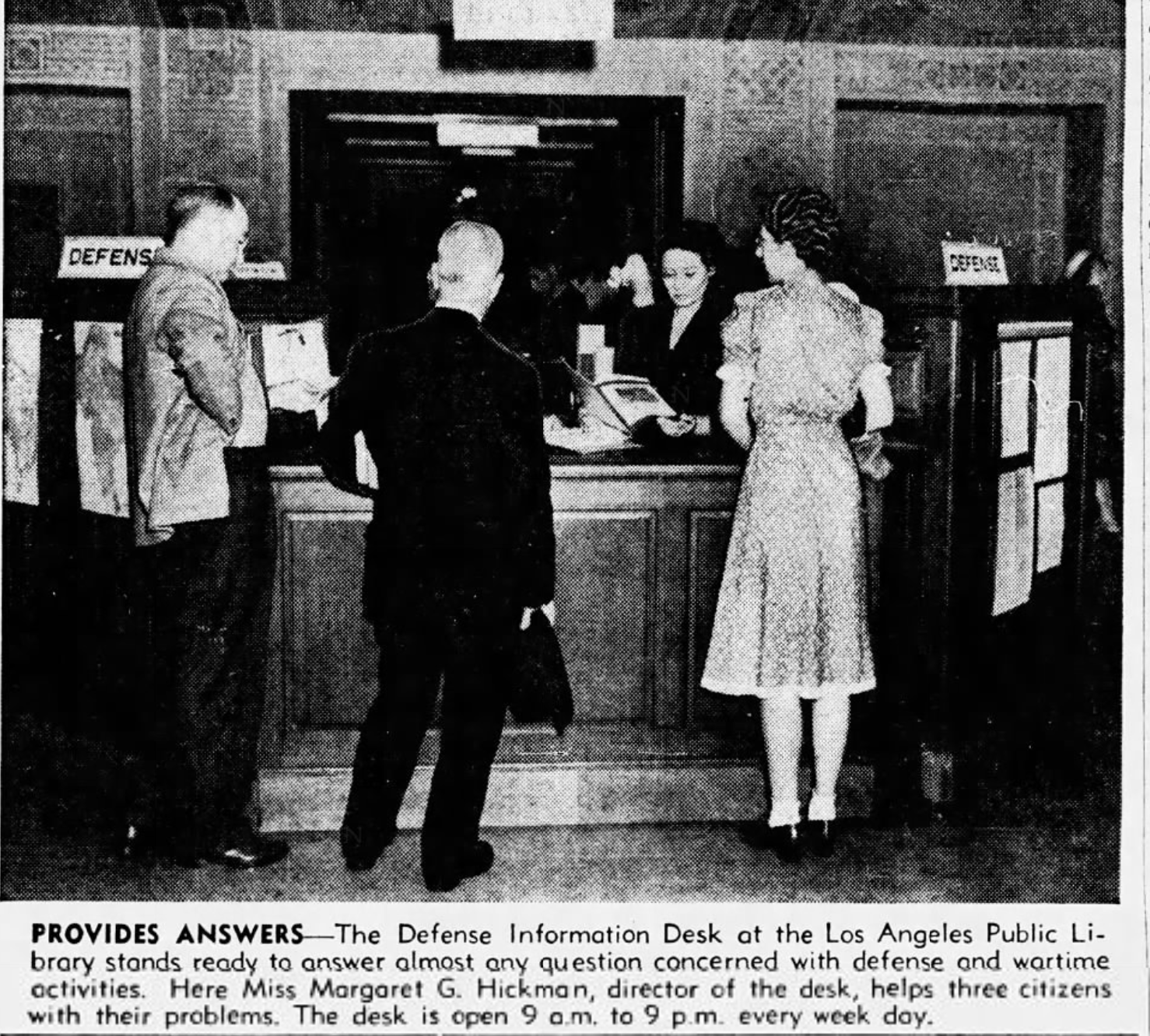
Within two weeks of the bombing of Pearl Harbor the Los Angeles Public Library opened their Wartime Information Desk, centrally located in the lobby off of Fifth Street. The desk would "disseminate information on national defense" and anything pertaining to World War II. Its earliest name, according to the Los Angeles Times was the Citizens' Bureau of Information. The library had thought about providing a similar service for a few months but Municipal Reference librarian (stationed at City Hall) Josephine Hollingsworth convinced Althea Warren that, after December 7, 1941, they was receiving far too many reference questions to keep up with. Ms. Warren put the Wartime Information Desk in the hands of principal librarian Margaret Gabriel Hickman who had been the head of the foreign language department since 1928. The 1942 library annual report lists an organizational chart that mentions that Wartime Information Desk personnel were taken from other library departments. Staffing the desk was supplemented by Work Project Administration (WPA) and National Youth Administration (NYA) workers.
Los Angeles Daily News December 17, 1941

The Wartime Information Desk averaged 300 questions a day with another 100 arriving via letters received weekly. Throughout much of 1942 and into 1943 the library had a frequent column called "War Queries" in the Los Angeles Daily News answering some of the questions. These included queries about military service, defense jobs, Victory Garden information, and V-mail.
Los Angeles Daily News December 19, 1941

Los Angeles Daily News, December 1942

The desk was ended in October 1943 because the public by then was better educated on the workings of the war (specifically rationing, the draft, and housing), and the efforts turned towards veteran's vocational training. The clipping files, pamphlets and indexes from the Wartime Information Desk were deposited with the Sociology Department (are they still there?).

Thursday, September 2, 2021

Los Angeles Public Library Moved to City Hall in 1889


On September 2, 1889, the Los Angeles Public Library opened its doors on the third floor of the newly constructed City Hall on Broadway between Second and Third Street. According to the 1889 Annual Report, the library's first formal annual report which coincided with Tessa Kelso's first year as City Librarian, the new location was described as "well-lighted and airy" space with library fixtures constructed of the "best possible materials." Others on the library staff included Jessie Gavitt as First Attendant (Ms. Gavitt had been the fourth City Librarian, 1884-1889) and attendants Adelaide (Addie) Hasse, Estella Haines, Lena B. Fenner and Mrs. E.A. Wellman.
    
General Plan of the Los Angeles Public Library, City Hall location

A long article in the Los Angeles Daily Herald on September 1 prepared Angelenos, explaining all they needed to know to meet their new library. They were invited to freely use its space Monday through Saturday from 9am to 9:30pm, and the reading room was open on Sundays 1pm to 6pm. If a patron wanted to check books out for home use they needed a membership which cost one dollar quarterly (approximately $100 for a year, adjusted for inflation). Los Angeles teachers were allowed to use the library free of charge, courtesy the library's new Board of Directors (five gentlemen of "taste and judgement" appointed by Mayor Henry T. Hazard). However, only library staff was allowed in the stacks, which meant patrons had to know what they wanted and were unable to browse the collection.


The library, which previously occupied rooms in the Downey Block at Temple and Spring, was closed for two months as it prepared for its new location. According to the annual report the books were "cleaned, repaired, counted, classified (Dewey), numbered, bookplates inserted, placed into position, shelf catalogued in duplicate, and a card catalogue begun." Coinciding with the move to a new location, the Board of Directors put out a call in local newspapers for the creation of a bookplate design. Their criteria was that the only lettering on the design should say "Los Angeles Public Library" but there was no set shape or design beyond that. After looking over 46 submissions, San Francisco-based lithography firm H.S. Crocker and Co. was awarded $10 for their winning design. These were the bookplates inserted into the circulating (green angel) and non-circulating (red angel) books. There were 6356 books in the library upon opening in September 1889 (approximately half of them, including government documents, were deemed uninteresting to the general public) with another 4771 added to the collection by December of the same year. Other collections being built included photographs of works of art and architecture, as well as musical scores.


The library could be accessed by stairs or elevator. Initially the elevator only operated from 9am to 5pm daily, which meant library users had to use the stairs after 5. To remedy the situation the library helped pay elevator operating costs. [According to the 1890 annual report the library paid $480 (approximately $13,000 today) that first year.] Indexers greeted library users that arrived by stairs or elevator. Indexers, which looked like wooden boxes with a glass top, helped patrons discover materials the library had available and order them at the appropriate counter (e.g. fiction, non-fiction, periodical). The user would use a hand-crank to browse through cards that listed the materials in the library collection. Larry T. Nix's Library History Buff blog explains the Rudolph Indexer, of the type used in the early years at the City Hall location.


The largest rooms of the library were a general reading room and the non-fiction "book room." This reading room was 75x29 feet and held six reading tables and racks for seventy newspapers. The book room (aka closed stacks) measured 70x50 feet and contained twenty oak bookshelves capable of holding 800 books. Books were retrieved by staff and delivered to a large oak counter. It's interesting to note the number of overhead lamps and the lack of bookends-- used to keep the books upright and prevent damage.


The "Librarian's Room" was 13x15 feet and held union catalogs, book lists, publisher's catalogs. Rare books were also kept in the librarian's office. The library's Board of Directors had a separate office under the tower. The office was described as a small apartment (18x18 feet) where the Board of Directors and librarian met weekly around a giant oak table and surrounded by government and patent documents on the shelves lining the walls.


A 26x29 feet "light and airy apartment, carpeted and with every convenience" served as the Ladies Reading Room. This room, located between the large reading room and Librarian's Room and Director's Room, was also made available to teachers or "any club who wishes to make use of it for discussion." This room later served as a lecture hall also. The library outgrew City Hall and moved to the second floor of the Homer Laughlin Building (aka Grand Central Market building) in 1906; followed by the Hamburger Building in 1908; the Metropolitan Building in 1914 and finally, the Central Library in 1926.

Sources: Los Angeles Public Library Institutional Collection, Annual Reports of the Los Angeles Public Library, Los Angeles Daily Herald, Los Angeles Times.


Tuesday, June 1, 2021

Los Angeles Public Library Opens in the Metropolitan Building

Charging, receiving and registration desk at the Los Angeles Public Library in the Metropolitan Building, [n.d], Los Angeles Public Library Institutional Collection

On June 1, 1914 the Los Angeles Public Library opened in the Metropolitan Building at 5th and Broadway. Accessible only by an elevator, the library rented the seventh, eighth and ninth floors. In addition to subject departments the library featured a music room and spaces to display art. 

Art display at the Los Angeles Public Library in the Metropolitan Building, [1926], 
Los Angeles Public Library Institutional Collection


Music room at the Los Angeles Public Library in the Metropolitan Building, [1926], 
Los Angeles Public Library Institutional Collection

Crowd at the Los Angeles Public Library in the Metropolitan Building, [1926], 
Los Angeles Public Library Institutional Collection

By the early 1920s the location was overcrowded and City Librarian Everett R. Perry enlisted library worker Monica Shannon (graduate of the library's 1915 Training Class) to head their Publicity Department and spearhead a campaign for a new library building. The campaign included advertisements on the side of streetcars and in movie theaters, display windows in downtown department stores, informative talks by library staff and prominent Angelenos, as well as branch-level publicity in the form of bookmarks slipped into checked out items. The campaign was a success and in 1926 the library moved out of the Metropolitan Building and into the beautiful Central Library. Visit https://www.lapl.org/collections-resources/blogs/lapl/monica-shannon-advocate-libraries-leprechauns-and-luckless to learn more about Ms. Shannon and the library's campaigns to free itself from rented spaces.

Monday, May 3, 2021

Richard Henry Dana Branch of the Los Angeles Public Library

Richard Henry Dana Branch Library, [n.d], photo by Dick Whittington, 
Security Pacific National Bank Collection, 
Los Angeles Public Library Photo Collection

On May 3, 1927 at 1p.m. the Richard Henry Dana Branch of the Los Angeles Public Library threw open its doors to the public at 3320 Pepper Avenue in Cypress Park. This branch, originally called the Dayton Avenue Branch, opened October 11, 1920 and closed April 30, 1927 to move into their new building. 

Information on the branch's history, available via tessa.lapl.org, includes a letter from the branch architect, Harry Sims Bent (best known for work in Honolulu and locally at the Arboretum). Bent described his thinking behind choosing the Colonial Style to fit in with the residential surroundings. He praised the style on its "simplicity, unpretentiousness, dignity and repose." 

(Left): Dayton Avenue Branch Library 
(507 West Avenue 28), [n.d], 
Security Pacific National Bank Collection, 
Los Angeles Public Library Photo Collection


Photos in the late 1920s/early 1930s show the branch's popularity with children, a fact echoed by the aforementioned branch history. The building is now the Cypress Park Club House and the Cypress Park Branch Library is now at 1150 Cypress.


(Right): Children reading on the back patio of the library, [n.d],  Security Pacific National Bank Collection, Los Angeles Public Library Photo Collection

Thursday, April 1, 2021

Frank Lloyd Wright's Hollyhock House as a branch of the Los Angeles Public Library?


(Modified) Aline Barnsdall in front of Hollyhock House [n.d] Security Pacific National Bank Collection, Los Angeles Public Library Photo Collection

No joke. It almost happened. Heiress Aline Barnsdall (b. April 1, 1882) gifted part (various sources list the size between 6-10 acres) of Olive Hill, including the Frank Lloyd Wright-designed Barnsdall House (aka Hollyhocks), to the city of Los Angeles. The house was to be used as a public library and the rest of the land would become a municipal park. 


Ms. Barnsdall's gift was given in memory of her oilman father, T.N. Barnsdall, on December 6, 1923. As she explained to the Los Angeles Record, "There must be many people in Los Angeles who want an oasis like this in the desert of jazz. I feel it...should be the property of the people." The park and library departments accepted the gift, pending the city's "legal department" preparing the deed of gift and engineering details.
Artist's Drawing of Barnsdall Olive Hill Donation, Los Angeles Times, February 24, 1924

By late March 1924, the Public Welfare Committee of the City Council was urging the Council to decline Aline Barnsdall's gift, citing too many strings attached. For example, Ms. Barnsdall asked the city to spend $20,000 a year for the property's upkeep. Additionally, no palms or geraniums were to be planted; no war monuments or displays were to be placed on the property; and the library was to keep a fire burning from October to April. Indeed, the city declined the gift but thanked Ms Barnsdall for her offer.


Aline Barnsdall soon found another tenant for the Hollyhock House-- the California Art Club moved in at the end of August 1927 and stayed fifteen years.

Saturday, October 31, 2020

Phantom Libraries for Halloween! (Sounds spookier than "former libraries")

I'm fascinated by phantom libraries, as well as libraries that were formerly something else (e.g. The Santa Paula Library used to be a Safeway?). Former library locations can still be found all over Southern California. Some were built expressly as libraries while others were just a temporary location, or storefront. How did these library spaces get their phantom status-- aka why did the library move?  Oftentimes the library simply outgrew their space. I've included only a few phantoms here, most of which fit that reason, although the Moneta/Junipero Serra Branch was damaged in the 1987 Whittier Narrows earthquake. Do you have a favorite phantom library?

Canoga Park Branch, Los Angeles Public Library
The Canoga Park Branch opened July 6, 1959 with some special features-- air-conditioning, high windows that permitted a "maximum amount of shelving space" and an amazing zig-zag roof. The library was located at 7260 Owensmouth and designed by Ralph Bowerman and Charles Hobson (who also designed the 1962 Woodland Hills Branch with its parabolic roof). The building now houses an early learning center.


Moneta/Junipero Serra Branch, Los Angeles Public Library
The Moneta Branch formally opened September 28, 1923 at 4255 S. Olive Street. The Mediterannean Revival building was designed by architect Lyman Farwell who also was responsible for the Magic Castle (aka Rollin B. Lane house). In 1934, the branch was renamed Junipero Serra. Unfortunately the 1987 Whittier Narrows earthquake damaged the building and the library was forced to relocate.


Hyde Park Branch, Los Angeles Public Library
Opened at 6527 Crenshaw on August 1, 1960, this mid-century gem was designed by Kegley, Westphall and Arbogast (who also did the Van Nuys Branch). Information on this location can be found in the California Index at tessa.lapl.org, and includes building specs (branch had 10 parking spaces, seating for 24 adults and 16 children) branch histories (no AC until 1966-67) and an invitation to the opening. The location is vacant and the new Hyde Park Miriam Matthews Branch was opened at Florence and Van Ness in December 2004.


Helen Hunt Jackson Branch, Los Angeles Public Library
This Spanish-Mediterranean Revival branch was designed by C.E. Noerenberg, who also designed the Jefferson, Figueroa and the 1923 Edendale branches. The branch, named after "Ramona" author Helen Hunt Jackson, opened November 3, 1925 at 2330 Naomi Avenue. The building was auctioned off in 1963 and is now occupied by a church.


Figueroa Branch, Los Angeles Public Library
Opened in 1923, the Figueroa Branch sat on the northwest corner of 80th Street and Figueroa. The English cottage design was by C.E. Nuremberg (who also designed the Helen Hunt Jackson, Jefferson and the 1923 Edendale branches). There are a few Figueroa Branch items in the California Index (via tessa.lapl.org), including a 1936 newspaper article about summer reading (tracked by race horse figures!). The building has been remodeled several times over the years and has been the home of the New Zion Baptist Church since the mid-1960s.


Sunday, July 5, 2020

Hollywood (CA) Branch: The Little Library That Grew and Grew


The history of the Hollywood Branch library starts out like many others (e.g. founded by local women's club) but through the years its locale, patrons and staff have shaped it. As Hollywood grew from a small community to become a tourist destination, first because of artist Paul de Longpre and then as a movie studio mecca, the library kept pace--splitting not once, but twice--literally and figuratively. So far I've completed Part One (1905-1922) and Part Two (1923-1940) of its history, more to come...


Friday, January 25, 2019

Eleanor Brodie Jones: Hollywood Librarian 1908-1926 [Abridged]

Holly Leaves, July 1922

According to her obituary, Eleanor Brodie Jones taught English Literature at Lincoln High School in Nebraska before moving to Hollywood. It is cliché to say she was able to put that knowledge to work, but that is exactly what she did. As head librarian at the Hollywood Public Library from 1908 to 1926 she also encouraged artists, championed the newly emerging movie industry, provided unique educational opportunities for her community, and initiated the Hollywood Studio Club.

Following her move to Southern California from Nebraska, Jones attended the Training School at the Los Angeles Public Library (LAPL). These training classes, which began in 1888, prepared women for library work. Applicants were expected to have a high school education, be between the ages of eighteen and thirty (unless they already had library experience), be physically fit, and pass an entrance exam consisting of lengthy questions dealing with literature, art, history and general knowledge.  In 1907 Jones was one of six women who passed (her score was 75.5) one of the "severest library examinations" (Los Angeles Herald, October 22, 1907). City Librarian Charles Fletcher Lummis proclaimed in his annual report that Harvard freshman would find the exam difficult to pass. That same annual report for the library contains a sample of questions from the entrance exam for the Training School. I have yet to find examples of the questions on the final exam but based on the entrance exam it was not an easy test. Following completion of the training courses Mrs. Jones took a position as the head librarian at the Hollywood Public Library.  

1907 Los Angeles Public Library Training Class Entrance Exam (55 questions total)

Hollywood had its own independent library before being annexed into the city of Los Angeles. In 1905 a group of women formed the Hollywood Woman's Club expressly to establish a public library. Andrew Carnegie funded most of the project and the rest came from local businessmen. The Woman's Club established a library through this arrangement in 1906, turning it over to an appointed Hollywood Library Board the following year. Mrs. Jones, hired in 1908 to lead the library, retained her position after the annexation in 1910 and the branch became part of the Los Angeles Public Library.

Postcard of Hollywood Public Library circa 1910 (Author's Collection)

Eleanor Brodie Jones was the library's biggest booster, she was also one of the biggest boosters of Hollywood, both as a community and as an industry. One early outreach endeavor of Jones' had the Hollywood Library supply books to the famous Hotel Hollywood for guests to read. In addition to a selection of books available in the lobby, guests could request books from the branch or Central Library be delivered to the hotel for their enjoyment.

Library Journal, November, 1915

Art and artists were celebrated in early 20th century Hollywood. In fact, when Jones began at the Hollywood Library in 1908, the most visited tourist destination was artist Paul de Longpre's studio and gardens at the corner of Hollywood and Cahuenga. Art was important to the community and Jones championed artists, inviting many to show their work in the library's art gallery. The Hollywood Art Association regularly held exhibits and meetings at the Hollywood Public Library.
Tourists visiting artist Paul de Longre's studio at Hollywood Blvd and Cahuenga in 1905.
(Security National Bank Collection, Los Angeles Public Library Photo Collection)

As movie studios began populating Hollywood, the earliest was founded by the Horsley brothers in 1911, Mrs. Jones was there to extol the graces of the library. Scenarists (aka screenwriters) visited the Hollywood Library regularly to do research. Jones and her coworkers helped actors prepare for historical roles by providing period appropriate materials. The services of the library proved so useful that movie studios began opening their own libraries on their lots, employing librarians who would be solely at their disposal. 

Young women who flocked to Hollywood in hopes of making it in motion pictures frequently met to read plays at the library. Mrs. Jones, concerned about the living conditions these young women experienced, set the wheels in motion for what would become the Hollywood Studio Club. She rallied the support of the wives of movie industry notables, including Mrs. Jesse Lasky and Mrs. William C. DeMille, for the project. According to the Los Angeles Times she persuaded the Hollywood Board of Trade and several film companies to advance the money for the first year's rent on the Studio Club. Hollywood historian Bruce Torrence mentions Mrs. Jones' involvement and has great photos of the first Studio Club at 6129 Carlos.

Holly Leaves, July 5, 1919 - First location of the Hollywood Studio Club at 6129 Carlos Avenue

Eleanor Brodie Jones was a clubwoman as well as a librarian and news of her club work showed up in the pages of magazines such as Clubwoman, California Southland, and The Women Citizen. She was an active member of the Woman's Club, the organization that initially established the first public library in Hollywood.  An early proponent of the Hollywood Bowl, she signed the petition as a representative of the Hollywood Public Library alongside representatives from the Ebell, the Friday Morning Club, USC, and the Woman's Club. Mrs. Jones also served in a leadership capacity of the Los Angeles Drama League in 1916 and hosted several luncheons honoring visiting thespians and poets. 

Clubwoman, October 1920

Mrs. Jones was no stranger to throwing parties, hosting receptions, and organizing unique learning opportunities. For example, when World War I ended she was on the committee to host a party for all enlisted men in Hollywood, according to the Los Angeles Times (May 21, 1919), "whether they got an invitation or not." The party began with a parade from the library to the high school, followed by hors d'oeurve at the Woman's Club house, and a dance at the Hotel Hollywood. In 1919 she was on the University Extension board (UC) and organized lecture courses, open to the public for a fee and including university credit, that covered artistic topics and were held at the Woman's Club. 

Los Angeles Times,
October 12, 1917


The Hollywood film colony loved Eleanor Brodie Jones for her dedication over the years. The studios and scenarists, along with the young women who benefited from the Studio Club, rallied around Jones when it was threatened that political influence was underway to "place Mrs. Jones in some out-of-the-way library." according to an October 12, 1917 Los Angeles Times article.  What caused the uproar? The annual reports for the library don't say and I am still researching other sources. 

It was also in 1917 that Jones wrote in a report on branch activities about her satisfaction as a librarian.

"In surveying the year, the thing that stands out as of greatest value is the human touch of the library with the community. Through the clubs and the local papers and book talks in the Library the constant aim is to keep the community in the current of ideas and to know each individual and make him feel the Library is a friendly place and not merely a public institution."

The news of Jones' bad luck or ill-health made it into the pages of the local press due to her popularity. Luckily, several of these sources are digitized. For example, the September 1919 Hollywood weekly magazine Holly Leaves reported that she fell down the library stairs on the eve of a vacation back east, and spent time at the Glendale Sanitarium recuperating. According to a digitized history of the Hollywood branch I learned she fell again in 1924 and broke her arm. Digging deeper I found a 1925 blurb in News Notes of California Libraries that announced Jones missed four months of work due to a spider bite on her tear duct. Each of these illnesses and injuries forced her to miss work for a few months. 
Holly Leaves, September 6, 1919

Several hours spent reading Holly Leaves at the Frances Howard Goldwyn branch led to another sad discovery. Mrs. Jones and her son Tom fled their burning home on December 31, 1920. They only had the clothes on their back and were able to save their dog and automobile. She lost all possessions including antiques, a valuable book collection, and rare Navajo rugs collected by her late husband.

Holly Leaves, January 1, 1920

Mrs. Jones returned to the Hollywood branch again and again after recuperating from her latest spell of bad luck, until late 1926 when she transferred down to Central Library to manage the Lecture and Exhibit Room. By that point she had missed months and months of work over the previous seven years due to illness. The Library Board of Commissioners, citing Mrs. Jones' ill-health, felt it was best to replace her as head librarian at Hollywood, which by then was the largest and busiest branch in the system. In November 1926 the Hollywood community hosted a very large dinner and program for Mrs. Jones to show their appreciation.  She worked briefly at Central before she had to retire due to her health. Sadly, Eleanor Brodie Jones passed away September 19, 1929, at the age of 57 and is buried at Hollywood Forever Cemetery in an unmarked wall crypt.

Holly Leaves, May 28, 1921

Eleanor Brodie Jones is just one of many, many librarians who make a difference in their patron's lives and deserve thanks. She was part of the Hollywood community and the Los Angeles Public Library benefited from her growth with the city, and the industry, of Hollywood. From the early days when artist Paul de Longpre's studio and rose garden were the main reasons people visited Hollywood through the early 1920s when floodgates of film hopefuls flocked to Hollywood and Vine, Mrs. Jones was a fixture. She should be more widely known.

Sources:

Board of Library Commissioners Reports (many thanks to librarian Sheryn Morris for her help with these), Circular of Information (Training School of the Los Angeles Public Library), Clubwoman, Holly Leaves (thanks to Jeff Sargent, the Senior Librarian at the Frances Howard Goldwyn Hollywood Regional Library, for letting me peruse these on short notice), Library Journal, Los Angeles Herald (historical articles are available via Access Newspapers with your LAPL library card), Los Angeles Public Library Annual Reports (available throughTessa's California Index), and the Los Angeles Times (historical articles are available via ProQuest with your LAPL library card).
Tuesday, July 21, 2015

Circa 1940 - How do you use the Los Angeles Public Library?

Do you remember how you learned to use the library?  Perhaps through a school field trip or a parent took you and explained the ropes.  For some people they go years between visits to a public library and have to re-learn that nonfiction is broken done (generally) by the Dewey decimal system and that fiction is shelved alphabetically by the author’s last name.  But there is more to know to get the fullest benefit of what a public library has to offer.
With that in mind, City Librarian Althea Warren compiled the Los Angeles Public Library Handbook of Central Library Collections in 1940.  The handbook served as gentle instruction on potentially daunting tasks such as obtaining a library card, finding a book in the catalog, and locating the item on the shelves.  One thing that I felt was lacking in the handbook was a reassurance that reference librarians do not bite and are there to help guide you in your search for information.  Each of these things, how to get a card, find what you are looking for, ask for help, are still obstacles for some patrons today.
There are interesting facts revealed throughout the handbook.  For example, having a phone book/city directory listing in your name, along with a photo ID, was the quickest way to get a library card in 1940.  The oldest holding specifically mentioned in the handbook is a 1535 edition of Ptolemy.  
Originally priced at 25 cents, the 60-page handbook is a fascinating glimpse into the workings of a pre-WWII Central Library.  With only two floors open to the public they packed a lot of knowledge into a small area, and each specialized department is still recognizable today.   Compare maps of the 1940 Central Library to the renovated library today.


In 1940, the first floor featured Teachers and Children’s books, Genealogy, International languages, Philosophy and Religion, Periodicals, Newspapers, the bindery, and the lecture and exhibits room.  (Today it holds the Popular library, Circulation desks, Library Store, Security, Meeting Rooms, and cafe.)


The second floor in 1940 featured History, Sociology, Science and Industry, Fiction, Literature, Art, Music, the Map room, and the California Room.  The Circulation counters were located in the Rotunda that features Dean Cornwell’s murals.  All that remains of the card catalog can be seen there as well.  (Today its the Children's section, Teen'scape and the Getty Gallery.)

Each specialized department is given several pages in the handbook.  Specific Department Librarians summarize their department beginning with where it is located within the Central Library.  Additional information given includes the (then) current total of books in each Dewey decimal subclass, certain items in the collection are highlighted, the most-used reference materials in the department are listed, and oftentimes needs or goals of the department are communicated.
Want to know more? You can read Los Angeles Public Library Handbook of Central Library Collections for yourself at the Central Library!  (Call number: REF 027.47949 L881-8 1940)