Gladys Caldwell, Gladys Case, Gladys English
Gladys Caldwell (September 29, 1884- January 19, 1979)

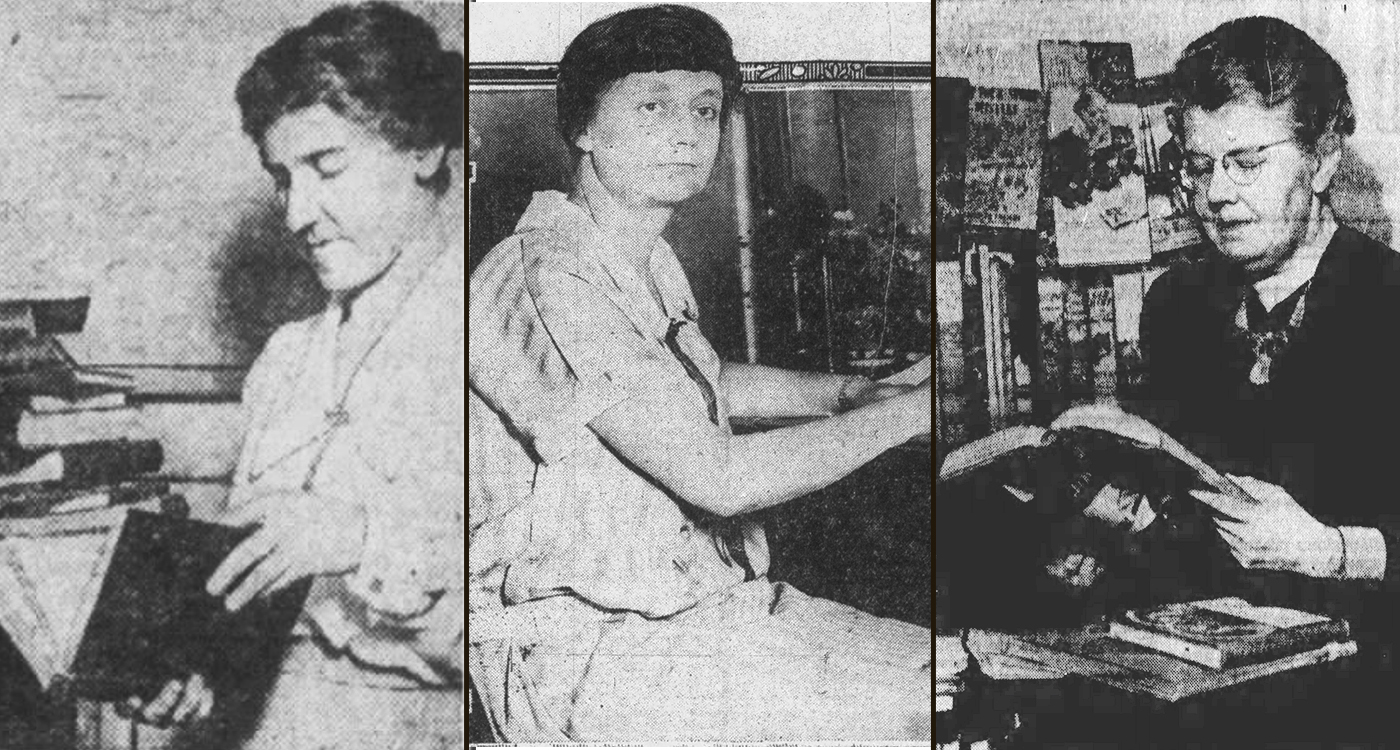
"Miss Gladys Caldwell examining a consignment of music books which arrived at the public library yesterday. They were the first purchase out of the $1400 fund raised by a concert given by the Philharmonic Orchestra. It is planned to have one of the best musical libraries in the country in Los Angeles just as soon as it is possible to do so." Daily News, November 10, 1923.
In 1922, Gladys Caldwell (1919 graduate of the Los Angeles Public Library Training School) was hired as the head of the Art and Music Department. During her first year a benefit concert was put on at the Philharmonic Auditorium with proceeds going to boost the library's music collection. Caldwell told the Los Angeles Evening Post Record that the library "has a splendid working collection of scores and record books, but it is in great need of circulating copies." (Today the Los Angeles Public Library has the Orchestral Scores Collection, containing 2000+ scores that can be lent to orchestras in Southern California.) Art was also on display at the library, some even on loan from Earl Stendahl's gallery or private collectors. [The Art and Music Department was started in 1914 on the ninth floor of the Metropolitan Building. One feature was a soundproof room with a piano for patrons to try out the sheet music collection. It was also used as a study room.]

The Art Department in the Metropolitan Building location was on the ninth floor. The "Study Club Room" was also the Music Room and featured a piano for patron's to use. The building layout is from the May/June 1914 issue of Library Books Monthly Bulletin of the Los Angeles Public Library available through the California Index on Tessa.

In July 1925, Gladys Caldwell (or G.C. as she was known to staff apparently) was part of the Los Angeles Public Library staff attending the American Library Association conference in Seattle. (Gladys Case was also there, representing the library's children's department). Caldwell gave an address at the conference on how her department worked with motion picture studios. It was so well received that the National Association of Motion Picture Producers and Distributors (today known as MPAA) asked ALA to reprint it in booklet form, as an aid to their studio research departments. Caldwell was also chairperson of the ALA Motion Picture and Visual Aid Round Table.


After moving to the new building (the current Central Library) the Art & Music Dept held more concerts and music lectures, and a new soundproof piano room proved popular. [One apocryphal 1928 story from Lee Shippey was that one of the "hermits" (Peter perhaps?) enjoyed using the piano room. One day he told Caldwell that he wanted to attend a Hollywood Bowl concert, and she was able to make it happen. He was so appreciative he brought her cushions he'd purloined from the Bowl as a present for her.] Over the years Caldwell was active in many cultural and professional organizations including the California Federation of Music Clubs and the Art Reference Round Table of the American Library Association.
As chairperson of the survey committee of Pro-Musica's Los Angeles chapter, Caldwell and her staff compiled a list of compositions of major music programs in Los Angeles since 1923. The intention of the survey was to help with future music programming, the ability to study programs already given, and to help discover neglected composers or schools. The results indicated Wagner was very, very popular in Los Angeles from 1923-1927.
As a young pianist, Caldwell studied with Elizabeth Sprague Coolidge. They remained friendly and Caldwell was able to attend a series of free concerts Coolidge funded across Europe in 1931. Caldwell wrote about the trip, including stops in Moscow, Budapest, Frankfurt, Paris, Asolo, Rome, and Naples, for the Los Angeles Times. Sprague also financed concerts at the library and a collaboration between the library and the Greek Theater, which was attended by as many as 4000 people.
For years, Caldwell had asked to update the library with equipment and materials that would bring it up to speed with the ability to listen to phonographs. (Note: the Pomona Public Library had a popular program playing records for the public since 1920.) In 1938 it was noted in the Los Angeles Daily News that a woman named Alice Bluett donated money to the library for a phonograph and approximately 400 "carefully and liberally chosen" records. Another collection of records was donated by Mabel Brousseau in the name of her sister Kate. Combined, the collection made Los Angeles Public Library one of the best "listening libraries" in the country. A local music company, Birkel-Richardson, helped the library fine tune the operation through their expertise on amplification. This allowed the library to expand their musical programming with recorded music alongside lectures and live concerts. The crowds for the noon-day record listening events often overflowed out onto the patio and into the library's garden. Soon the Los Angeles Times and Carnegie Corporation also donated records to the collection. Sadly, these record listening events became intermittent in 1943 due to lack of staff.

Gladys Caldwell promoting the popular record listening events at Central Library. Daily News, January 1, 1941
[Interesting tidbit-- In 1939, Caldwell was asked to join a City Council sponsored committee to work on picking an official song for the city. One councilmember warned against picking swing music. He said the song should be dignified and have pep "but no jitterbug stuff." Another committee member (an Assemblyman who was also a musician) vetoed "futuristic music, which ordinary mortals can't understand." I haven't found what became of the committee or a song chosen by them.]
Miss Caldwell represented the library all over town, including club meetings, local concerts, music salons, and Hollywood Bowl events. She retired in 1948 and passed away at the age of 94 in 1979. Gladys Caldwell is buried at the Santa Barbara Cemetery.

Engagement photo of Gladys Blake Spear, St. Louis Post Dispatch, April 27, 1913
St. Louis native Gladys Blake Spear, daughter of the St. Louis Edible Nut Company president George B. Spear, attended the Carnegie Library of Pittsburgh Training School for Children's Librarians from 1910-11 before accepting a children's librarian position at the Barr Branch of the St. Louis Public Library. She married Rufus William Case in 1913 which, according to the local papers, made her the fourteenth assistant librarian to get married and resign from the library. She soon returned to the St. Louis Public Library and became the assistant to the supervisor of the Children's Department from 1915-1917. Sadly her husband was a victim of the 1918 flu epidemic, dying of pneumonia at the age of 32. She resigned from the St. Louis Public Library in December 1918. At the time she was working in the Traveling Libraries Department (aka Bookmobile).

Although the librarian is not named, I'm fairly certain that this is Gladys Case sitting at a desk at the Barr Branch of the St. Louis Public Library in 1912, St. Louis Public Library Archives
Gladys Case joined the Los Angeles Public Library as a children's librarian in 1919 and a year later became head of the Juvenile Department under Jasmine Britton, the head of the Department of Work with Children. Case taught courses pertaining to working with children at the Los Angeles Public Library Training School (and later at USC). She was also put in charge of storytelling at the 1920 annual Hans Christian Andersen Festival in Elysian Park. The library sent thirty-five "crackajack story-tellers" to the festival. Each was seated under a numbered tree and each told a different story. Children were invited to choose the type of tale they wanted to hear (pirate story, fairy tale, folk tale, soldier story, etc) and go to the appropriate tree/storyteller.
Case spoke to groups about children's literature and National Book Week was celebrated at the library every year. In 1921, she noted that the number of motion picture producers using the children's room had increased. They were looking for children's books to adapt to films specifically for that audience. (Similarly to Gladys Caldwell, Mrs. Case was dedicated to the idea of creating motion pictures specifically for children and spoke on the topic for years, even after she was no longer leading the Department of Work with Children.) When Britton's successor as head of the Department of Work with Children resigned in 1922, Case was promoted to that position. (News Notes of California Libraries said Case gave "capable, wide awake service.") In addition to storytimes, book weeks, and Hans Christian Andersen festivals the library participated in Boys Week. For one week a year boys would go to various locations throughout the week -- factories, banks, stadiums, courtrooms etc-- and learn what grown up life was like for the people who worked there. For the 1925 Boys Week, Gladys Case expected 40,000 boys to visit the libraries across the city and planned to survey the genre preferences of junior high boys, and ask high schoolers to outline standards for contemporary magazine editing. In the evening the libraries offered the boys "musical, literary, and dramatic programs."

Gladys Case at her desk, Los Angeles Evening Record, June 30, 1925
In 1926, Gladys Case, with the help of LAPL children's librarians, published the pamphlet Public Library Service to Elementary Schools, which described the collaboration between the public and school library. Jasmine Britton, Case's former boss, was in charge of the Los Angeles school system's libraries at the time and their collaboration worked well. The pamphlet offered lesson outlines and the wish that every student in second grade (and up) would visit the public library with their teacher and receive instruction on using the library. These "appreciation hours" should include the introduction of a topic (e.g. what you might see at the beach), a short story, and then set the kids loose in the library to read whatever they want for the rest of the hour. This illustrates to them the joy of reading for pleasure. The librarian is also called upon to visit the children in their classroom and to be familiar with their curriculum. "Cooperation between teacher and librarian makes possible the development of the highest sense of appreciation of reading-- that which translates dreams into action, and sets one's face in the direction of the high road."

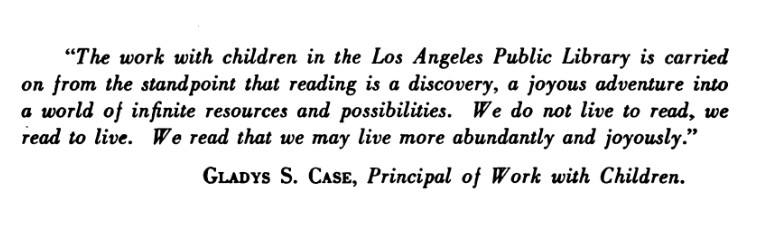
Public Library Service to Elementary School pamphlet (1926), including opening quote by Gladys Case (via Hathitrust)
Gladys Case was in charge of the Department of Work with Children during the exciting opening of the new Central Library in 1926. Case and the head of the Children's Department, Rosemary Livsey, planned a spectacular opening of the Ivanhoe Room complete with a pied piper. The Ivanhoe Room featured ten scenes from Sir Walter Scott's Ivanhoe that were painted by Julian Garnsey and A.W. Parsons. More about the room, which now part of the International Languages Department, can be found here.

Frontispiece of Public Library Service to Elementary School pamphlet featuring photo of new Ivanhoe Room

The wedding scene from Ivanhoe, featured in the Hand Book of the Central Building Los Angeles Public Library (1926) via Hathitrust
Case resigned in December 1926 to marry Dr. Glen G. Miller (dentist). According to the 1940 census she was working as a secretary at a religious reading room. Dr. Miller passed away in 1946 and Gladys Blake Spear Case Miller returned to the Los Angeles Public Library where she was in charge of the information desk in the library's rotunda. It's unclear how long she remained at the Los Angeles Public Library. She passed away in 1979 at the age of 90.
Gladys Ann English (January 14, 1886-December 5, 1956)

Gladys English, faculty photo from 1925 Piedmont (CA) High School yearbook
Gladys English became the head of the Work with Children Department in August 1930. By then she'd had a full gamut of the range of librarianship. She was an assistant at the Oakland Library in 1915-1916 and graduated from the Western Reserve University School of Library Science in Cleveland in 1917. She was assistant children's librarian at East Cleveland Library in 1917-1918. English then moved to the Fresno Public Library where she was head of the School Department from 1918-1921. From there she was a junior assistant at Berkeley Public Library 1921-1922, head of circulation at Mills College Library 1922-1923, county librarian at Tuolumne County Library 1923-1924, librarian at Piedmont High School Library 1924-1926, librarian with ALA 1926-1927, librarian at Piedmont High School Library again 1927-1930. And then on to the Los Angeles Public Library.

Los Angeles Times, November 8, 1942
Her job as Principal Librarian of Work with Children meant that she supervised 48 children's librarians. During her first year in the position they completed a survey of 142 public schools served by branch libraries. Jasmine Britton, formerly with the Los Angeles Public Library, was in charge of all Los Angeles school libraries so there was close collaboration between the library and schools. Miss English spoke frequently in front of groups all over the city (and even county) about the best books for children, and at library sponsored book fairs with authors present. Branch libraries hosted open houses inviting parents to peruse displays of children's books, and National Book Week was always met with special programs. On more than one occasion, children from the city's schools dressed up as literary characters, often introduced by Miss English. She championed children's books by California writers including Monica Shannon (formerly with LAPL) and W.W. Robinson (who wrote children's books with his wife). She also participated in committee work including as a member of the Newbery award committee.
The Depression hampered children using the library in several ways including the reticence of parents to incur fines (in some cases the library allowed kids to work off their fines), a reduction of the book budget, and the closing of library branches on Saturday afternoon as a cost-cutting measure. In 1933-34, English became the chairperson of the California Library Association's Work with Children committee and in 1938 was elected to a similar position for the American Library Association. In the late 1930s Miss English was performing children's stories on the radio, cutting them off at the exciting parts to entice kids to head to the library to find out how the story progressed. She also wrote book reviews for various newspapers including the Daily News and The Tidings.

Daily News, October 15, 1945
Miss English supervised the Victory Book campaign in Los Angeles. The public was encouraged to donate books that would be sent to servicemen around the world. Folks could drop off their books at Standard Oil stations, Safeway stores, or any city or county library. [Fun tidbit: Althea Warren was in charge of the Victory Book campaign nationwide. For twelve days she had actors and literary folks, including Gypsy Rose Lee, speaking about the Victory Book campaign on the steps of the New York Public Library.] The war had a definite impact on the number of children who visited the library. Apparently children in Los Angeles were instructed by their teachers to go straight home after school.

News Pilot (San Pedro, CA), October 6, 1949
In 1931, Gladys English and Althea Warren rented an apartment together in Palos Verdes and drove to work together each day. Their friend, Martha Boaz, described them as "very different in personality and in their reactions to situations but each needed the opposite qualities of the other: they were devoted and loyal to each other." They later moved to a home Warren bought in Eagle Rock. The women lived together from 1931 until 1947 when Gladys and her sister moved into a small home not far from Althea Warren.
Miss English retired from LAPL in 1950. She then became the librarian at the Immaculate Heart High School Library and taught a course on children's literature at Immaculate Heart College. She worked there until she passed away in December 1956. The Gladys English Memorial Collection was soon established by the California Library Association and exhibits of the art (original illustrations from children's books) toured the state. Althea Warren was instrumental in building the memorial collection, sending hundreds of letters to authors, artists, illustrators, and publishers. The collection is now at the Los Angeles Public Library.
Gladys Marion Crowe worked as a children's librarian at Central Library as far back as 1914. She received her training at the Los Angeles Public Library Training School in the Fall 1913-Spring 1914 class. Miss Crowe later went on to branch work and for the last 17 years of her life she was the head librarian at the Junipero Serra Branch (formerly known as the Moneta Branch). Sadly, she allegedly died from a tetanus infection caused by a cat scratch in April 1950.

Library staff of Cahuenga Branch Library (1917); shown are: Gladys Glenn, Fannie Dorman, 1st Librarian and Carrie Ziegler. Los Angeles Public Library Institutional Collection
In 1919, Gladys Glenn (a 1916 graduate of the LAPL Training School) and Gladys Case were both added as children's librarians at Central, which must have caused some confusion as Gladys Crowe was working as a children's librarian there as well (she became Miss Case's principal attendant when Case promoted). [Miss Glenn soon bounced over to the Registration and Loan Department, ostensibly to be the only Gladys in the department. She later worked at the Hollywood Branch and at Cahuenga.]. Gladys McKee was a page/messenger clerk at Central as far back as 1916. Gladys Huls was in charge of one of the playground sub-branches in 1919 and by 1921 was a sr. attendant in the sociology department (she later became a dance instructor specializing in tap but also proficient in interpretative dance, ballet, the tango and the carioca apparently).
All in all, the Los Angeles Public Library had a lively bunch of Gladyses over the years!