Saturday, October 31, 2020

Phantom Libraries for Halloween! (Sounds spookier than "former libraries")

I'm fascinated by phantom libraries, as well as libraries that were formerly something else (e.g. The Santa Paula Library used to be a Safeway?). Former library locations can still be found all over Southern California. Some were built expressly as libraries while others were just a temporary location, or storefront. How did these library spaces get their phantom status-- aka why did the library move?  Oftentimes the library simply outgrew their space. I've included only a few phantoms here, most of which fit that reason, although the Moneta/Junipero Serra Branch was damaged in the 1987 Whittier Narrows earthquake. Do you have a favorite phantom library?

Canoga Park Branch, Los Angeles Public Library
The Canoga Park Branch opened July 6, 1959 with some special features-- air-conditioning, high windows that permitted a "maximum amount of shelving space" and an amazing zig-zag roof. The library was located at 7260 Owensmouth and designed by Ralph Bowerman and Charles Hobson (who also designed the 1962 Woodland Hills Branch with its parabolic roof). The building now houses an early learning center.


Moneta/Junipero Serra Branch, Los Angeles Public Library
The Moneta Branch formally opened September 28, 1923 at 4255 S. Olive Street. The Mediterannean Revival building was designed by architect Lyman Farwell who also was responsible for the Magic Castle (aka Rollin B. Lane house). In 1934, the branch was renamed Junipero Serra. Unfortunately the 1987 Whittier Narrows earthquake damaged the building and the library was forced to relocate.


Hyde Park Branch, Los Angeles Public Library
Opened at 6527 Crenshaw on August 1, 1960, this mid-century gem was designed by Kegley, Westphall and Arbogast (who also did the Van Nuys Branch). Information on this location can be found in the California Index at tessa.lapl.org, and includes building specs (branch had 10 parking spaces, seating for 24 adults and 16 children) branch histories (no AC until 1966-67) and an invitation to the opening. The location is vacant and the new Hyde Park Miriam Matthews Branch was opened at Florence and Van Ness in December 2004.


Helen Hunt Jackson Branch, Los Angeles Public Library
This Spanish-Mediterranean Revival branch was designed by C.E. Noerenberg, who also designed the Jefferson, Figueroa and the 1923 Edendale branches. The branch, named after "Ramona" author Helen Hunt Jackson, opened November 3, 1925 at 2330 Naomi Avenue. The building was auctioned off in 1963 and is now occupied by a church.


Figueroa Branch, Los Angeles Public Library
Opened in 1923, the Figueroa Branch sat on the northwest corner of 80th Street and Figueroa. The English cottage design was by C.E. Nuremberg (who also designed the Helen Hunt Jackson, Jefferson and the 1923 Edendale branches). There are a few Figueroa Branch items in the California Index (via tessa.lapl.org), including a 1936 newspaper article about summer reading (tracked by race horse figures!). The building has been remodeled several times over the years and has been the home of the New Zion Baptist Church since the mid-1960s.


Sunday, July 5, 2020

Hollywood (CA) Branch: The Little Library That Grew and Grew


The history of the Hollywood Branch library starts out like many others (e.g. founded by local women's club) but through the years its locale, patrons and staff have shaped it. As Hollywood grew from a small community to become a tourist destination, first because of artist Paul de Longpre and then as a movie studio mecca, the library kept pace--splitting not once, but twice--literally and figuratively. So far I've completed Part One (1905-1922) and Part Two (1923-1940) of its history, more to come...


Friday, January 25, 2019

Eleanor Brodie Jones: Hollywood Librarian 1908-1926 [Abridged]

Holly Leaves, July 1922

According to her obituary, Eleanor Brodie Jones taught English Literature at Lincoln High School in Nebraska before moving to Hollywood. It is cliché to say she was able to put that knowledge to work, but that is exactly what she did. As head librarian at the Hollywood Public Library from 1908 to 1926 she also encouraged artists, championed the newly emerging movie industry, provided unique educational opportunities for her community, and initiated the Hollywood Studio Club.

Following her move to Southern California from Nebraska, Jones attended the Training School at the Los Angeles Public Library (LAPL). These training classes, which began in 1888, prepared women for library work. Applicants were expected to have a high school education, be between the ages of eighteen and thirty (unless they already had library experience), be physically fit, and pass an entrance exam consisting of lengthy questions dealing with literature, art, history and general knowledge.  In 1907 Jones was one of six women who passed (her score was 75.5) one of the "severest library examinations" (Los Angeles Herald, October 22, 1907). City Librarian Charles Fletcher Lummis proclaimed in his annual report that Harvard freshman would find the exam difficult to pass. That same annual report for the library contains a sample of questions from the entrance exam for the Training School. I have yet to find examples of the questions on the final exam but based on the entrance exam it was not an easy test. Following completion of the training courses Mrs. Jones took a position as the head librarian at the Hollywood Public Library.  

1907 Los Angeles Public Library Training Class Entrance Exam (55 questions total)

Hollywood had its own independent library before being annexed into the city of Los Angeles. In 1905 a group of women formed the Hollywood Woman's Club expressly to establish a public library. Andrew Carnegie funded most of the project and the rest came from local businessmen. The Woman's Club established a library through this arrangement in 1906, turning it over to an appointed Hollywood Library Board the following year. Mrs. Jones, hired in 1908 to lead the library, retained her position after the annexation in 1910 and the branch became part of the Los Angeles Public Library.

Postcard of Hollywood Public Library circa 1910 (Author's Collection)

Eleanor Brodie Jones was the library's biggest booster, she was also one of the biggest boosters of Hollywood, both as a community and as an industry. One early outreach endeavor of Jones' had the Hollywood Library supply books to the famous Hotel Hollywood for guests to read. In addition to a selection of books available in the lobby, guests could request books from the branch or Central Library be delivered to the hotel for their enjoyment.

Library Journal, November, 1915

Art and artists were celebrated in early 20th century Hollywood. In fact, when Jones began at the Hollywood Library in 1908, the most visited tourist destination was artist Paul de Longpre's studio and gardens at the corner of Hollywood and Cahuenga. Art was important to the community and Jones championed artists, inviting many to show their work in the library's art gallery. The Hollywood Art Association regularly held exhibits and meetings at the Hollywood Public Library.
Tourists visiting artist Paul de Longre's studio at Hollywood Blvd and Cahuenga in 1905.
(Security National Bank Collection, Los Angeles Public Library Photo Collection)

As movie studios began populating Hollywood, the earliest was founded by the Horsley brothers in 1911, Mrs. Jones was there to extol the graces of the library. Scenarists (aka screenwriters) visited the Hollywood Library regularly to do research. Jones and her coworkers helped actors prepare for historical roles by providing period appropriate materials. The services of the library proved so useful that movie studios began opening their own libraries on their lots, employing librarians who would be solely at their disposal. 

Young women who flocked to Hollywood in hopes of making it in motion pictures frequently met to read plays at the library. Mrs. Jones, concerned about the living conditions these young women experienced, set the wheels in motion for what would become the Hollywood Studio Club. She rallied the support of the wives of movie industry notables, including Mrs. Jesse Lasky and Mrs. William C. DeMille, for the project. According to the Los Angeles Times she persuaded the Hollywood Board of Trade and several film companies to advance the money for the first year's rent on the Studio Club. Hollywood historian Bruce Torrence mentions Mrs. Jones' involvement and has great photos of the first Studio Club at 6129 Carlos.

Holly Leaves, July 5, 1919 - First location of the Hollywood Studio Club at 6129 Carlos Avenue

Eleanor Brodie Jones was a clubwoman as well as a librarian and news of her club work showed up in the pages of magazines such as Clubwoman, California Southland, and The Women Citizen. She was an active member of the Woman's Club, the organization that initially established the first public library in Hollywood.  An early proponent of the Hollywood Bowl, she signed the petition as a representative of the Hollywood Public Library alongside representatives from the Ebell, the Friday Morning Club, USC, and the Woman's Club. Mrs. Jones also served in a leadership capacity of the Los Angeles Drama League in 1916 and hosted several luncheons honoring visiting thespians and poets. 

Clubwoman, October 1920

Mrs. Jones was no stranger to throwing parties, hosting receptions, and organizing unique learning opportunities. For example, when World War I ended she was on the committee to host a party for all enlisted men in Hollywood, according to the Los Angeles Times (May 21, 1919), "whether they got an invitation or not." The party began with a parade from the library to the high school, followed by hors d'oeurve at the Woman's Club house, and a dance at the Hotel Hollywood. In 1919 she was on the University Extension board (UC) and organized lecture courses, open to the public for a fee and including university credit, that covered artistic topics and were held at the Woman's Club. 

Los Angeles Times,
October 12, 1917


The Hollywood film colony loved Eleanor Brodie Jones for her dedication over the years. The studios and scenarists, along with the young women who benefited from the Studio Club, rallied around Jones when it was threatened that political influence was underway to "place Mrs. Jones in some out-of-the-way library." according to an October 12, 1917 Los Angeles Times article.  What caused the uproar? The annual reports for the library don't say and I am still researching other sources. 

It was also in 1917 that Jones wrote in a report on branch activities about her satisfaction as a librarian.

"In surveying the year, the thing that stands out as of greatest value is the human touch of the library with the community. Through the clubs and the local papers and book talks in the Library the constant aim is to keep the community in the current of ideas and to know each individual and make him feel the Library is a friendly place and not merely a public institution."

The news of Jones' bad luck or ill-health made it into the pages of the local press due to her popularity. Luckily, several of these sources are digitized. For example, the September 1919 Hollywood weekly magazine Holly Leaves reported that she fell down the library stairs on the eve of a vacation back east, and spent time at the Glendale Sanitarium recuperating. According to a digitized history of the Hollywood branch I learned she fell again in 1924 and broke her arm. Digging deeper I found a 1925 blurb in News Notes of California Libraries that announced Jones missed four months of work due to a spider bite on her tear duct. Each of these illnesses and injuries forced her to miss work for a few months. 
Holly Leaves, September 6, 1919

Several hours spent reading Holly Leaves at the Frances Howard Goldwyn branch led to another sad discovery. Mrs. Jones and her son Tom fled their burning home on December 31, 1920. They only had the clothes on their back and were able to save their dog and automobile. She lost all possessions including antiques, a valuable book collection, and rare Navajo rugs collected by her late husband.

Holly Leaves, January 1, 1920

Mrs. Jones returned to the Hollywood branch again and again after recuperating from her latest spell of bad luck, until late 1926 when she transferred down to Central Library to manage the Lecture and Exhibit Room. By that point she had missed months and months of work over the previous seven years due to illness. The Library Board of Commissioners, citing Mrs. Jones' ill-health, felt it was best to replace her as head librarian at Hollywood, which by then was the largest and busiest branch in the system. In November 1926 the Hollywood community hosted a very large dinner and program for Mrs. Jones to show their appreciation.  She worked briefly at Central before she had to retire due to her health. Sadly, Eleanor Brodie Jones passed away September 19, 1929, at the age of 57 and is buried at Hollywood Forever Cemetery in an unmarked wall crypt.

Holly Leaves, May 28, 1921

Eleanor Brodie Jones is just one of many, many librarians who make a difference in their patron's lives and deserve thanks. She was part of the Hollywood community and the Los Angeles Public Library benefited from her growth with the city, and the industry, of Hollywood. From the early days when artist Paul de Longpre's studio and rose garden were the main reasons people visited Hollywood through the early 1920s when floodgates of film hopefuls flocked to Hollywood and Vine, Mrs. Jones was a fixture. She should be more widely known.

Sources:

Board of Library Commissioners Reports (many thanks to librarian Sheryn Morris for her help with these), Circular of Information (Training School of the Los Angeles Public Library), Clubwoman, Holly Leaves (thanks to Jeff Sargent, the Senior Librarian at the Frances Howard Goldwyn Hollywood Regional Library, for letting me peruse these on short notice), Library Journal, Los Angeles Herald (historical articles are available via Access Newspapers with your LAPL library card), Los Angeles Public Library Annual Reports (available throughTessa's California Index), and the Los Angeles Times (historical articles are available via ProQuest with your LAPL library card).

Thursday, December 22, 2016

San Fernando Valley Season's Greetings in 1962

These photos from the Valley Times (part of the Los Angeles Public Library Photo Collection) captured the holiday spirit of the San Fernando Valley in 1962. Street decorations were plentiful throughout the Valley, and the aerospace influence and individual creativity are pretty impressive!
Photograph caption dated December 18, 1962 reads, "Debbie Richardson, 5, Van Nuys, gets a thrilling ride hanging onto Rudolph's antlers as Santa steadies his mechanized sleigh and 'team' for a visit to the Salvation Army's Van Nuys Corps, 14933 Victory Blvd., Van Nuys, from 7 to 9 p.m. Wednesday. Robert Richardson, 8, Van Nuys, waits for his turn. The sleigh will be loaded with candy treats for all the children who visit Santa. For those who want to help Santa, containers will be available for donations of cans of food for needy families." (Photo from the Los Angeles Public Library Photo Collection)

Photograph article dated December 16, 1962 partially reads, "When you talk Christmas around a certain Miller household in Van Nuys, you'd better use capital letters. And underline it...'The decorations reflect years and years of the family enjoying themselves together,' Mrs. Miller said. 'We're a tradition-bound family. It's something we've had since my sons and daughter were children and now I couldn't do away with it if I tried. That's the strength of a family,' she said. 'It holds families together.'" (Photo from the Los Angeles Public Library Photo Collection)

Photograph caption dated December 17, 1962 reads, "Studio City features bells on Ventura Blvd. at Vantage Ave." Visible signs include Sinclair Paints, Valley Lighting and Lamps, Doll House, marquee reading The Three Ks Dancing, Picture Framing, a bowling alley, Standard gas station, Chevron gas station, Riding and Play Clothes, Valley Gem Shop, a record store. (Photo from the Los Angeles Public Library Photo Collection)
Photograph caption dated December 17, 1962 reads, "Northridge sends greetings from Reseda Blvd. and Roscoe Blvd." Visible signs include Citizens National Bank, Mick's Grill, a Mexican restaurant, Stores for Lease, Childrens Sample Land, an Optician, Cleaners, Beauty Salon, a real estate office, Nittin, Wood Pit Barbecue, a car wash. (Photo from the Los Angeles Public Library Photo Collection)
Photograph caption dated December 17, 1962 reads, "Van Nuys offers lots of angels." Visible signs include Pep Boys, Shoe repair, Zenith, Dr. Scholl's, TV, Coffee Shop, Shop E-Z Mattress, Surplus, Credit Dentist - Dr. Rossin (?), Drugs, a Schlitz billboard, another Credit Dentist. (Photo from the Los Angeles Public Library Photo Collection)
Photograph caption dated December 17, 1962 reads, "Sunland-Tujunga, East from Foothill Blvd." Legible signs include Meats-Deli-Fish-Poultry, cocktails, Pet Shop, saddlery, Richfield, Trailer Park, Rooms-Apartments, Florist, Mutual Savings, and another florist. (Photo from the Los Angeles Public Library Photo Collection)
Photograph caption dated December 18, 1962 reads, "Magnolia Park: east on Magnolia Blvd. from Hollywood Way." Visible signs include Bender (?) Furniture, Men's Shoes, Penny's Flowers, Park (?) Jewelers, Security First National Bank, insurance, Supreme Radio, California movie theater, Thrifty drugs, Cockneys, Beauty supply, Cozy Cove, Typewriters, Beneficial Finance Co.-Loans, Verners (?) Shoes, Hi-Shop, corset, upholstering, restaurant, travel, Flying A Service, liquor, car wash, another liquor store.(Photo from the Los Angeles Public Library Photo Collection)
Photograph caption dated December 18, 1962 reads, "San Fernando: Decorations fill sky along San Fernando Rd." Visible signs include Town House cocktails, Liquor - park in rear, Western Union, Bill's Valley Tavern cocktails, Seaboard, Hardware-Power Tools, Goodyear Tires. (Photo from the Los Angeles Public Library Photo Collection)
Photograph caption dated December 22, 1962 reads, "Reseda: looking west along Sherman Way from Lindley Ave to Etiwanda Ave." Visible signs include Metropolitan Savings, Pep Boys. In the island is an "I Want YOU for U.S. Army" poster, created by James Flagg. (Photo from the Los Angeles Public Library Photo Collection)

Photograph caption dated December 20, 1962 reads, "Santa and reindeer race across roof at 5813 Lubao Ave., Woodland Hills." (Photo from the Los Angeles Public Library Photo Collection)
Photograph caption dated December 23, 1962 reads, "Santa rides rocket at 638 Magnolia Blvd., Burbank." (Photo from the Los Angeles Public Library Photo Collection)
Photograph caption dated December 22, 1962 reads, "Canoga Park: lights sparkle along Sherman Way business district." Visible signs include Hardware, Style Shop, 5 and 10, Jewelers, Green Thumb Hardware Garden Center, United California Bank, Pharmacy, Safeway, Bank of America. (Photo from the Los Angeles Public Library Photo Collection)

Photograph caption dated December 18, 1962 reads, "Tarzana: between Mecca and Wilbur Ave. on Ventura Blvd." Visible signs include Custom Interiors Furniture, Paul White Carnaham Realty Co., Avalon Motel, pet shop, Citizens National Bank, Fox. (Photo from the Los Angeles Public Library Photo Collection)

Photograph caption dated December 17, 1962 reads, "Sherman Oaks, west on Ventura at Van Nuys." Visible signs include Free Parking 4 Doors West, Tailors, Custom Furniture, Cleaners, Clark Jewelers, Repair, Bakery, Sherman Oaks Savings and Loan, Hiskoff's, tailor, dept store, Mark's Valley Drugs, market, liquor. (Photo from the Los Angeles Public Library Photo Collection)


Photograph caption dated December 23, 1962 reads, "Santa rides rocket at 638 Magnolia Blvd., Burbank." (Photo from the Los Angeles Public Library Photo Collection)

Tuesday, July 21, 2015

Circa 1940 - How do you use the Los Angeles Public Library?

Do you remember how you learned to use the library?  Perhaps through a school field trip or a parent took you and explained the ropes.  For some people they go years between visits to a public library and have to re-learn that nonfiction is broken done (generally) by the Dewey decimal system and that fiction is shelved alphabetically by the author’s last name.  But there is more to know to get the fullest benefit of what a public library has to offer.
With that in mind, City Librarian Althea Warren compiled the Los Angeles Public Library Handbook of Central Library Collections in 1940.  The handbook served as gentle instruction on potentially daunting tasks such as obtaining a library card, finding a book in the catalog, and locating the item on the shelves.  One thing that I felt was lacking in the handbook was a reassurance that reference librarians do not bite and are there to help guide you in your search for information.  Each of these things, how to get a card, find what you are looking for, ask for help, are still obstacles for some patrons today.
There are interesting facts revealed throughout the handbook.  For example, having a phone book/city directory listing in your name, along with a photo ID, was the quickest way to get a library card in 1940.  The oldest holding specifically mentioned in the handbook is a 1535 edition of Ptolemy.  
Originally priced at 25 cents, the 60-page handbook is a fascinating glimpse into the workings of a pre-WWII Central Library.  With only two floors open to the public they packed a lot of knowledge into a small area, and each specialized department is still recognizable today.   Compare maps of the 1940 Central Library to the renovated library today.


In 1940, the first floor featured Teachers and Children’s books, Genealogy, International languages, Philosophy and Religion, Periodicals, Newspapers, the bindery, and the lecture and exhibits room.  (Today it holds the Popular library, Circulation desks, Library Store, Security, Meeting Rooms, and cafe.)


The second floor in 1940 featured History, Sociology, Science and Industry, Fiction, Literature, Art, Music, the Map room, and the California Room.  The Circulation counters were located in the Rotunda that features Dean Cornwell’s murals.  All that remains of the card catalog can be seen there as well.  (Today its the Children's section, Teen'scape and the Getty Gallery.)

Each specialized department is given several pages in the handbook.  Specific Department Librarians summarize their department beginning with where it is located within the Central Library.  Additional information given includes the (then) current total of books in each Dewey decimal subclass, certain items in the collection are highlighted, the most-used reference materials in the department are listed, and oftentimes needs or goals of the department are communicated.
Want to know more? You can read Los Angeles Public Library Handbook of Central Library Collections for yourself at the Central Library!  (Call number: REF 027.47949 L881-8 1940)

Sunday, March 1, 2015

Los Angeles Library Tour - Altadena Main Library


How has this library gone under our radar for so many years? We've been through Altadena. We've had friends who live in Altadena. And yet, we've never visited either of their two libraries. 
We finally made up for lost visits a couple of weekends ago. The library is almost hidden in the woodsy foothills at the corner of Mariposa and Santa Rosa Avenue (aka Christmas Tree Lane). Walking inside, a sense of familiarity and comfort takes over. The library, designed by Boyd Georgi & Associates (from Altadena) was opened in 1967.  There have been some modernizations, but for the most part, it feels like 1967 in the best possible way
There are beautiful sculptures at both entryways.  Wood relief panels surround the desks. 


The children's room has a colorful mural.

The feature we loved the most there is a sunken reading area in the center of the library, complete with palm tree planter. (We hear they are looking for landscapers to propose a new design to fill the planters.
 
We were astounded at some of the books and cds in their collection. Thankfully the library has held onto the amazing collection they've built over the years instead of excessively weeding it of its charm.  They have incredible art and photography books, lots of jazz cds, and local history books we haven't seen at any other library. We checked out a boxful on our first visit. They had Glenn Bray's The Blighted Eye! I can't find that anywhere!
This library is a hidden gem in the forest, absolutely worth a visit.

Tuesday, August 19, 2014

Los Angeles Library Tour- Grant R. Brimhall Library (aka Thousand Oaks' main library)

Close your eyes and imagine the library Buck Rogers visits. Its likely that the Grant R. Brimhall Library in Thousand Oaks might be a close proximity. I would even describe my initial impression of the library as 'breathtaking.'


A quick zip around the fiction and non-fiction section revealed a nice selection and the library definitely has little touches that show they have the customer in mind.

Things like:

*A sorting shelf at the end of each row that indicates the newly returned books that are waiting to be reshelved but available to be checked out.

* Signage is plentiful and informative but not overwhelming.

* Fliers for events are strategically placed throughout the library (and again, not overwhelming).

* The placement of the public computer stations allows a greater amount of room between you and the neighboring computer.

* They have an honor system coffee cart and vending machines with bottled water.

* Their library foundation runs a gift shop.

* There are lots of spaces to sit and get lost in a book.

*It is quiet without being oppressively quiet.

Aside from the architecture, there are several things that make this library unique. They have a huge children's section (easily larger than any other Southern California library I've been to) which has a large fish tank at its entrance (similar to the Cerritos library), is well-maintained, and has an incredible selection of puppets that are available to check out. PUPPETS!


If at all possible plan your visit to coincide with the hours that the Special Collections room is open (currently Tuesday and Wednesday 1 to 5pm, and Thursday 5 to 8pm). Besides being a remarkable repository of local history, the Special Collections librarian, Jeannette Berard, can show you the library's piece de resistance- the American Radio Archive. Established in 1984 to preserve and document the history of radio. What started as a collection of radio history, it has grown to include all of broadcasting. They have sound recordings, scripts, dvds, and a whole lot of books on every aspect of broadcasting. Its very easy to while away a few hours at this library.

Thursday, May 29, 2014

Los Angeles Library Tour - Inglewood Public Library + UPDATE

The day started off innocently enough, we were heading towards Inglewood to see Helen Lundeberg's WPA mural "The History of Transportation." I only had a vague idea of where it was located and we did our usual 'lets hit up anything that looks interesting along the way.' After the obligatory stop at Randy's donuts we headed east on Manchester and passed by a very cool intaglio piece snaking up the side of a building. We circled the block to get a closer view and discovered signs pointing us to a public library.

Highlights included:
The largest(circa 1972)poured-in-place intaglio sculpture known in the world by artist Tom Van Sant.


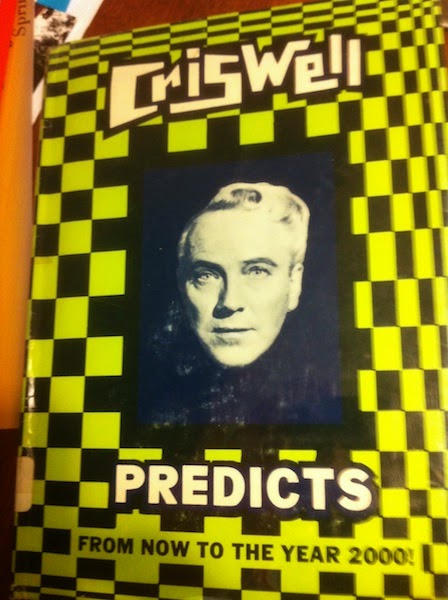
The ability to check out Criswell Predicts From Now To the Year 2000 (1968), in which the Amazing Criswell prognosticates computers ('education and newspapers which will be available through your TV') and same-sex marriage (though he did think it would happen in England by 1972). Its been a fun read.

They have artwork available for circulation!

Inglewood's former Library Director John W.Perkins (1962 to ?)must have been a hell of a guy. The collection developed by the library during his tenure is amazing. There are so many volumes here that I haven't seen in other systems. We'll be sure to check out their online catalog before our next visit, similar to LAPL's Central Branch they have more material in a depository downstairs, but are happy to retrieve the items.

The parking lot was metered and unfortunately we didn't have enough change in the car for more than an hour of browsing but the quick tour we made, and the new library card we acquired, ensures that we'll be back.

*** UPDATE ***

The above blog post has been sitting in my drafts file for a year (our original visit was May 24, 2013). Aside from the fact a year flies by in the blink of an eye, here is what else I learned within that year.

Inglewood's former Library Director John W. Perkins was indeed a hell of a guy who amassed an amazing collection, AND wrote or commissioned many books on library service and administration (take a look at them on Worldcat). I was able to get most of these books through interlibrary loan and found them interesting and forward thinking -- they even published Library of Congress Classification Adapted for Children's Library Materials! Another fascinating read associated with the Inglewood Library was a report documenting their decision to break free of the Los Angeles County Library system and become a municipal library. Perkins was hired on following the split and did a remarkable job of building a research library in Inglewood.

Sadly the collection has undergone heavy weeding within the past year, so get down there and check it out NOW!