Thursday, March 31, 2022

Libraries in Southern California Named After Women

Women's History Month seems like a fitting time to look at some of the local libraries named after women. In addition to the libraries listed below, the 7 1/2 Los Angeles Public Library branches named after women can be found here. More photos of all of these libraries can be found on Instagram.

AC Bilbrew Library


The AC Bilbrew branch of the Los Angeles County Library was dedicated in 1974. The architect, Vincent J. Proby, also designed the beautiful, colorful glass feature in the lobby.

I can't say enough good things about this library. The staff is friendly, the collection is unique, and don't miss that cloth lion in the children's section (near the patio). The Black Resource Center and the art (part of the Golden State Mutual Life Insurance art collection) are incredible--worth the drive from all over Southern California.

Madame AC Bilbrew was a radio personality, musician, composer and more. She deserves much more recognition, as does her namesake library.


The Brewitt Neighborhood Library, a branch of the Long Beach Public Library, was named after former Long Beach City Librarian Theodora R. Brewitt in 1955. There is an excellent branch history (and coloring book page!) online at: longbeach.gov/library/news/brewitt-anniversary/ Before her career at Long Beach (she started with LBPL in 1921, and was City Librarian from 1922 to 1950), Theodora Brewitt headed the Los Angeles Public Library training class, and worked at the Alhambra Public Library. She was an early adopter of adding films and vinyl records to libraries.

The brick and steel library, designed by Francis J. Heusel, features large windows that let in a lot of natural light. Newspaper articles at the time of its opening described the large front windows, likening the library's ambiance to that of an expensive store (I'm guessing the beached mahogany furniture helped that assessment).

The staff is incredibly helpful.

Ruth Bach Neighborhood Library
The Ruth Bach Branch of the Long Beach Public Library was named in honor of Long Beach's first female councilmember. Mrs. Bach was community oriented and active in many clubs and committees before she died in 1956 at the age of 50. [Interesting tidbit: Her son, Richard Bach, wrote the bestsellers Jonathan Livingston Seagull, and Illusions: The Adventures of a Reluctant Messiah.] The Long Beach Public Library has created a history of the Bach Branch, including a coloring page. https://www.longbeach.gov/library/news/bach-feature/

The library, designed by Louis Shoall Miller, opened in February 1958 and photos taken at the time look like they're straight out of Sunset magazine. When it was built, it was the largest branch in the Long Beach system. The library is still a mid-century beauty with large windows/walls of glass. I love the park setting, and when I was there, the place was buzzing with kids finding books to take home. Don't miss their Long Beach local history section, lots of unique items.


Mayme Dear was a library volunteer, Library Council member, and president of the Gardena Friends of the Library. Her interest in libraries was lifelong. She worked in her high school library growing up in Ohio, and after graduation worked at the Youngstown and Mahoning County Library (the building is still there). According to a family history, her intention was to major in library science but Youngstown University didn't offer that degree--she settled on a liberal arts degree instead. Following her death in 1990, community members asked that the library be named in her honor. This Los Angeles County Library was renamed the Gardena Mayme Dear Library in May 1992. Family members, including her eldest son Don Dear (former mayor of Gardena), were in attendance. A portrait of Mayme Dear by artist Betty Donahue hangs on a wall at the library.

Two more works of art grace the library. A 1964 mosaic by Livio Napoliltani, offering an interpretation of the evolution of man's culture, graces the front of the library. A beautiful and serene garden designed by Japanese landscape designer Paul Takuma Tono, was built by Gardena Valley Gardener's Association in 1964. The award-winning garden can be enjoyed on three sides from within the library. The staff is very helpful and the collection contained materials I haven't found at other libraries.
Mayme Dear [February 1990] as the first patron to use the new automated system. 
Image from library's scrapbook, photographer unknown.
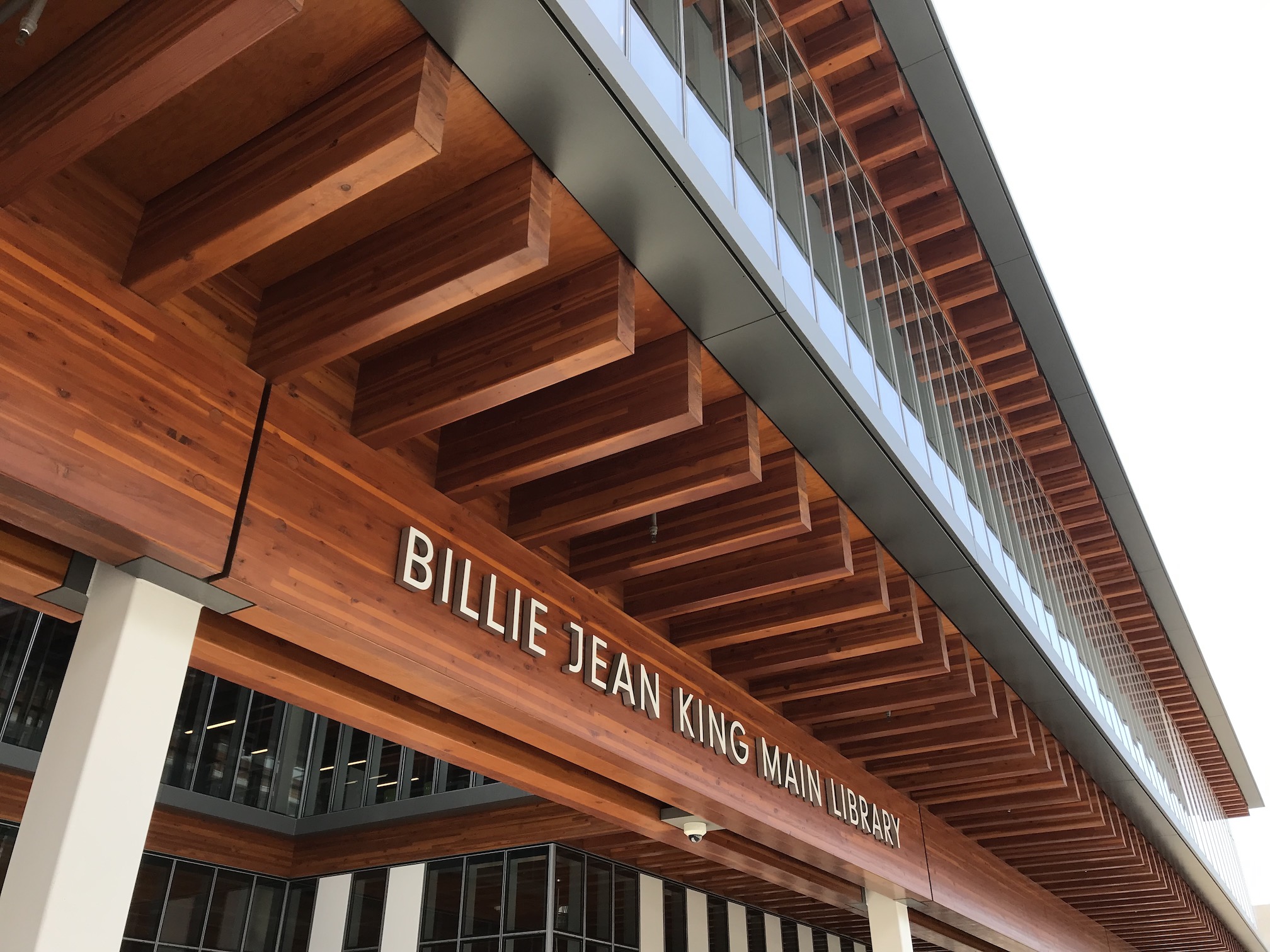

The Long Beach Public Library named their new main location after tennis legend Billie Jean King, who was born and raised in Long Beach (and learned to play tennis on it's public tennis courts). The longtime advocate for gender equality is also the author of nine books, available at her namesake library.

The large glass, steel and wood structure was dedicated September 21, 2019. The library definitely feels huge when you walk in, thanks to high ceilings, light colors, and minimal bookcases on the first floor near the staircase. Don't miss the nautical themed children's section and The Studio (an all-ages makerspace with 3D printers, a Cricut, sewing machine, letterpress and more). There is a lot to explore, including the Special Collections available to look at by appointment in the Miller Room. The restored Suzanne Miller WPA murals, although high up on the wall, are pretty impressive.


The Michelle Obama Neighborhood Library, a branch of the Long Beach Public Library, was dedicated September 16, 2010. The library has sustainable features (including LEED and community garden) and I really appreciated the displays celebrating the businesses/buildings that were replaced by the library, as well as the history of the library (originally known as the North Library). You can't miss the refurbished spire from the Atlantic Theatre (1942-2014).


In 2019, the Claremont Library was renamed in honor of Helen Renwick, a local philanthropist who, in 1919, donated the land the library sits on. The current building, designed by architects Laurence Hutner Jr. and Richard Appel, was dedicated in 1975.

Ms. Renwick was the widow of a Davenport (IA) lumber mill owner who moved to Claremont following his death. In addition to donating the land for the library, she also funded buildings and donated land to Pomona College. Did I mention she also wrote poetry?

This branch has a great book collection, a robust Friends group and a shiny, modern public restroom. Shops, restaurants, a museum, and a Rhino Records store are all within walking distance.

There are more local libraries named after women that I hope to visit soon. Do you have a favorite one to share?

Sunday, October 31, 2021

Celebrating Phantom Libraries for Halloween! 2021 Edition

Libraries move for a variety of reasons-- the library outgrew the space, moved from a rented space to their own library-owned building, the building sustained earthquake damage, or were the victim of budget constraints.

It's October, a perfect time to celebrate these phantom libraries (click here to see last year's roundup). First up is a former Los Angeles County Public Library branch.

Phantom Library: Duarte Branch (1955-1966)

After years in a small cottage on Santo Domingo Avenue, the Duarte Branch moved into rented quarters at 1430 E. Huntington Drive. It was formally dedicated March 20, 1955.

The library was popular immediately, dramatically increasing their cardholders and doubling their circulation in the first year. They also held art exhibits, thanks in part to artist Alberta Babcock who served as Art Chairman for the branch. It wasn't long before newspaper articles that mentioned the library's success also began to mention that more room for growth was required.

By 1964, a site and architects were chosen for a new library funded by the city of Duarte that would be leased back to the county. The new Duarte library, which opened on Buena Vista in February 1966, replaced this location and is still in use. Today, the slightly altered phantom library at 1430 E. Huntington Dr. serves as the headquarters for UA Local 345 Landscape & Irrigation.

[Historical photo: County of Los Angeles Public Library History]


Phantom Library: Wilmington Branch (1927-1988)

This Wilmington Branch of the Los Angeles Public Library formally opened on March 18, 1927. The Pasadena-based firm Marston, Van Pelt & Maybury were the architects of the Spanish Colonial Revival library located at 309 W. Opp. [They also designed the Hill Branch of Pasadena Public Library.]

According to a 1926 Press-Telegram (Long Beach) article, the library design contained space for a historical museum. Relics of local history were displayed at the opening including a silk quilt made by Mrs. Phineas Banning and an 1872 photo of the San Pedro waterfront. It is fitting that today the location serves as the home of the Wilmington Historical Society.

The library outgrew its building long before it was replaced by the current Wilmington Branch at 1300 N. Avalon Blvd in 1988.

[Historic photo: Los Angeles Public Library Legacy Collection]

Phantom Library: Henry Adams Branch (Part I:1927-1952)

The Henry Adams Branch of the Los Angeles Public Library opened November 18, 1927 at 3534 Larga Avenue, on the side of the newly constructed Citizen's Trust and Savings Bank at the corner of Glendale Blvd and Larga Avenue. It's beginnings sound plucky--the new library was short-staffed, and their book supply and furniture were borrowed from other branches (Harbor City and Echo Park respectively).

The library provided information and entertainment to the neighborhood, especially during the Great Depression. Unfortunately budget cuts in 1940, compounded by the fact that the library had to pay rent for the space, meant a reduction in hours (down to three days a week open). Henry Adams was one of six branches in rented quarters that faced closure in order to save funds. The community rallied together to fight for the library to remain open.

Nonetheless the library was later evicted from this location in November 1952 and replaced by a meat market/delicatessen (it is now a paint store). The books and furniture were sent to the Helen Hunt Jackson Branch for storage while the library searched for their next location (stay tuned for Part 2). Read about the history of (what is now known as) Atwater Village Branch at https://www.lapl.org/branches/atwater-village/history

[Historical photo: Security National Bank Collection/Los Angeles Public Library]


Phantom Library: Edendale Branch (1923-1959)


The Edendale Branch of the Los Angeles Public Library opened at 2030 Glendale Blvd in 1923. Designed by architect C.E. Noerenberg, the branch was used by the artists and designers who lived in the surrounding area. Over time traffic increased, there was high staff turnover at the branch, and the hours of operation were decreased. This location of the Edendale Branch closed May 22, 1959.

The neighborhood changed over the years and no longer has as many neighbors as it once did. Once quaint and inviting, the building now sits right next to the Glendale off-ramp of the 2 Freeway and traffic whizzes by very quickly. It is difficult to get a decent photo from the sidewalk but you get an idea of what it used to look like.


Phantom Library: Echo Park Branch (1908- 1925)

The Echo Park Library started as a deposit station inside the Echo Park Clubhouse, which sat on a playground (known locally as Playground No. 2) on Bellevue Avenue. Within the first year, Echo Park had the highest attendance and circulation of playgrounds with deposit stations. During the week the station was open two afternoons, one evening and "all day" on Saturdays. The clubhouse was used by a variety of clubs and organizations so the books were kept in locked bookshelves when library attendants were not present. By the early 1920s a new clubhouse building was being designed and the library took the opportunity to build a branch of their own.

In 1925, the library moved to a rented storefront at 1811 Temple and then to the "new" Echo Park Branch at 520 Glendale Blvd in 1928. After the Sylmar earthquake damaged that structure, the library temporarily took up residence at 515 N. Lavetta Terrace. The current location at 1410 W. Temple opened in 1997.

What happened to the Echo Park clubhouse? Distressed by the plan to demolish the "old" clubhouse for replacement in the 1920s, a Los Angeles clubwoman spoke up and offered a piece of land she owned as a permanent location. The clubhouse was moved from its location on Bellevue to 1004 Echo Park Avenue where it still sits today (seen here via Google Street View).

[Historical photo: Los Angeles Public Library Legacy Collection]

Phantom Library: Watts Branch (1960-1996)

This Watts Branch of the Los Angeles Public LIbrary, located at 1501 East 103rd Street, was opened on July 18, 1960. It was designed by Earl G. Kaltenbach, the architect for several tracts in Orange County, including Rossmoor and Yorba Linda Estates.

At the time of opening, the 3600-sq ft, brick-clad Mid-Century Modern building held 14,000 books, 3.5 staff members and had seating capacity for 19 adults and 16 children. An entrance wall was covered with imported white marble mosaic tiles that extended from the outside into the branch itself.

Circulation in the branch doubled in their first year and eventually the library outgrew the building. A new branch opened in June 1996 around the corner on Compton Avenue.

It's now a Ghost of a Phantom Library-- the building was recently demolished to make way for Kaiser Permanente. Via Google Street View we are able to see images of the building prior to demolition.

[Historical photo: Dick Whittington/Los Angeles Public Library Institutional Collection]


Phantom Library: Tujunga Library/Station (1932-1952)

Tujunga received library service from Los Angeles County prior to the annexation of Tujunga into the city of Los Angeles. Upon annexation, County Librarian Helen Vogleson cancelled the lease at 125 W. El Centro, where the library rented space at $32.50 per month. The Los Angeles Library took over library service, furnishing a supply of books along with tables and chairs for the emptied County branch, and opened July 15, 1932. [El Centro was renamed Valmont along the way and the Tujunga Station address became 7212 Valmont St]

In 1940, there was some talk of moving the Edendale Branch building from 2030 Glendale Blvd over to the grounds of the Tujunga City Hall in order to provide a new library building for Tujunga. The idea was not acted upon and the station was closed April 18, 1952. The book collection was sent to the new Sunland-Tujunga Branch Library that opened July 28, 1952.

This location is now a Ghost of a Phantom Library. The building that housed the Tujunga Station was torn down within the past few months. After all these years standing I was unable to photograph it before it was demolished. Reviewing the building via Google Street Views (seen here) shows the stone work matched up with the photo available at tessa.lapl.org.

[Historic photo: Los Angeles Public Library Institutional Collection]


Phantom Library: Ascot Branch (1939-2005)

This location of the Ascot Branch of the Los Angeles Public Library at 256 W. 70th Street was formally dedicated November 13, 1939. The steel and concrete library, designed by architect Henry F. Withey, was a Public Works Administration (PWA) project. [Withey also designed the John Muir Branch]

The library faced challenges over the years. For instance, the construction of the Harbor Freeway cut the library off from patrons living west of the freeway. The lack of a parking lot at the library became an issue as the population in the area increased. Shelf space also became an issue. A larger branch with a parking lot became a reality in 2005 with the new Ascot Branch at 120 W. Florence.


Thursday, September 2, 2021

Los Angeles Public Library Moved to City Hall in 1889


On September 2, 1889, the Los Angeles Public Library opened its doors on the third floor of the newly constructed City Hall on Broadway between Second and Third Street. According to the 1889 Annual Report, the library's first formal annual report which coincided with Tessa Kelso's first year as City Librarian, the new location was described as "well-lighted and airy" space with library fixtures constructed of the "best possible materials." Others on the library staff included Jessie Gavitt as First Attendant (Ms. Gavitt had been the fourth City Librarian, 1884-1889) and attendants Adelaide (Addie) Hasse, Estella Haines, Lena B. Fenner and Mrs. E.A. Wellman.
    
General Plan of the Los Angeles Public Library, City Hall location

A long article in the Los Angeles Daily Herald on September 1 prepared Angelenos, explaining all they needed to know to meet their new library. They were invited to freely use its space Monday through Saturday from 9am to 9:30pm, and the reading room was open on Sundays 1pm to 6pm. If a patron wanted to check books out for home use they needed a membership which cost one dollar quarterly (approximately $100 for a year, adjusted for inflation). Los Angeles teachers were allowed to use the library free of charge, courtesy the library's new Board of Directors (five gentlemen of "taste and judgement" appointed by Mayor Henry T. Hazard). However, only library staff was allowed in the stacks, which meant patrons had to know what they wanted and were unable to browse the collection.


The library, which previously occupied rooms in the Downey Block at Temple and Spring, was closed for two months as it prepared for its new location. According to the annual report the books were "cleaned, repaired, counted, classified (Dewey), numbered, bookplates inserted, placed into position, shelf catalogued in duplicate, and a card catalogue begun." Coinciding with the move to a new location, the Board of Directors put out a call in local newspapers for the creation of a bookplate design. Their criteria was that the only lettering on the design should say "Los Angeles Public Library" but there was no set shape or design beyond that. After looking over 46 submissions, San Francisco-based lithography firm H.S. Crocker and Co. was awarded $10 for their winning design. These were the bookplates inserted into the circulating (green angel) and non-circulating (red angel) books. There were 6356 books in the library upon opening in September 1889 (approximately half of them, including government documents, were deemed uninteresting to the general public) with another 4771 added to the collection by December of the same year. Other collections being built included photographs of works of art and architecture, as well as musical scores.


The library could be accessed by stairs or elevator. Initially the elevator only operated from 9am to 5pm daily, which meant library users had to use the stairs after 5. To remedy the situation the library helped pay elevator operating costs. [According to the 1890 annual report the library paid $480 (approximately $13,000 today) that first year.] Indexers greeted library users that arrived by stairs or elevator. Indexers, which looked like wooden boxes with a glass top, helped patrons discover materials the library had available and order them at the appropriate counter (e.g. fiction, non-fiction, periodical). The user would use a hand-crank to browse through cards that listed the materials in the library collection. Larry T. Nix's Library History Buff blog explains the Rudolph Indexer, of the type used in the early years at the City Hall location.


The largest rooms of the library were a general reading room and the non-fiction "book room." This reading room was 75x29 feet and held six reading tables and racks for seventy newspapers. The book room (aka closed stacks) measured 70x50 feet and contained twenty oak bookshelves capable of holding 800 books. Books were retrieved by staff and delivered to a large oak counter. It's interesting to note the number of overhead lamps and the lack of bookends-- used to keep the books upright and prevent damage.


The "Librarian's Room" was 13x15 feet and held union catalogs, book lists, publisher's catalogs. Rare books were also kept in the librarian's office. The library's Board of Directors had a separate office under the tower. The office was described as a small apartment (18x18 feet) where the Board of Directors and librarian met weekly around a giant oak table and surrounded by government and patent documents on the shelves lining the walls.


A 26x29 feet "light and airy apartment, carpeted and with every convenience" served as the Ladies Reading Room. This room, located between the large reading room and Librarian's Room and Director's Room, was also made available to teachers or "any club who wishes to make use of it for discussion." This room later served as a lecture hall also. The library outgrew City Hall and moved to the second floor of the Homer Laughlin Building (aka Grand Central Market building) in 1906; followed by the Hamburger Building in 1908; the Metropolitan Building in 1914 and finally, the Central Library in 1926.

Sources: Los Angeles Public Library Institutional Collection, Annual Reports of the Los Angeles Public Library, Los Angeles Daily Herald, Los Angeles Times.


Friday, June 11, 2021

Pomona Carnegie Library Opened June 11, 1903


Thanks to a $15,000 donation from Andrew Carnegie and $2100 from local contributors, the new Pomona Library opened its doors on June 11, 1903 at the corner of Center and Main (380 N. Main). At least six architecture firms submitted plans and Franklin Pierce Burnham and William John Bliesner Jr. were chosen to design the building. [Burnham also designed Carnegie libraries in Corona and Oxnard]


Librarian Mabel E. Prentiss and her assistants May Topliff and Mrs. S.B. Minler were the only library staff at the time of the opening. The move took eleven working days for books to be removed from the old location, fumigated, and placed in the new space. The first person through the doors on opening day was Mrs. S.J.L Loop, whose late husband Revered C.F. Loop gifted the library with their marble statue of the Goddess Pomona in 1889, which can still be seen on display in the current library. Librarians from all over Southern California were in attendance for opening day as well, including librarians from Los Angeles, Pasadena, San Bernardino, Riverside and Covina.


Pomona Public Library [ca. 1906]. California State Library

The library had its beginnings in 1887 as an organization started by clubwomen known as the Pomona Public Library and Floral Association. The group held flower shows to raise funds for the library. A close look at some of these photos show flowers and plants throughout the new Carnegie Library. The library was expanded in 1912/13 plus a WPA renovation in 1939. The Carnegie library closed its doors in 1965 when it was replaced by the current Welton Becket-designed building.


Thursday, June 3, 2021

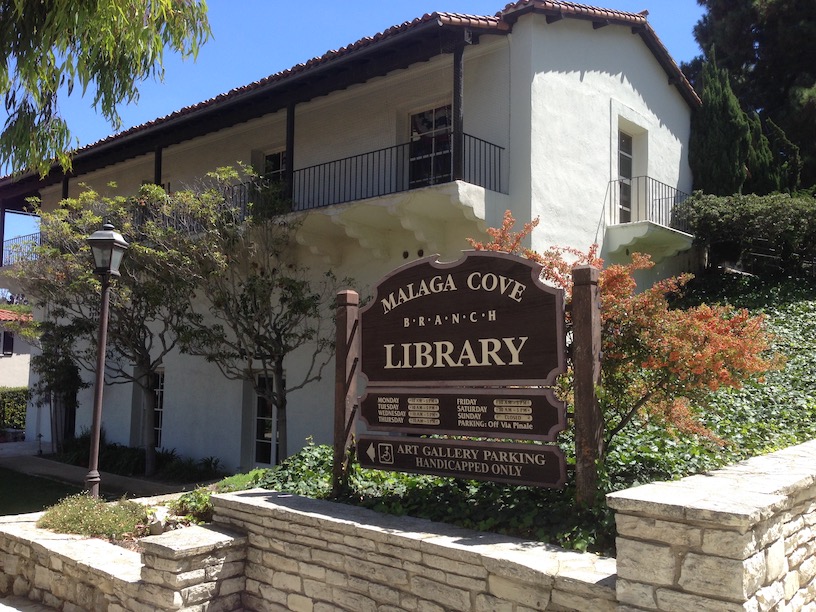
Palos Verdes Public Library (aka Malaga Cove Branch) Opened in 1930

Malaga Cove Branch Library, Palos Verdes Library District [Photo by author]

June 3, 1930 - The Palos Verdes Public Library, then a branch of the Los Angeles County Public Library, opened its doors to the public with an exhibit in its art gallery. The purchase prize exhibit featured the works of sixty artists on loan from the Stendahl, Wilshire, Dalzell Hatfield and Klevits galleries. Myron Hunt, who designed the library, also served on the art jury for the exhibit. Attendees included attorney and banker Orra E. Monnette (longtime Los Angeles Public Library Board Member), banker and journalist Frank A. Vanderlip (major landowner in Palos Verdes), singer and clubwoman Estelle Heartt Dreyfuss, soprano Amelita Galli-Curci and librarian Agnes McMillan. 

                    Plaque of the Palos Verdes Library opening [Photo by author]

A more formal dedication of the library was held June 27, 1930 to coincide with the ALA convention taking place in Los Angeles. According to the December 1956 staff newsletter from the Los Angeles County Public Library, the branch broke away from the County system in June 1946 and became an independent library. It is now known as the Malaga Cove Branch of the Palos Verdes Library District. Sam Gnerre tells more of the library's story at http://blogs.dailybreeze.com/history/2017/06/17/malaga-cove-library-opened-in-1930-still-going-strong-in-palos-verdes-estates/

Visit the Malaga Cove Branch during their book sales in order to visit the basement and get a glimpse of the dumbwaiter and vault.


Basement vault in the Malaga Cove Branch Library, Palos Verdes Library District [Photo by author]

Tuesday, June 1, 2021

Los Angeles Public Library Opens in the Metropolitan Building

Charging, receiving and registration desk at the Los Angeles Public Library in the Metropolitan Building, [n.d], Los Angeles Public Library Institutional Collection

On June 1, 1914 the Los Angeles Public Library opened in the Metropolitan Building at 5th and Broadway. Accessible only by an elevator, the library rented the seventh, eighth and ninth floors. In addition to subject departments the library featured a music room and spaces to display art. 

Art display at the Los Angeles Public Library in the Metropolitan Building, [1926], 
Los Angeles Public Library Institutional Collection


Music room at the Los Angeles Public Library in the Metropolitan Building, [1926], 
Los Angeles Public Library Institutional Collection

Crowd at the Los Angeles Public Library in the Metropolitan Building, [1926], 
Los Angeles Public Library Institutional Collection

By the early 1920s the location was overcrowded and City Librarian Everett R. Perry enlisted library worker Monica Shannon (graduate of the library's 1915 Training Class) to head their Publicity Department and spearhead a campaign for a new library building. The campaign included advertisements on the side of streetcars and in movie theaters, display windows in downtown department stores, informative talks by library staff and prominent Angelenos, as well as branch-level publicity in the form of bookmarks slipped into checked out items. The campaign was a success and in 1926 the library moved out of the Metropolitan Building and into the beautiful Central Library. Visit https://www.lapl.org/collections-resources/blogs/lapl/monica-shannon-advocate-libraries-leprechauns-and-luckless to learn more about Ms. Shannon and the library's campaigns to free itself from rented spaces.