Thursday, April 29, 2021

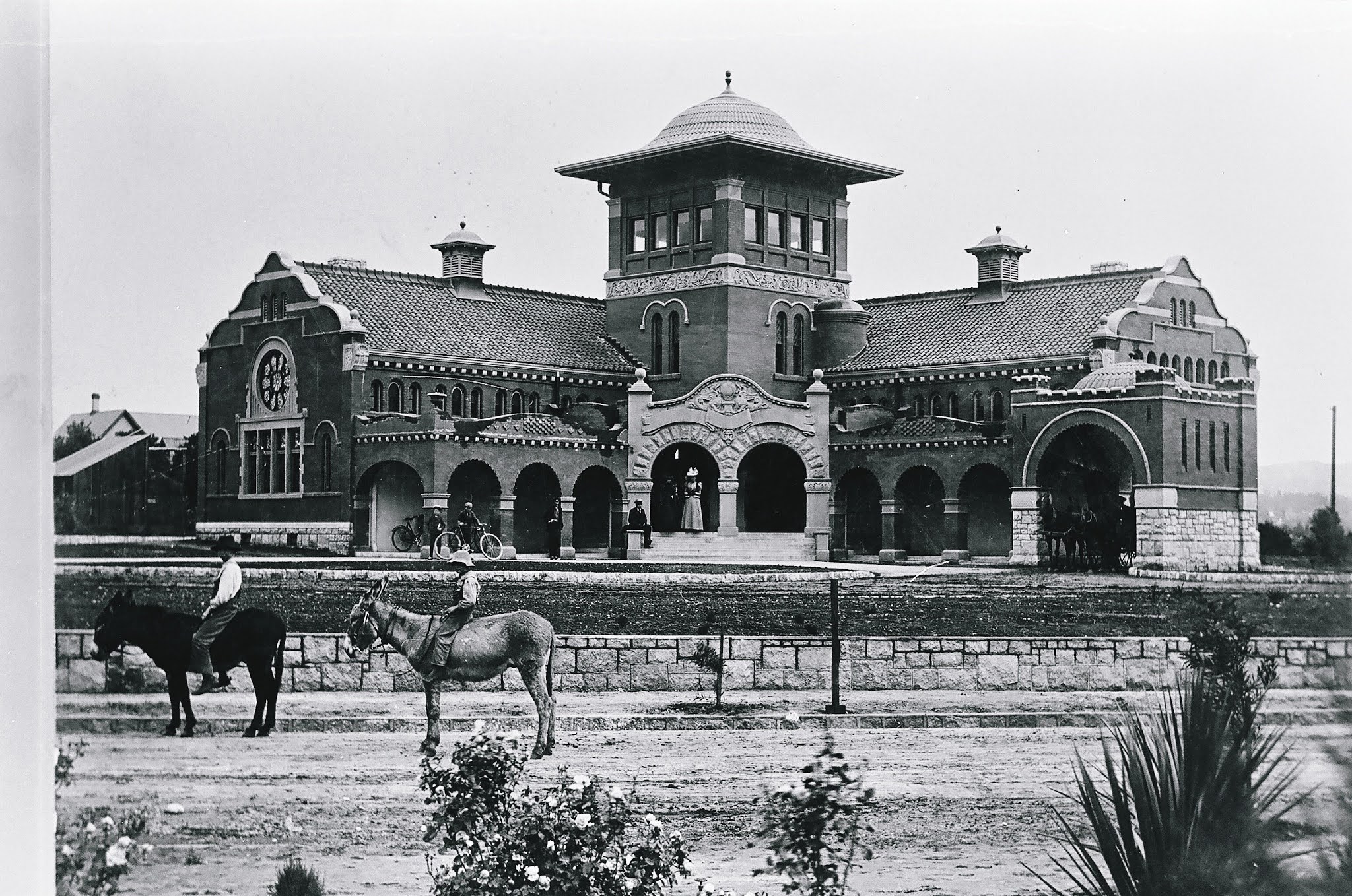
A.K. Smiley Public Library Dedicated April 29, 1898

Early image of the A.K. Smiley Public Library [n.d]

The beautiful A.K. Smiley Public Library was dedicated on April 29, 1898. The library's website features the story of the library's founding thanks to the philanthropy of the prosperous Smiley twin brothers, Alfred and Albert. Speakers at the library's dedication included the Mayor (William Fowler), various clergymen and E.G. Judson, a co-founder of Redlands. The Los Angeles Herald noted, "the rooms are admirably arranged for light, ventilation and comfort" and eighty-three electric lamps provided further illumination. According to the National Register of Historic Places Nomination Form, the library was designed in the Moorish Revival Style by Redlands architect T.R. Griffith. [Fun side note- each of the library's wings had full basements, also constructed of hand-cut stone and cement.] Antoinette Humphreys was the librarian in Redlands from 1895-1910.

Alfred & Albert Smiley

Interestingly, the (Los Angeles) Evening Express noted that Los Angeles City Librarian Harriet Child Wadleigh, First Attendant Daisy Austin and William F. Burbank, a member of the Los Angeles Public Library's Board of Directors were also dedication attendees. The article mentioned that Redland's library had adopted the open stacks model, which had been implemented at LAPL by Wadleigh. Just one year later, Burbank would be the one board member who did not want Ms Wadleigh to resign.

Early postcard of A.K. Smiley Public Library published by M(ichael) Rieder
 
The beautiful library was the subject of many souvenir postcards. Additionally, impressive photos can be found from the library itself, as well as California Historical Society via USC Digital Library and the Redlands Area Historical Society. A nifty souvenir plate featuring the library is in the collection of the Museum of Redlands. The library is open and welcoming patrons but if you can't make it be sure to check out the informative virtual 360 degree tour of the library.


Wednesday, April 7, 2021

A Look at the Mobilibraries of the Los Angeles County Library

For National Bookmobile Day (newly dubbed National Library Outreach Day), here is a quick look at the Mobilibraries of the Los Angeles County Library (aka County of Los Angeles Public Library). For a history of the Los Angeles Public Library Traveling Branches click here.

From September 17 through October 3, 1948, Los Angeles County Fairgoers in Pomona got their first glimpse of the Mobilibrary. It was parked right there in front of the race track grandstand on the main thoroughfare and was visited by approximately 1000 people according to the library's staff newsletter. Mobilibrary Unit No. 1 was the first bookmobile of the Los Angeles County Library system and two librarians were there from 2pm to 8pm daily to explain how it would be used. The bookmobile, or mobile unit as the library called it, had been on display for one day, September 9, at the Antelope Valley Fair. Its purpose was to provide service to smaller communities in the Antelope Valley, not including Lancaster and Palmdale which already had library branches.


Los Angeles County Supervisor Roger W. Jessup takes a look at Los Angeles County Library's Mobile Unit No. 1. Note the shelving which was custom built in the "Library Shop" (aka Property and Transportation Division). Photo dated February 8, 1949. Herald Examiner Collection/Los Angeles Public Library Photo Collection

Monday, February 7, 1949 marked the beginning of the Mobilibrary's weekly 600-mile tours of the Antelope Valley. The bookmobile initially carried 1000 books on custom-made shelves. The shelving was the work of James E. Cobb, head of the Library's Property and Transportation Division, and his crew. By mid-1949, a duplicate of Mobilibrary Unit No. 1, this one owned by the Los Angeles County Sheriff's Department, was also pressed into service. This bookmobile, which had one library-appointed driver and librarian, provided service to road camps and forestry camps in remote areas of the county. This bookmobile, later dubbed Wayside Mobilibrary, was housed at Wayside Honor Rancho (now known as Peter J. Pitchess Detention Center).

The end of 1949 saw the start of Mobilibrary Unit No. 2 service to western Los Angeles County--Malibu, Topanga, Cornell, Agoura and Calabasas, which was not already served by branch libraries. The bookmobile--which also provided reference, reader's advisory and accepted requests for any book in the system-- stopped at schools, fire stations, post offices and beaches. Some stops were as short as fifteen minutes while others stretched to three hours. Scheduled stops were adjusted over time based on popularity and use. However, the wear and tear of servicing such large areas weekly necessitated the request for new Mobiliibraries in 1950.

The Los Angeles County Library Antelope Valley Mobilibrary in 1951.
County of Los Angeles Public Library History Collection

Although owned by the Sheriff's Department, an agreement was reached in December 1951 to allow the Wayside Mobilibrary to service the lower Mint Canyon and Bouquet Canyon communities on a trial basis for two days a week. This supplemented the service of the Newhall Branch Library and the Library Stations in the Saugus and Sulphur Spring schools. This route also served Castaic and Val Verde. According to The Newhall Signal at the time, County Librarian John D. Henderson hoped the service would be useful to the communities and that a future budget would allow the library to purchase a bookmobile dedicated to full-time library service in the area. Children made use of the bookmobile but adult circulation was low. Unfortunately the resignation of the librarian in May 1952 meant the temporary suspension of service to this area.

Responding to the rapid growth of the Lakewood area, Mobilibrary Unit No. 4 was added in late 1951 to supplement the small branch library there. The bookmobile was initially housed at Bellflower and would become known as the Los Cerritos Mobilibrary. It was later housed in Norwalk. One fun tidbit about that bookmobile--when the driver/attendant retired after almost sixteen years of working with the Mobilibrary, his younger brother took over as driver/attendant.

One of the Los Angeles County Library's Mobilibraries parked at an unknown location, circa 1954.
County of Los Angeles Public Library History Collection

A new Mobilibrary, with capacity for 1700 books, was added in March 1956. It was broken in by subbing for a Lancaster bookmobile which was in the shop. It would soon make its way to the Malibu route and the (old) Malibu Mobilibrary will take over for the Puente Valley Mobilibrary, which will become a spare bookmobile. Additional mobile units on some routes and replacement vehicles for the bookmobile service were often noted in the staff newsletters. Three $9,000 bookmobiles were ordered in 1957 and arrived in 1958. This meant a second Mobilibrary (aka Newhall Mobilibrary) could be added to the Antelope Valley, which allowed for longer stops, and better service, for the outlying areas. The late 1950s summer schedules of the Newhall Mobilibrary even included brief stops to homes! Second mobilibraries were also added to the East San Gabriel Valley Region (housed at the West Covina Branch) and Malibu.

The East San Gabriel Valley Region Mobilibrary as seen in the Monrovia Daily News-Post, 
October 17, 1958

Housing the bookmobile was a challenge. The first Malibu Mobilibrary is a prime example. It was originally housed in the garage of the driver. When the driver retired it briefly lived at the Las Flores Canyon Fire Station before a Beverly Hills real estate developer allowed the bookmobile to park at a property he had on Malibu Road. That accommodation lasted six months and the Malibu Mobilibrary was moved to the Lennox Branch. One perk to this arrangement was the quicker filling of requests and more varied rotation of stock than at previous housing locations.

At the height of Mobilibrary service there were seven community Mobilibraries and one institutional (Wayside) Mobilibrary that, along with branches, served an area of 3315 square miles (per 1959-60 Los Angeles County Library Annual Report). That is a pretty impressive feat. Today, the Antelope Valley and Santa Clarita (aka Newhall) bookmobiles continue to provide service. A third, known as the Urban Outreach bookmobile, serves areas of Whittier, East Los Angeles, La Puente, Rowland Heights and Azusa. A tip of the hat to Los Angeles County Library bookmobile drivers and librarians, past and present!

Sources: LA County Library staff newsletters and various newspapers including Monrovia Daily News-Post, The Signal (Santa Clarita, CA), The Van Nuys News, Los Angeles Times, The East Whittier Review and more.

Thursday, April 1, 2021

Frank Lloyd Wright's Hollyhock House as a branch of the Los Angeles Public Library?


(Modified) Aline Barnsdall in front of Hollyhock House [n.d] Security Pacific National Bank Collection, Los Angeles Public Library Photo Collection

No joke. It almost happened. Heiress Aline Barnsdall (b. April 1, 1882) gifted part (various sources list the size between 6-10 acres) of Olive Hill, including the Frank Lloyd Wright-designed Barnsdall House (aka Hollyhocks), to the city of Los Angeles. The house was to be used as a public library and the rest of the land would become a municipal park. 


Ms. Barnsdall's gift was given in memory of her oilman father, T.N. Barnsdall, on December 6, 1923. As she explained to the Los Angeles Record, "There must be many people in Los Angeles who want an oasis like this in the desert of jazz. I feel it...should be the property of the people." The park and library departments accepted the gift, pending the city's "legal department" preparing the deed of gift and engineering details.
Artist's Drawing of Barnsdall Olive Hill Donation, Los Angeles Times, February 24, 1924

By late March 1924, the Public Welfare Committee of the City Council was urging the Council to decline Aline Barnsdall's gift, citing too many strings attached. For example, Ms. Barnsdall asked the city to spend $20,000 a year for the property's upkeep. Additionally, no palms or geraniums were to be planted; no war monuments or displays were to be placed on the property; and the library was to keep a fire burning from October to April. Indeed, the city declined the gift but thanked Ms Barnsdall for her offer.


Aline Barnsdall soon found another tenant for the Hollyhock House-- the California Art Club moved in at the end of August 1927 and stayed fifteen years.

Sunday, March 28, 2021

Monica Shannon: Advocate for Libraries, Leprechauns and Luckless Pigwidgeons

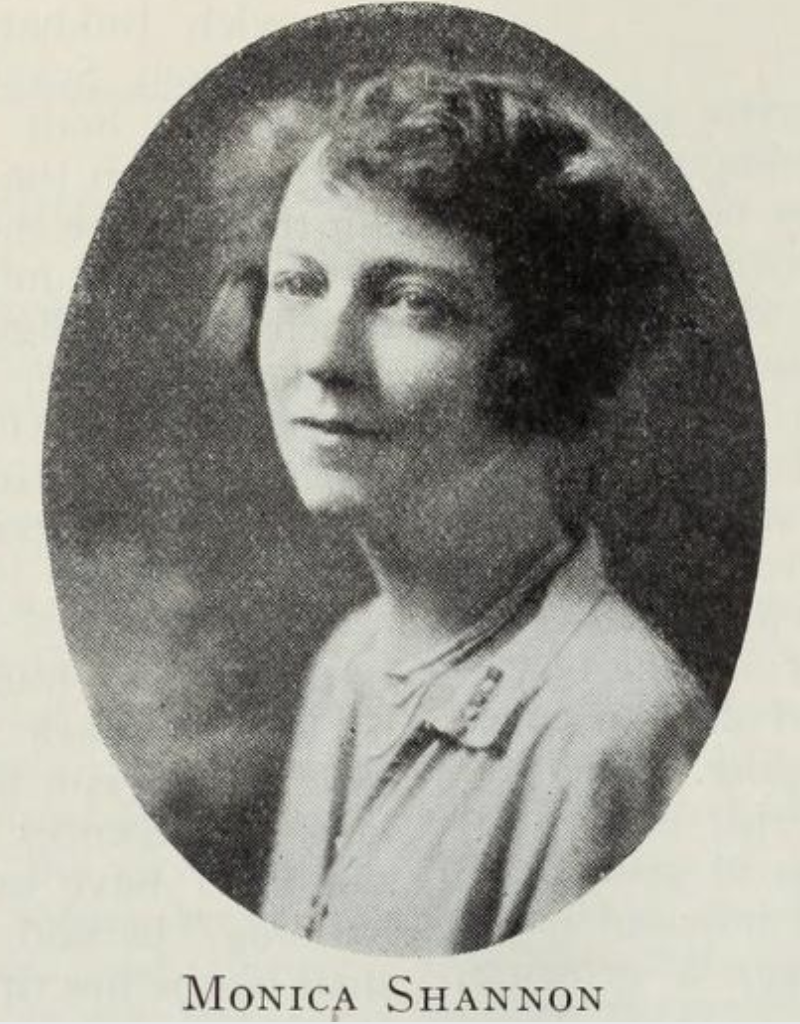
You may know Monica Shannon as the author of the 1935 Newbery Award-winning book Dobry, but have you read her fairy tales set in California? They are remarkably descriptive and among the strangest books I’ve read in a long time. We also have her to thank, at least partly, each time we walk through the doors of the Central Library. Women's History Month marks the perfect time to remember Monica Shannon (1889-1965), the library staff member who became a Newbery Award-winning author of whimsical children’s books and, as the person in charge of the early 1920s library bond issue campaigns, played a large role in the construction of Central Library and several branches.

Portrait of Monica Shannon [n.d] Library Journal, January 1, 1930.

Monica Shannon grew up in a household of bibliophiles and storytellers which may have contributed to her choice of librarianship as a profession. She was one of the fourteen graduates from the 1915 class of the Training Class of the Los Angeles Public Library, which prepared attendees for library work. At the time, the library rented three upper floors within the Metropolitan Building at the corner of S. Broadway and W. 5th Street “in the very center of the shopping district.” For the next two years following her graduation, Ms. Shannon worked as an Attendant in the Circulation Department of the library. Something about her, perhaps her work ethic or way with people, propelled her through the ranks. By 1918, according to the library’s annual report, Ms. Shannon was the Attendant-in-Charge of the Science and Industry Department, assisting patrons with reference questions and requests which were often focused on the petroleum industry. She was soon given a new position, one that required excellent organizational and personal skills.

The Metropolitan Building location was quickly being outgrown and City Librarian Everett C. Perry understood the value of sharing the library’s plight with the city. On October 1, 1919 Monica Shannon became responsible for the newly created Department of Publicity. Her first order of business was to educate the public on the benefits of the library and the need for a “suitable central building.” An effort to highlight library departments, locations and services began in earnest in late 1919 within the Los Angeles Public Library Monthly Bulletin, given freely to patrons. Topical articles were written by Ms. Shannon or under her direction. For example, the August 1920 issue centered on the impact of branches and small locations called deposit stations. Meanwhile, another issue chronicled the history of the Los Angeles Public Library from its inception in 1872 until 1920. Thanks to these informative bulletins, Angelenos became better acquainted with the library and its contributions to the city. They more easily understood the importance of having a “Main Library” in a building the library owned that offered a sense of permanence and eliminated rent payments.

Los Angeles Public Library Monthly Bulletin, [March 1921], Google Books.

By 1921, the reasons for the library of Los Angeles to have its own building were many. Los Angeles was one of the fastest growing cities in the United States and, remarkably, the number of library patrons were multiplying quicker than the population. It required an elevator ride, at the Metropolitan Building, to access the library and it wasn’t a particularly large elevator. The library was in a great part of town but it was difficult to get to, the space was crowded and the rent was set to go up by a considerable amount within a few years. Anticipating that it may take quite some time for the approval and construction of a new library, on April 1 the Library Board of Commissioners appealed to the Los Angeles City Council to include a library bond issue on an upcoming ballot. The City Council agreed to place a $2,500,000 bond on the June 7 ballot for a library building and site.

Overcrowding in the library was a problem by 1921. [n.d.] Graham Photo Co./Los Angeles Public Library Institutional Photo Collection
https://tessa.lapl.org/cdm/singleitem/collection/photos/id/96036/rec/8

City Librarian Everett R. Perry, the Board of Library Directors and Monica Shannon (as the Director of Publicity for the Los Angeles Public Library) created a plan for the bond issue drive that was impressive, all the more so when you realize it was just a four week campaign.

Bruggemeyer Memorial Library Dedicated in March 1929

Bruggemeyer Memorial Library in 1940. 

Judge Mancha Bruggemeyer gifted Monterey Park with a library on March 28, 1929. The $40,000 library, at 256 W. Garvey, was complete with automatic heating/cooling and shelves full of donated books.

It was built as a memorial to Bruggemeyer's late wife, (Ro)Berta Pauline Bruggemeyer. A portrait of Mrs. Bruggemeyer by artist Mischa Askenazy was hung in the "memory room" of the library. According to the Los Angeles Times, "objects in memory of Mrs. Bruggemeyer will be placed [in the memorial hall] until such time as the demand for book space shall call for a change of plans."

Monterey Park mayor, Sam B. Jones, accepted the library from Bruggemeyer. The library was, at that time, a branch of the Los Angeles County Library system. County Librarian Helen E. Vogleson and Monterey Park branch librarian, Mrs. Helen Thomas, were also in attendance at the library dedication.

Mrs. Helen Thomas and Mr. Bruggemeyer were married the next month, on April 21, 1929.

Undated photo of Judge Mancha Bruggemeyer
Learn more about the interesting life of Mr. Bruggemeyer here.


Thursday, January 28, 2021

The Story of the Texas Twin to the Old Lancaster Branch of the Los Angeles County Library

 In 1950, three siblings from Texas paid a visit to the Pasadena Public Library. John, Louemma and Winnie May Reber sought the advice of Doris Hoit, City Librarian of Pasadena. Could she recommend any small library buildings for them to tour? The siblings wanted to donate a library to their community of Raymondville in Willacy County, Texas and were looking for inspiration. 

        The Reber siblings (left to right): Louemma, John and Winnie May Reber [n.d]
Screenshot from Reber Memorial Library, Raymondville, Texas YouTube video [2014]

The Rebers grew up working on their family's 260-acre farm in Illinois. Those early lessons of hard work stuck with them throughout life. As an adult in his early 40s, John Reber moved to Texas for health reasons and purchased land and cattle. With the help of his sisters who also moved, they soon had a "model ranch," according to local newspaper reports. The Reber sisters helped organize a woman's club in Raymondville (Texas) and that's when the need for a library was most keenly felt. Club meetings involved presentations based on essays that members were assigned to write on a variety of topics. Without a library nearby, club members used the Reber family's set of Encyclopedia Brittanica to conduct research for their essays. The Reber siblings talked it over and offered the county $50,000 to build a library, if the county would finance the book collection, fund the personnel and run the library. County officials agreed. Fast forward to the Rebers on their library exploratory trip in Southern California during the summer of 1950.

Ms. Hoit suggested they visit the newly dedicated Los Angeles County Branch Library in Lancaster on Fig Avenue. This library was in service from April 1950 until a new Lancaster Library (on Avenue J at Kingtree) was built in 1964. The Rebers were impressed with the Lancaster Library. They contacted the County of Los Angeles Board of Supervisors for permission to use the library's plans and specifications in order to build the Reber Memorial Library in Texas. The architects of the library, [Robert Farquhar] Train and [Robert George] Smith, were also consulted.

Los Angeles County Library, Lancaster Branch 
opened April 1950 on Fig Avenue
(Photo: County of Los Angeles Public Library History/LA County Library Digital Collections)
 

A plaque that once graced the front entrance of the Lancaster Library, also known as the Antelope Valley Regional Library, attests to the determination of women's clubs to champion libraries.
(Photo: County of Los Angeles Public Library History/LA County Library Digital Collections)

The Reber siblings were in luck, the consulted parties said yes. Soon they were back in Raymondville to begin library construction. While I could not find an exact date, I believe the library opened in July 1951. The Rebers were happy that the community took so quickly to the library. For example, individuals and organizations in the area donated books to fill the library's shelves. The Rebers also praised Mrs. J.S. Robinson, the librarian, for her wonderful work as evidenced by "the happy youngsters [at the library] for one of the story teller's hours." The Rebers saw the library as their legacy. Not only does the building's cornerstone announce their gift 'Given to the people of Willacy County and their children,' but a newspaper article in 1955 describes a large cherry wood grandfather clock made by Jacob Reber, the sibling's grandfather, that would also be left to the library.


Reber Memorial Library at 193 N. 4th Street, Raymondville, Texas
Built in 1951 using the same plans as the Fig Avenue location of the 
Los Angeles County (CA) Public  Library,  Lancaster Branch. Train and Smith, architects.

Cornerstone of the Reber Memorial Library in Raymondville, Texas

The folks in Los Angeles seemed pleased as well, according to the October/November 1951 Los Angeles County Library staff newsletter. The Los Angeles County Librarian, John D. Henderson, flew out to Texas on November 2 to tour the new library building in Raymondville. "The full day November 3 was spent with the Librarian, the special trustees appointed to oversee the construction of the building, and the Library Advisory Board discussing procedures and policies, as well as budget, that should provide an adequate public library service for the 10,000 residents of Raymondville and the additional 10,000 residences of Willacy County." Mr. Henderson was impressed with Texas hospitality and the "splendid building which the Reber family provided for their community." It seems that a segment of the flight home was a high point as well--- as the only passenger Mr. Henderson was allowed to ride in the cockpit and enjoyed a good cigar with the co-pilot.

Los Angeles County Librarian John D. Henderson (3rd from left) visits the Reber Memorial Library.
Valley Morning Star [Harlingen, TX], November 7, 1951


So many questions! Why did the Rebers travel to Southern California to look at small libraries? Who did they speak to besides Doris Hoit? What other libraries did Ms. Hoit suggest besides Lancaster? Did the library receive the Reber's grandfather clock and do they still have it? I've called the Reber Memorial Library several times to find out but a message says their hours are reduced due to the pandemic and to call back later. 

References

"County Librarian Flies Again." News Letter Los Angeles County Library, October-November 1951, p. 3.

Hendry, A.B. "Reber Family 'Builds' Library in Raymondville." Valley Morning Star [Harlingen, TX], 7 Jan 1955, p. 13.

News Letter Los Angeles County Library, January 1951, p. 4.

"Visits Reber Memorial Library." Valley Morning Star [Harlingen, TX], 7 JNov 1951, p. 3.


Saturday, October 31, 2020

Phantom Libraries for Halloween! (Sounds spookier than "former libraries")

I'm fascinated by phantom libraries, as well as libraries that were formerly something else (e.g. The Santa Paula Library used to be a Safeway?). Former library locations can still be found all over Southern California. Some were built expressly as libraries while others were just a temporary location, or storefront. How did these library spaces get their phantom status-- aka why did the library move?  Oftentimes the library simply outgrew their space. I've included only a few phantoms here, most of which fit that reason, although the Moneta/Junipero Serra Branch was damaged in the 1987 Whittier Narrows earthquake. Do you have a favorite phantom library?

Canoga Park Branch, Los Angeles Public Library
The Canoga Park Branch opened July 6, 1959 with some special features-- air-conditioning, high windows that permitted a "maximum amount of shelving space" and an amazing zig-zag roof. The library was located at 7260 Owensmouth and designed by Ralph Bowerman and Charles Hobson (who also designed the 1962 Woodland Hills Branch with its parabolic roof). The building now houses an early learning center.


Moneta/Junipero Serra Branch, Los Angeles Public Library
The Moneta Branch formally opened September 28, 1923 at 4255 S. Olive Street. The Mediterannean Revival building was designed by architect Lyman Farwell who also was responsible for the Magic Castle (aka Rollin B. Lane house). In 1934, the branch was renamed Junipero Serra. Unfortunately the 1987 Whittier Narrows earthquake damaged the building and the library was forced to relocate.


Hyde Park Branch, Los Angeles Public Library
Opened at 6527 Crenshaw on August 1, 1960, this mid-century gem was designed by Kegley, Westphall and Arbogast (who also did the Van Nuys Branch). Information on this location can be found in the California Index at tessa.lapl.org, and includes building specs (branch had 10 parking spaces, seating for 24 adults and 16 children) branch histories (no AC until 1966-67) and an invitation to the opening. The location is vacant and the new Hyde Park Miriam Matthews Branch was opened at Florence and Van Ness in December 2004.


Helen Hunt Jackson Branch, Los Angeles Public Library
This Spanish-Mediterranean Revival branch was designed by C.E. Noerenberg, who also designed the Jefferson, Figueroa and the 1923 Edendale branches. The branch, named after "Ramona" author Helen Hunt Jackson, opened November 3, 1925 at 2330 Naomi Avenue. The building was auctioned off in 1963 and is now occupied by a church.


Figueroa Branch, Los Angeles Public Library
Opened in 1923, the Figueroa Branch sat on the northwest corner of 80th Street and Figueroa. The English cottage design was by C.E. Nuremberg (who also designed the Helen Hunt Jackson, Jefferson and the 1923 Edendale branches). There are a few Figueroa Branch items in the California Index (via tessa.lapl.org), including a 1936 newspaper article about summer reading (tracked by race horse figures!). The building has been remodeled several times over the years and has been the home of the New Zion Baptist Church since the mid-1960s.


Sunday, July 5, 2020

Hollywood (CA) Branch: The Little Library That Grew and Grew


The history of the Hollywood Branch library starts out like many others (e.g. founded by local women's club) but through the years its locale, patrons and staff have shaped it. As Hollywood grew from a small community to become a tourist destination, first because of artist Paul de Longpre and then as a movie studio mecca, the library kept pace--splitting not once, but twice--literally and figuratively. So far I've completed Part One (1905-1922) and Part Two (1923-1940) of its history, more to come...


Friday, January 25, 2019

Eleanor Brodie Jones: Hollywood Librarian 1908-1926 [Abridged]

Holly Leaves, July 1922

According to her obituary, Eleanor Brodie Jones taught English Literature at Lincoln High School in Nebraska before moving to Hollywood. It is cliché to say she was able to put that knowledge to work, but that is exactly what she did. As head librarian at the Hollywood Public Library from 1908 to 1926 she also encouraged artists, championed the newly emerging movie industry, provided unique educational opportunities for her community, and initiated the Hollywood Studio Club.

Following her move to Southern California from Nebraska, Jones attended the Training School at the Los Angeles Public Library (LAPL). These training classes, which began in 1888, prepared women for library work. Applicants were expected to have a high school education, be between the ages of eighteen and thirty (unless they already had library experience), be physically fit, and pass an entrance exam consisting of lengthy questions dealing with literature, art, history and general knowledge.  In 1907 Jones was one of six women who passed (her score was 75.5) one of the "severest library examinations" (Los Angeles Herald, October 22, 1907). City Librarian Charles Fletcher Lummis proclaimed in his annual report that Harvard freshman would find the exam difficult to pass. That same annual report for the library contains a sample of questions from the entrance exam for the Training School. I have yet to find examples of the questions on the final exam but based on the entrance exam it was not an easy test. Following completion of the training courses Mrs. Jones took a position as the head librarian at the Hollywood Public Library.  

1907 Los Angeles Public Library Training Class Entrance Exam (55 questions total)

Hollywood had its own independent library before being annexed into the city of Los Angeles. In 1905 a group of women formed the Hollywood Woman's Club expressly to establish a public library. Andrew Carnegie funded most of the project and the rest came from local businessmen. The Woman's Club established a library through this arrangement in 1906, turning it over to an appointed Hollywood Library Board the following year. Mrs. Jones, hired in 1908 to lead the library, retained her position after the annexation in 1910 and the branch became part of the Los Angeles Public Library.

Postcard of Hollywood Public Library circa 1910 (Author's Collection)

Eleanor Brodie Jones was the library's biggest booster, she was also one of the biggest boosters of Hollywood, both as a community and as an industry. One early outreach endeavor of Jones' had the Hollywood Library supply books to the famous Hotel Hollywood for guests to read. In addition to a selection of books available in the lobby, guests could request books from the branch or Central Library be delivered to the hotel for their enjoyment.

Library Journal, November, 1915

Art and artists were celebrated in early 20th century Hollywood. In fact, when Jones began at the Hollywood Library in 1908, the most visited tourist destination was artist Paul de Longpre's studio and gardens at the corner of Hollywood and Cahuenga. Art was important to the community and Jones championed artists, inviting many to show their work in the library's art gallery. The Hollywood Art Association regularly held exhibits and meetings at the Hollywood Public Library.
Tourists visiting artist Paul de Longre's studio at Hollywood Blvd and Cahuenga in 1905.
(Security National Bank Collection, Los Angeles Public Library Photo Collection)

As movie studios began populating Hollywood, the earliest was founded by the Horsley brothers in 1911, Mrs. Jones was there to extol the graces of the library. Scenarists (aka screenwriters) visited the Hollywood Library regularly to do research. Jones and her coworkers helped actors prepare for historical roles by providing period appropriate materials. The services of the library proved so useful that movie studios began opening their own libraries on their lots, employing librarians who would be solely at their disposal. 

Young women who flocked to Hollywood in hopes of making it in motion pictures frequently met to read plays at the library. Mrs. Jones, concerned about the living conditions these young women experienced, set the wheels in motion for what would become the Hollywood Studio Club. She rallied the support of the wives of movie industry notables, including Mrs. Jesse Lasky and Mrs. William C. DeMille, for the project. According to the Los Angeles Times she persuaded the Hollywood Board of Trade and several film companies to advance the money for the first year's rent on the Studio Club. Hollywood historian Bruce Torrence mentions Mrs. Jones' involvement and has great photos of the first Studio Club at 6129 Carlos.

Holly Leaves, July 5, 1919 - First location of the Hollywood Studio Club at 6129 Carlos Avenue

Eleanor Brodie Jones was a clubwoman as well as a librarian and news of her club work showed up in the pages of magazines such as Clubwoman, California Southland, and The Women Citizen. She was an active member of the Woman's Club, the organization that initially established the first public library in Hollywood.  An early proponent of the Hollywood Bowl, she signed the petition as a representative of the Hollywood Public Library alongside representatives from the Ebell, the Friday Morning Club, USC, and the Woman's Club. Mrs. Jones also served in a leadership capacity of the Los Angeles Drama League in 1916 and hosted several luncheons honoring visiting thespians and poets. 

Clubwoman, October 1920

Mrs. Jones was no stranger to throwing parties, hosting receptions, and organizing unique learning opportunities. For example, when World War I ended she was on the committee to host a party for all enlisted men in Hollywood, according to the Los Angeles Times (May 21, 1919), "whether they got an invitation or not." The party began with a parade from the library to the high school, followed by hors d'oeurve at the Woman's Club house, and a dance at the Hotel Hollywood. In 1919 she was on the University Extension board (UC) and organized lecture courses, open to the public for a fee and including university credit, that covered artistic topics and were held at the Woman's Club. 

Los Angeles Times,
October 12, 1917


The Hollywood film colony loved Eleanor Brodie Jones for her dedication over the years. The studios and scenarists, along with the young women who benefited from the Studio Club, rallied around Jones when it was threatened that political influence was underway to "place Mrs. Jones in some out-of-the-way library." according to an October 12, 1917 Los Angeles Times article.  What caused the uproar? The annual reports for the library don't say and I am still researching other sources. 

It was also in 1917 that Jones wrote in a report on branch activities about her satisfaction as a librarian.

"In surveying the year, the thing that stands out as of greatest value is the human touch of the library with the community. Through the clubs and the local papers and book talks in the Library the constant aim is to keep the community in the current of ideas and to know each individual and make him feel the Library is a friendly place and not merely a public institution."

The news of Jones' bad luck or ill-health made it into the pages of the local press due to her popularity. Luckily, several of these sources are digitized. For example, the September 1919 Hollywood weekly magazine Holly Leaves reported that she fell down the library stairs on the eve of a vacation back east, and spent time at the Glendale Sanitarium recuperating. According to a digitized history of the Hollywood branch I learned she fell again in 1924 and broke her arm. Digging deeper I found a 1925 blurb in News Notes of California Libraries that announced Jones missed four months of work due to a spider bite on her tear duct. Each of these illnesses and injuries forced her to miss work for a few months. 
Holly Leaves, September 6, 1919

Several hours spent reading Holly Leaves at the Frances Howard Goldwyn branch led to another sad discovery. Mrs. Jones and her son Tom fled their burning home on December 31, 1920. They only had the clothes on their back and were able to save their dog and automobile. She lost all possessions including antiques, a valuable book collection, and rare Navajo rugs collected by her late husband.

Holly Leaves, January 1, 1920

Mrs. Jones returned to the Hollywood branch again and again after recuperating from her latest spell of bad luck, until late 1926 when she transferred down to Central Library to manage the Lecture and Exhibit Room. By that point she had missed months and months of work over the previous seven years due to illness. The Library Board of Commissioners, citing Mrs. Jones' ill-health, felt it was best to replace her as head librarian at Hollywood, which by then was the largest and busiest branch in the system. In November 1926 the Hollywood community hosted a very large dinner and program for Mrs. Jones to show their appreciation.  She worked briefly at Central before she had to retire due to her health. Sadly, Eleanor Brodie Jones passed away September 19, 1929, at the age of 57 and is buried at Hollywood Forever Cemetery in an unmarked wall crypt.

Holly Leaves, May 28, 1921

Eleanor Brodie Jones is just one of many, many librarians who make a difference in their patron's lives and deserve thanks. She was part of the Hollywood community and the Los Angeles Public Library benefited from her growth with the city, and the industry, of Hollywood. From the early days when artist Paul de Longpre's studio and rose garden were the main reasons people visited Hollywood through the early 1920s when floodgates of film hopefuls flocked to Hollywood and Vine, Mrs. Jones was a fixture. She should be more widely known.

Sources:

Board of Library Commissioners Reports (many thanks to librarian Sheryn Morris for her help with these), Circular of Information (Training School of the Los Angeles Public Library), Clubwoman, Holly Leaves (thanks to Jeff Sargent, the Senior Librarian at the Frances Howard Goldwyn Hollywood Regional Library, for letting me peruse these on short notice), Library Journal, Los Angeles Herald (historical articles are available via Access Newspapers with your LAPL library card), Los Angeles Public Library Annual Reports (available throughTessa's California Index), and the Los Angeles Times (historical articles are available via ProQuest with your LAPL library card).

Thursday, December 22, 2016

San Fernando Valley Season's Greetings in 1962

These photos from the Valley Times (part of the Los Angeles Public Library Photo Collection) captured the holiday spirit of the San Fernando Valley in 1962. Street decorations were plentiful throughout the Valley, and the aerospace influence and individual creativity are pretty impressive!
Photograph caption dated December 18, 1962 reads, "Debbie Richardson, 5, Van Nuys, gets a thrilling ride hanging onto Rudolph's antlers as Santa steadies his mechanized sleigh and 'team' for a visit to the Salvation Army's Van Nuys Corps, 14933 Victory Blvd., Van Nuys, from 7 to 9 p.m. Wednesday. Robert Richardson, 8, Van Nuys, waits for his turn. The sleigh will be loaded with candy treats for all the children who visit Santa. For those who want to help Santa, containers will be available for donations of cans of food for needy families." (Photo from the Los Angeles Public Library Photo Collection)

Photograph article dated December 16, 1962 partially reads, "When you talk Christmas around a certain Miller household in Van Nuys, you'd better use capital letters. And underline it...'The decorations reflect years and years of the family enjoying themselves together,' Mrs. Miller said. 'We're a tradition-bound family. It's something we've had since my sons and daughter were children and now I couldn't do away with it if I tried. That's the strength of a family,' she said. 'It holds families together.'" (Photo from the Los Angeles Public Library Photo Collection)

Photograph caption dated December 17, 1962 reads, "Studio City features bells on Ventura Blvd. at Vantage Ave." Visible signs include Sinclair Paints, Valley Lighting and Lamps, Doll House, marquee reading The Three Ks Dancing, Picture Framing, a bowling alley, Standard gas station, Chevron gas station, Riding and Play Clothes, Valley Gem Shop, a record store. (Photo from the Los Angeles Public Library Photo Collection)
Photograph caption dated December 17, 1962 reads, "Northridge sends greetings from Reseda Blvd. and Roscoe Blvd." Visible signs include Citizens National Bank, Mick's Grill, a Mexican restaurant, Stores for Lease, Childrens Sample Land, an Optician, Cleaners, Beauty Salon, a real estate office, Nittin, Wood Pit Barbecue, a car wash. (Photo from the Los Angeles Public Library Photo Collection)
Photograph caption dated December 17, 1962 reads, "Van Nuys offers lots of angels." Visible signs include Pep Boys, Shoe repair, Zenith, Dr. Scholl's, TV, Coffee Shop, Shop E-Z Mattress, Surplus, Credit Dentist - Dr. Rossin (?), Drugs, a Schlitz billboard, another Credit Dentist. (Photo from the Los Angeles Public Library Photo Collection)
Photograph caption dated December 17, 1962 reads, "Sunland-Tujunga, East from Foothill Blvd." Legible signs include Meats-Deli-Fish-Poultry, cocktails, Pet Shop, saddlery, Richfield, Trailer Park, Rooms-Apartments, Florist, Mutual Savings, and another florist. (Photo from the Los Angeles Public Library Photo Collection)
Photograph caption dated December 18, 1962 reads, "Magnolia Park: east on Magnolia Blvd. from Hollywood Way." Visible signs include Bender (?) Furniture, Men's Shoes, Penny's Flowers, Park (?) Jewelers, Security First National Bank, insurance, Supreme Radio, California movie theater, Thrifty drugs, Cockneys, Beauty supply, Cozy Cove, Typewriters, Beneficial Finance Co.-Loans, Verners (?) Shoes, Hi-Shop, corset, upholstering, restaurant, travel, Flying A Service, liquor, car wash, another liquor store.(Photo from the Los Angeles Public Library Photo Collection)
Photograph caption dated December 18, 1962 reads, "San Fernando: Decorations fill sky along San Fernando Rd." Visible signs include Town House cocktails, Liquor - park in rear, Western Union, Bill's Valley Tavern cocktails, Seaboard, Hardware-Power Tools, Goodyear Tires. (Photo from the Los Angeles Public Library Photo Collection)
Photograph caption dated December 22, 1962 reads, "Reseda: looking west along Sherman Way from Lindley Ave to Etiwanda Ave." Visible signs include Metropolitan Savings, Pep Boys. In the island is an "I Want YOU for U.S. Army" poster, created by James Flagg. (Photo from the Los Angeles Public Library Photo Collection)

Photograph caption dated December 20, 1962 reads, "Santa and reindeer race across roof at 5813 Lubao Ave., Woodland Hills." (Photo from the Los Angeles Public Library Photo Collection)
Photograph caption dated December 23, 1962 reads, "Santa rides rocket at 638 Magnolia Blvd., Burbank." (Photo from the Los Angeles Public Library Photo Collection)
Photograph caption dated December 22, 1962 reads, "Canoga Park: lights sparkle along Sherman Way business district." Visible signs include Hardware, Style Shop, 5 and 10, Jewelers, Green Thumb Hardware Garden Center, United California Bank, Pharmacy, Safeway, Bank of America. (Photo from the Los Angeles Public Library Photo Collection)

Photograph caption dated December 18, 1962 reads, "Tarzana: between Mecca and Wilbur Ave. on Ventura Blvd." Visible signs include Custom Interiors Furniture, Paul White Carnaham Realty Co., Avalon Motel, pet shop, Citizens National Bank, Fox. (Photo from the Los Angeles Public Library Photo Collection)

Photograph caption dated December 17, 1962 reads, "Sherman Oaks, west on Ventura at Van Nuys." Visible signs include Free Parking 4 Doors West, Tailors, Custom Furniture, Cleaners, Clark Jewelers, Repair, Bakery, Sherman Oaks Savings and Loan, Hiskoff's, tailor, dept store, Mark's Valley Drugs, market, liquor. (Photo from the Los Angeles Public Library Photo Collection)


Photograph caption dated December 23, 1962 reads, "Santa rides rocket at 638 Magnolia Blvd., Burbank." (Photo from the Los Angeles Public Library Photo Collection)