
Wednesday, September 5, 2012
Los Angeles Library History: Happy 100th Birthday to the County of Los Angeles Public Library
Today is officially the 100th birthday of the County of Los Angeles Library system. They have been counting down the days to the Centennial Celebration, which will take place at all the branches on Saturday, September 8, by publishing a new library fact daily on their website. Check out their facts here, and don't forget to check out the countywide birthday parties on Saturday!
 To read an interesting and personal history of the library's origin you should check out County Free Library Organizing in California 1909-1918 by Harriet G. Eddy. Ms Eddy was the County Library Organizer for the California State Library from 1909-1918.

Wednesday, August 22, 2012
Los Angeles Library History: Pershing Square book cart
While reading through the 1936-37 Annual Report from the Board of Library Commissioners of the Los Angeles Public Library I came across a section called 'Books Outdoors' that drove me to see if I could find an accompanying photo in the LAPL Photo Collection.
The 1936-37 Annual Report reported that in July 1936 an outdoor 'Reading Station' had been set up on the Central Library lawn, complete with a 'big sun umbrella, a book truck, table and benches.' Soon 1500 books and magazines a month were being borrowed from the Reading Station. A photo of this Reading Station is part of LAPL's recently digitized Herman J. Schultheis Collection.
Apparently the Park Commission was so impressed they asked the library to set up a reading corner in Pershing Square. WPA men were in charge of the corner when it opened in December 1936, its hours were Monday through Saturday 9:30am to 3pm. Herman Schultheis photographed the Pershing Square reading area also. Within ten months nearly 26,000 books and magazines had been borrowed from the two outdoor reading areas.
Would a reading corner be as popular in Pershing Square now?
The 1936-37 Annual Report reported that in July 1936 an outdoor 'Reading Station' had been set up on the Central Library lawn, complete with a 'big sun umbrella, a book truck, table and benches.' Soon 1500 books and magazines a month were being borrowed from the Reading Station. A photo of this Reading Station is part of LAPL's recently digitized Herman J. Schultheis Collection.

Apparently the Park Commission was so impressed they asked the library to set up a reading corner in Pershing Square. WPA men were in charge of the corner when it opened in December 1936, its hours were Monday through Saturday 9:30am to 3pm. Herman Schultheis photographed the Pershing Square reading area also. Within ten months nearly 26,000 books and magazines had been borrowed from the two outdoor reading areas.

Would a reading corner be as popular in Pershing Square now?
Friday, August 10, 2012
Los Angeles Library Tour - Pomona Public Library
The plaque at the entrance reads: Built by the people of Pomona for the preservation and advancement of the intellectual, cultural, and social life of the community.
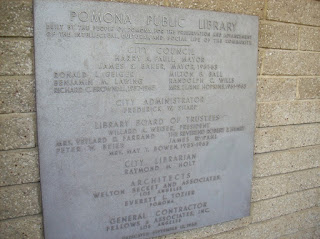 There has been much talk in the past several months about the possible closing of the Pomona Public Library. Pomona has been on my short list to visit for awhile and we were finally able to make it out there. With our trusty copy of Cruising the Pomona Valley by Charles Phoenix, we headed towards Pomona with the idea of making a day of it, maybe topped off with a period appropriate meal at Vince's or Grinder Haven.
I can't emphasize too strongly that it was well worth the trip. And we never made it further than the library. What's not to love? The Welton Becket designed building, the amazingly nice staff, the Laura Ingalls Wilder room, the quality book collection, the Pomona statue, the indoor patios, and most of all the lovingly prepared history of the library that currently lives downstairs. I was like a kid in a candy store, snapping away with my camera, perusing their stacks, and marveling at their reference and genealogy sections.
We had already steeled ourselves to the fact that it might be a tad foolhardy to get a library card at a library that was about an hour away from our house. That self-imposed rule quickly went out the window after browsing the aisles. The Pomona Public Library has books I've never seen on the shelves at other libraries. Dozens of books in my 'favorite' sections were new to me, I HAD to check them out. It took us years to finally visit, but we'll be coming back frequently.
If you've made it this far I'm sure your eyes may be glazing over so I'll hit the highlights-
Pomona Library is the third oldest system in all of Los Angeles County (only Los Angeles Public Library and Pasadena Public Library are older). It began life as a subscription library (at $3 per year) in 1887.
 In December 1901, the Pomona Library Board petitioned Andrew Carnegie for funds to build a public library. According to a February 18, 1902 Los Angeles Times article, the letter read in part: 'The population is largely composed of people of the middle class, highly appreciative of educational and literary advantages, but not able to gratify their tastes and inclinations except as they are furnished the opportunity through public libraries." Carnegie agreed to pony up $15,000 if the City Council agreed to provide a site and support the library 'at a cost of no less than $1500 a year'. Sadly the resulting Carnegie Library was demolished in 1966.
 The statue of Pomona, goddess of fruit and trees, was given to the Pomona Library for safe-keeping in 1889. Its featured on the Pomona city seal and the city flag! [The sign at her feet noted that it was a gift to the city by Rev. C.F. Loop. According to Los Angeles Times articles from 1889, it was shipped from Italy to New York, and finally on to Pomona. It was given to the city by Loop during the 1889 July 4th celebration. According to his March 1900 obituary in the Times, Loop was a successful horticulturalist and an expert on olives.] The library website has photos of the statue over the years. I especially love the one of the guy cleaning her with a dustbuster.
When the library re-opens on September 4, 2012 after a two-week shuffle to close off the bottom floor, I hope the exhibit of the library's history makes it upstairs. It deserves to be a highlight.
The much loved Laura Ingalls Wilder Room (her books are still in the top five best sellers on Amazon for children's American historical fiction) has an amazing wall sized wooden map based on Wilder's books. Clara Webber, Pomona's children's librarian from 1948-1970, began a correspondence with Laura Ingalls Wilder, information about the collection can be found here on Pomona's website.
 Welton Becket & Associates (in this case Randall Tozier) designed the 57,000 sq ft building, which was officially dedicated on September 13, 1965. An interesting letter regarding their collaboration can be found here. Becket's better known buildings include: Capitol Records, Cinerama Dome, (original) Pan Pacific Auditorium, Beverly Hilton Hotel, and the Los Angeles Music Center.
 I've come across former city librarian Raymond Holt's name over and over during my research. He seems to be a real mover and shaker, I'll have to delve deeper into his career.
While we were there we saw the Library Director Bruce Guter leading a tour of people through the building. I saw David Allen's post about 35 reasons to rescue Pomona's library on the Inland Valley Daily Bulletin website the next day. Mr. Allen, thank you for spreading the word, the library is definitely worth rescuing!

I can't emphasize too strongly that it was well worth the trip. And we never made it further than the library. What's not to love? The Welton Becket designed building, the amazingly nice staff, the Laura Ingalls Wilder room, the quality book collection, the Pomona statue, the indoor patios, and most of all the lovingly prepared history of the library that currently lives downstairs. I was like a kid in a candy store, snapping away with my camera, perusing their stacks, and marveling at their reference and genealogy sections.
We had already steeled ourselves to the fact that it might be a tad foolhardy to get a library card at a library that was about an hour away from our house. That self-imposed rule quickly went out the window after browsing the aisles. The Pomona Public Library has books I've never seen on the shelves at other libraries. Dozens of books in my 'favorite' sections were new to me, I HAD to check them out. It took us years to finally visit, but we'll be coming back frequently.
If you've made it this far I'm sure your eyes may be glazing over so I'll hit the highlights-
Pomona Library is the third oldest system in all of Los Angeles County (only Los Angeles Public Library and Pasadena Public Library are older). It began life as a subscription library (at $3 per year) in 1887.


When the library re-opens on September 4, 2012 after a two-week shuffle to close off the bottom floor, I hope the exhibit of the library's history makes it upstairs. It deserves to be a highlight.
The much loved Laura Ingalls Wilder Room (her books are still in the top five best sellers on Amazon for children's American historical fiction) has an amazing wall sized wooden map based on Wilder's books. Clara Webber, Pomona's children's librarian from 1948-1970, began a correspondence with Laura Ingalls Wilder, information about the collection can be found here on Pomona's website.


While we were there we saw the Library Director Bruce Guter leading a tour of people through the building. I saw David Allen's post about 35 reasons to rescue Pomona's library on the Inland Valley Daily Bulletin website the next day. Mr. Allen, thank you for spreading the word, the library is definitely worth rescuing!
Wednesday, July 18, 2012
Los Angeles Library Tour - Fontana Lewis Library & Technology Center
Ok, not technically Los Angeles, but its not too far down the road. As we often do when we're out driving around, we made a turn when we saw a sign that said 'Library' with an arrow pointing towards parts unknown.
 We weren't expecting to find the huge 'bright and shiny' Lewis Library & Technology Center. According to a plaque out front the library was dedicated April 19, 2008, with 'funding in the amount of $14,900,000 from the California Reading and Literacy Improvement and Public Library Construction and Renovation Act of 2000'.
Overall the library is light, airy, and spacious. The teen section looks like a cross between a Matchbox slick track and an amusement park ride, and was being well-used on the day we visited. There's a coffee bar attached to the library and a nice Friends of the Library bookstore (word of warning- they only sell FOTL books to library cardholders).
We weren't expecting to find the huge 'bright and shiny' Lewis Library & Technology Center. According to a plaque out front the library was dedicated April 19, 2008, with 'funding in the amount of $14,900,000 from the California Reading and Literacy Improvement and Public Library Construction and Renovation Act of 2000'.
Overall the library is light, airy, and spacious. The teen section looks like a cross between a Matchbox slick track and an amusement park ride, and was being well-used on the day we visited. There's a coffee bar attached to the library and a nice Friends of the Library bookstore (word of warning- they only sell FOTL books to library cardholders).
 Our favorite part of the library was definitely the Fontana Historical Society room on the second floor. Open whenever volunteers are available (call the library before you visit 909-574-4500), we enjoyed a leisurely hour learning about Fontana's Woman's Club (and seeing a photo of the men who were members), the Kaiser plant, and the Fontana Speedway. We also got directions to nearby historical buildings and a couple good places to eat. We'll definitely be back to visit.


Sunday, July 1, 2012
Los Angeles Library History: Library Bond of June 1923
Reading through a program for Los Angeles Music Week May 19-26, 1923, I was surprised to find an ad to 'Protect Your Library Site Vote Yes on Library Bonds June 5th, Proposition No. 2'. The ad featured a ditty:
It's up to you to see it through,
Ye voters, one and all.
Don't let our Library fine and new
Be hid by buildings tall.
Then vote for bonds the plot to buy,
The plot that hides our view;
This be our constant battle-cry,
"It's up to you! It's up to YOU!"
 I was not a fan of the ditty but I did wonder what the story was, so I did some searching on the Los Angeles Times via LAPL.
By May 1923, the site of the State Normal School on 'Normal Hill' had been acquired and cleared, ready to commence building the Central Library. The Flower Street frontage needed to be purchased still (hence Proposition No. 2), because it was 'covered with unsightly shacks' according to the May 20, 1923 edition of the Los Angeles Times. The article went on to point out that the Flower Street frontage was necessary as the new library would be overshadowed on all other sides - the Bible Institute on the south side, by a hill on the north side and the Biltmore Hotel on the east side.
The Library Bond had many supporters including the Los Angeles Stock Exchange, the Los Angeles Chamber of Commerce, City Planning Commission, and Sons of the Revolution. According to a May 27, 1923 Los Angeles Times article, three thousand Boy Scouts canvassed door to door to 'vote yes!', and small lunch wagons operating on the east side of the lot 'have printed library slogans on their menu cards.'
The June 6, 1923 edition of the Times lists:
YES - 10,880 votes
NO - 2,484 votes
Another interesting bond passed that day. Should a subway under Pershing Square be approved?
YES - 11,645
NO - 3,373
It's up to you to see it through,
Ye voters, one and all.
Don't let our Library fine and new
Be hid by buildings tall.
Then vote for bonds the plot to buy,
The plot that hides our view;
This be our constant battle-cry,
"It's up to you! It's up to YOU!"
 I was not a fan of the ditty but I did wonder what the story was, so I did some searching on the Los Angeles Times via LAPL.
By May 1923, the site of the State Normal School on 'Normal Hill' had been acquired and cleared, ready to commence building the Central Library. The Flower Street frontage needed to be purchased still (hence Proposition No. 2), because it was 'covered with unsightly shacks' according to the May 20, 1923 edition of the Los Angeles Times. The article went on to point out that the Flower Street frontage was necessary as the new library would be overshadowed on all other sides - the Bible Institute on the south side, by a hill on the north side and the Biltmore Hotel on the east side.

The Library Bond had many supporters including the Los Angeles Stock Exchange, the Los Angeles Chamber of Commerce, City Planning Commission, and Sons of the Revolution. According to a May 27, 1923 Los Angeles Times article, three thousand Boy Scouts canvassed door to door to 'vote yes!', and small lunch wagons operating on the east side of the lot 'have printed library slogans on their menu cards.'
The June 6, 1923 edition of the Times lists:
YES - 10,880 votes
NO - 2,484 votes
Another interesting bond passed that day. Should a subway under Pershing Square be approved?
YES - 11,645
NO - 3,373
Wednesday, June 20, 2012
Los Angeles Library Tour - Lennox Library (CLOSING for remodel June 29, 2012)
We stumbled upon the County of Los Angeles Public Library's Lennox branch recently and were amazed and charmed by both the building and the staff.

According to the Los Angeles Times, the library is part of the Lennox Civic Center that was dedicated May 14, 1948. The then $328,000 (approximately $3,380,000 today) Civic Center also housed a Sheriff's substation, the Los Angeles County Building and Safety Department and the County Charities Department.
Designed by architect Adrian Wilson, the brick building with its rounded corner entrance, and 'County Library' sign, are eye-catching as you drive north towards the intersection of Hawthorne Blvd and Lennox Avenue. Projects Adrian Wilson worked on include the New Chinatown Los Angeles Master Plan (1938), Los Angeles County Courthouse, the Anaheim Convention Center, Ship of the Desert house in Palm Springs, and the recently renovated Casa Verdugo Library in Glendale.
The other offices in the complex are boarded up and appear to have been closed a little while, but we were happy to see the library was open.
On our first visit, Library Manager Peter Hsu couldn't have been nicer or more helpful. He showed us around the library and pointed out the plans for an upcoming remodel the library would be undergoing. I returned some books today and found out that the last day the current library would be open is Friday, June 29. The remodel will take two years to complete.
 It is definitely worth the drive to see inside the original library now while you still can. Complete the trip with a stop at the beautiful Chips restaurant nearby, designed in 1957 by architect Harry Harrison.

According to the Los Angeles Times, the library is part of the Lennox Civic Center that was dedicated May 14, 1948. The then $328,000 (approximately $3,380,000 today) Civic Center also housed a Sheriff's substation, the Los Angeles County Building and Safety Department and the County Charities Department.
Designed by architect Adrian Wilson, the brick building with its rounded corner entrance, and 'County Library' sign, are eye-catching as you drive north towards the intersection of Hawthorne Blvd and Lennox Avenue. Projects Adrian Wilson worked on include the New Chinatown Los Angeles Master Plan (1938), Los Angeles County Courthouse, the Anaheim Convention Center, Ship of the Desert house in Palm Springs, and the recently renovated Casa Verdugo Library in Glendale.
The other offices in the complex are boarded up and appear to have been closed a little while, but we were happy to see the library was open.
On our first visit, Library Manager Peter Hsu couldn't have been nicer or more helpful. He showed us around the library and pointed out the plans for an upcoming remodel the library would be undergoing. I returned some books today and found out that the last day the current library would be open is Friday, June 29. The remodel will take two years to complete.
 It is definitely worth the drive to see inside the original library now while you still can. Complete the trip with a stop at the beautiful Chips restaurant nearby, designed in 1957 by architect Harry Harrison.
Tuesday, May 22, 2012
LAPL's Westwood Branch teams up with the Hammer Museum
I stopped by the Westwood Branch of the Los Angeles Public Library
 on Saturday and was excited to see a great promotion with the Hammer Museum. There were posters displayed upon entering the library, and repeated several times throughout the building, which read 'You're only 5 books away from FREE ART.' If you check out five books from the Westwood LAPL branch, and ask a librarian for details, you will receive free admission to the Hammer Museum around the corner. The free pass features a clever library theme and includes Hammer's pertinent details.
Wednesday, April 25, 2012
Glen Creason on Central Library's 1986 fire
Glen Creason, Los Angeles Public Library's Map Librarian and author of the great book Los Angeles in Maps, remembers the April 29, 1986 arson fire at the Central Library. I loved his article in the Los Angeles Downtown News.
Saturday, April 14, 2012
National Library Week in Los Angeles - Check Out a Librarian
Today is the last day of National Library Week 2012. Libraries deserve more than a week of recognition. We should realize how valuable they are now and always have been. Every day, libraries and the people that work in them, are putting information into the hands of people that didn't have it when they entered. That is an incredibly powerful gift to give, and its given free and freely. Even when the library is not open their online databases can be accessed and many have 24/7 Chat Reference. I've met some incredible people that work at the library, thank you for the job you're doing. You are making a difference in people's lives daily.
I remember a day at the library book sale at the La Canada Flintridge branch of the Los Angeles County Library. I picked up a book titled Check Out a Librarian by Johanna E. Tillman. I bought the book, took it home and proceeded to read it that night. It was an amazing tale of Ms. Tillman's of librarianship: graduation of Berkeley's School of Librarianship in 1937, part-time job at UCLA's School of Librarianship, assistant librarian at San Marino Public Library, working her way up at the Los Angeles County Library to become the Technical Reference Librarian, creating the Engineering Library at UCLA and finally Director of Libraries for Caltech. Her tale, and the way she wrote it, was inspirational and practical. Its not easy to find a circulating copy at the library but definitely worth trying.
I remember a day at the library book sale at the La Canada Flintridge branch of the Los Angeles County Library. I picked up a book titled Check Out a Librarian by Johanna E. Tillman. I bought the book, took it home and proceeded to read it that night. It was an amazing tale of Ms. Tillman's of librarianship: graduation of Berkeley's School of Librarianship in 1937, part-time job at UCLA's School of Librarianship, assistant librarian at San Marino Public Library, working her way up at the Los Angeles County Library to become the Technical Reference Librarian, creating the Engineering Library at UCLA and finally Director of Libraries for Caltech. Her tale, and the way she wrote it, was inspirational and practical. Its not easy to find a circulating copy at the library but definitely worth trying.
Friday, April 13, 2012
National Library Week in Los Angeles - Pre-LAPL libraries
The Los Angeles Public Library was established in 1872. According to Ludwig Louis Salvator's 1929 book, Los Angeles in the Sunny Seventies: A Flower From the Golden Land, the membership fee to join was $250, plus 50 cents per month or $5 per year. Members were allowed to take out two volumes at a time. If the membership fee was still charged today it would the equivalent of $6000 to join, and $125 per year dues. Thankfully they went 'free' in 1891.
Bernadette Dominique Sotter's 1993 book, The Light of Learning: An Illustrated History of the Los Angeles Public Library,lists three earlier attempts at libraries in Los Angeles. In 1844, a group known as Los Amigos del Pais opened Amigos Hall, a dance hall with a reading room on the side. Donated books and magazines could be read there for free. It wasn't long before funding gave out. In 1856 it was the Mechanic's Institute that opened a small reading room which lasted until 1858. A Library Association was formed in 1859 and opened a reading room in the Arcadia Block. There was a $5 initiation fee and dues were $1 per month. The money collected funded the library and assured it a longer life than the previous efforts by Los Amigos del Pais and the Mechanic's Institute. That was until the Civil War killed it. Read all about it at a library near you! **UPDATE: I think there was a typo in Salvator's Los Angeles in the Sunny Seventies, other sources cite the membership fee as $2.50.
Bernadette Dominique Sotter's 1993 book, The Light of Learning: An Illustrated History of the Los Angeles Public Library,lists three earlier attempts at libraries in Los Angeles. In 1844, a group known as Los Amigos del Pais opened Amigos Hall, a dance hall with a reading room on the side. Donated books and magazines could be read there for free. It wasn't long before funding gave out. In 1856 it was the Mechanic's Institute that opened a small reading room which lasted until 1858. A Library Association was formed in 1859 and opened a reading room in the Arcadia Block. There was a $5 initiation fee and dues were $1 per month. The money collected funded the library and assured it a longer life than the previous efforts by Los Amigos del Pais and the Mechanic's Institute. That was until the Civil War killed it. Read all about it at a library near you! **UPDATE: I think there was a typo in Salvator's Los Angeles in the Sunny Seventies, other sources cite the membership fee as $2.50.
Subscribe to:
Posts (Atom)